Real Results in Germany, Slovakia & India | BYG
Real Challenges. Real Impact.

See how BYG Consulting solves leadership crises in the Automotive & Tech sectors. Proven results in cross-cultural management, retention, and executive performance.
Theory is nice. But in the Automotive world, only results count.
“Hard Profits Need Soft Skills” is not just a slogan, it is a measurable strategy. Below, you will find three examples of how we turned cultural friction, leadership burnout, and strategic isolation into sustainable success.
The Multiplier Effect
The invisible High-Performer
The Slovakia R&D Genesis
Bridging the Cultural Divide
Case Study 1: The Multiplier Effect
Focus: Train-the-Trainer, Soft Skills for Techies, Sustainable Knowledge Transfer.
Target: Companies rolling out new software/standards or building internal academies.
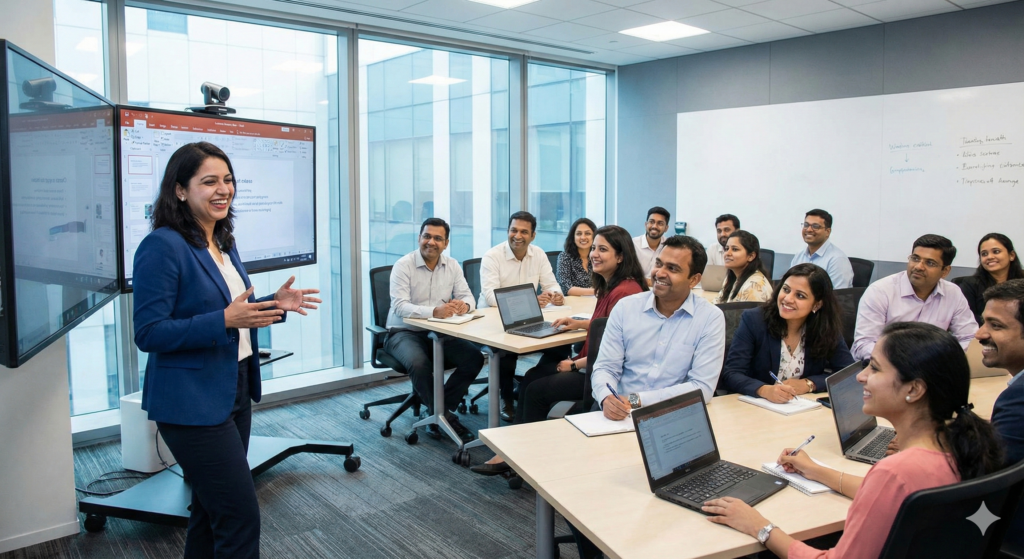

From “Techie” to Inspiring Teacher
Building a Self-Sustaining Training Academy in Pune, India
The Situation (The Gap):
During my tenure as Head of the Inhouse Training Academy in Pune, we faced a critical challenge: A massive global rollout of new Project Management Software.
As an Expat, I knew my time was limited. If I did all the training myself, the knowledge would leave when I left. I needed multipliers.
I trained 3 groups of local talent, Project Managers, Engineers, and Tech Leads. They were technically brilliant, but most had never stood in front of a crowd to inspire. The risk? A dry, “death-by-PowerPoint” rollout that no one would listen to.
The Intervention (The “Anti-Training” Approach):
I threw away the standard “Train-the-Trainer” manual. I didn’t teach them how to write on flipcharts. I used a Group Coaching Initiative.
- 📌The Identity Shift: Instead of lecturing them, I asked Powerful Questions: “What did the worst trainer you ever had do?” and “What does your ideal trainer look like?” We co-created the profile of a Great Trainer together. They didn’t just learn the standard; they invented it.
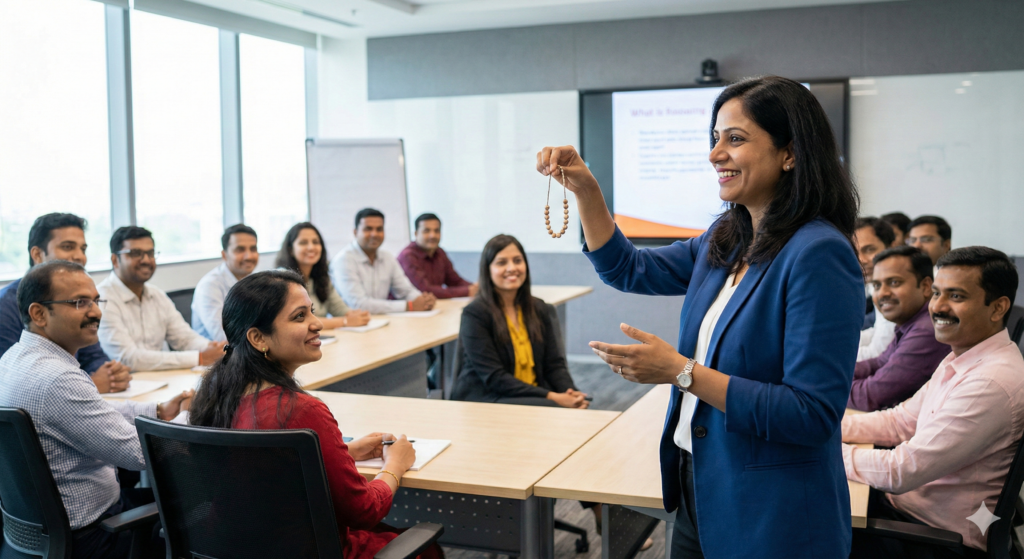
- 📌The “Personal Object” Challenge: To break the “robot mode,” I asked them to bring a personal object and explain its emotional significance to the group.
- The Neuro-Effect: This forced them to drop their professional mask and show vulnerability. It taught them that connection comes before content.
- 📌Real-Time Feedback loops: We used immediate peer-ratings to refine their presence, volume, and engagement techniques.
The Hard Results:
- ✅ 100% Conversion: Every single participant successfully transitioned into a Trainer role.
- ✅ Successful Rollout: The software adoption was faster because the training was delivered by trusted local peers, not “corporate HQ.”
- ✅ Hunger for More: Instead of dreading public speaking, the engineers reported they had fun and felt “hungry to train again.”
- ✅ Legacy: We built a local infrastructure of competence that continued to thrive long after my assignment ended.
💡 Andy’s Take:
“You don’t teach an expert to train by showing them slides. You teach them by unlocking their personality. People don’t learn from presentations; they learn from people.”
Case Study 2: The Invisible High-Performer
Focus: Leadership Visibility, Career Transition (Manager to Director), Emotional Intelligence.
Target: HR Directors looking to groom successors & Ambitious Managers stuck in the “Expert Trap”.


From Hidden Expert to Visible Director
Breaking the “Visibility Barrier” to Unlock Executive Potential
The Situation (The Stagnation):
A highly skilled Team Manager was on the succession plan for a Director role. Technically, he was brilliant. But in the boardroom, he was invisible.
His problem wasn’t competence; it was connection. He waited for instructions instead of taking the lead. In difficult situations or conflicts, he tended to “hide” behind emails or processes, hoping the storm would pass.
The feedback from upper management was clear: “He delivers numbers, but we don’t ‘feel’ him as a leader.” The promotion was on hold.
The Intervention (The Step Up):
We entered a focused “Leadership Transition Partnership”.
The goal was not to change his personality, but to amplify his presence.
- 📌The Visibility Shift: We worked on his ability to “take the stage”, not just delivering reports, but sharing a vision. He learned to speak up in meetings before he was asked.
- 📌Connection over Avoidance: We tackled his conflict-aversion. We role-played difficult conversations until he felt safe enough to stop hiding. He learned that leadership happens in the uncomfortable moments.
- 📌Proactive Engagement: We shifted his mindset from “waiting/reacting” to “anticipating/acting.”
The Hard Results:
- ✅ The Promotion: Within 12 months, he was successfully promoted to Director.
- ✅ Visible Confidence: He is now the first to address critical issues in town halls, earning deep respect from his team.
- ✅ Team Loyalty: By connecting on a human level (instead of hiding), his team finally felt “led” and supported, leading to higher morale.
💡 Andy’s Take:
“You cannot lead from the shadows. To become a Director, you must stop waiting for permission and start building genuine connections, even when it feels uncomfortable. Visibility is a choice.”

Case Study 3: The Slovakia R&D Genesis
Focus: Cultural Setup, Team Building, Retention.
Target: Companies setting up new sites or departments (Greenfield).


Building a High-Performance Family: From Scratch to R&D Excellence in Slovakia
The Situation:
I arrived in Prievidza, Slovakia, with a mandate to build an Electronics R&D Department from zero. The start was raw: a night drive over rough roads, a first impression of uncertainty. But the next morning, seeing the sun rise over Bojnice Castle, I saw the potential.
I negotiated a room for 25 people with the Plant Manager. I had the space, and within a few months, I had hired 17 talented engineers and technicians. But I had a group of strangers, not a team.
The Intervention:
I didn’t want a “working group”; I wanted a high-performance unit. I invested one full working day, my budget, my decision, for a Deep-Dive Team Charter Workshop.
- 📌The Investment: We stopped Development-Work for a day. No private time used. This signaled to the team: You are important.
- 📌The Process: We used ice-breakers to clear the air, followed by a rigorous “Values & Deal-Breakers” session.
- 📌The Data: We generated over 400 Post-Its. We defined exactly what we expect from each other and, crucially, what we will not tolerate (e.g., shouting, hiding mistakes).
- 📌The Consolidation: We distilled this chaos into 5 Non-Negotiable Team Rules. Every future newcomer had to commit to these rules on Day 1.
The Result:
We didn’t just build an R&D department; we built a culture.
- ✅ Instant Cohesion: The team moved from “storming” to “performing” in record time.
- ✅ High Retention: In a market fighting for talent, our fluctuation was minimal.
- ✅ The “Family” Factor: When I left for India 4 years later, the team didn’t just say goodbye. They told me: “How dare you? You are leaving a family.”
💡 Andy’s Take:
“You cannot buy a team. You have to build it like a product: Design the values, prototype the rules, and test the commitment. The result was the strongest team I ever led.”

Case Study 4: The “Sunglasses” Strategy
Bridging the Germany-India Divide
The Challenge (Looking at the Same Lemon, Seeing Different Colors):
During my two years living in Pune, I witnessed firsthand the daily friction between a local Indian tech hub and the German headquarters in Bamberg.
The problem wasn’t a lack of technical expertise; it was a fundamental clash of perceptions. Both sides were trapped in a cycle of assumptions, expecting the other to naturally understand a cultural context they hadn’t grown up in.
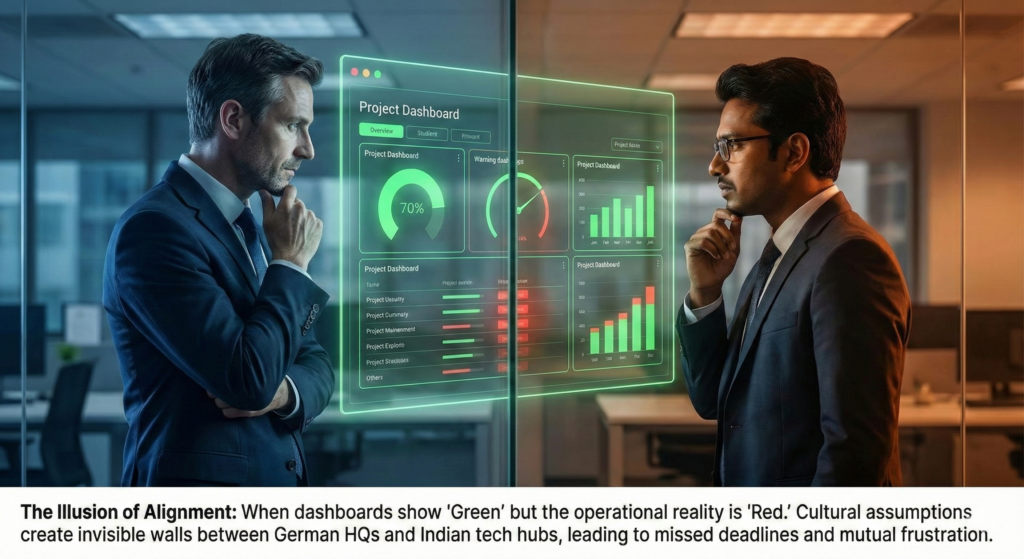

The Intervention (The “Red and Blue Sunglasses” Framework):
I stepped in to act as the direct operational and cultural bridge between Pune and Bamberg.
To break the deadlock, I translated context and connected the right stakeholders. I trained both sides using my “Sunglasses” metaphor:
Imagine a simple, yellow lemon (the project).
The Red Glasses (India): Driven by a relationship- and shame-focused culture, the Indian team looks through red lenses. To them, the yellow lemon looks Orange.
The Blue Glasses (Germany): Driven by a facts- and guilt-focused culture, the German team looks through blue lenses. To them, the exact same yellow lemon looks Green.
My core message: It makes no sense, and it is not enough, if only one side drops their glasses. Both sides have to drop their glasses simultaneously.
The Result (Eye-Level Communication):
We established a new communication standard based strictly on eye-level interaction.
By learning to stop assuming, the Pune and Bamberg teams stopped judging each other’s “colors” and started collaborating on the actual “lemon,” turning a frustrating bottleneck into a highly efficient, globally integrated powerhouse.
💡 Andy’s Take:
“As soon you accept, you know nothing, you can start learning everything.”