
You Were Promoted for Being the Best. Now That Same Excellence Is the Ceiling.
The calendar fills itself. Decisions pile up. The strategic work you were hired to do keeps moving down a list that never gets started. You are not failing. You are caught inside a transition that no one warned you about, and that most executive coaches have never lived from the inside.
This is the Expert Paradox. It is the most expensive and most invisible turning point in an engineering leader’s career. It has a name, a structural cause, and a precise solution.
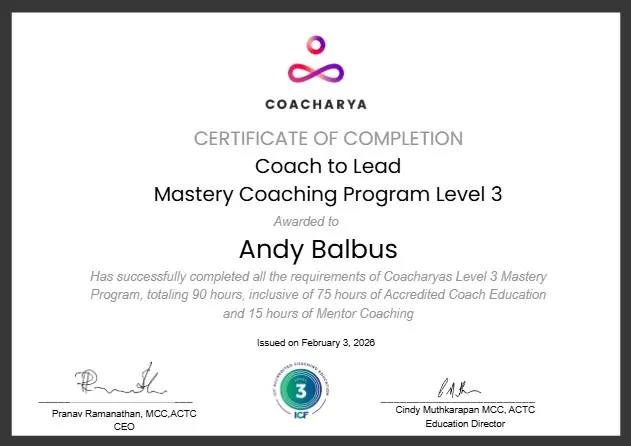
Engineering leadership coaching built on 25+ years of doing your exact job: transformation and crisis coaching for technical leaders at the most expensive turning point of their career. ICF PCC certified. 1,000+ documented coaching hours. Remote, confidential, worldwide.
A team of 40 engineers built from zero in four years. The department still delivers today, without its founder in the room.

The Room You Are in Has a Name.
You were promoted because you solved problems others could not even name. The precision that made you exceptional as an engineer is now working against you as a leader. Your team escalates everything to you because you have always been the one with the answer. Your calendar belongs to other people’s urgencies. Somewhere in the last six months, a quiet frustration settled in: you are managing everything except the thing that actually matters.
From Specialist to Generalist: Navigating the Leadership Transition
This transition has a precise name in organizational psychology. Michael D. Watkins identifies it as the first of seven seismic shifts every technical expert must navigate when moving into genuine leadership: the move from Specialist to Generalist. From being the person who goes deepest in one domain to the person who evaluates capability across functions you did not build. The second, directly connected, is from Problem Solver to Agenda Setter: from the neurochemical reward of closing a problem to the slower discipline of defining which problems should exist.
Most engineering directors encounter all seven simultaneously, without a map, while the machine keeps running at full speed.
Global Leadership Pressures and the Green-Melon Effect
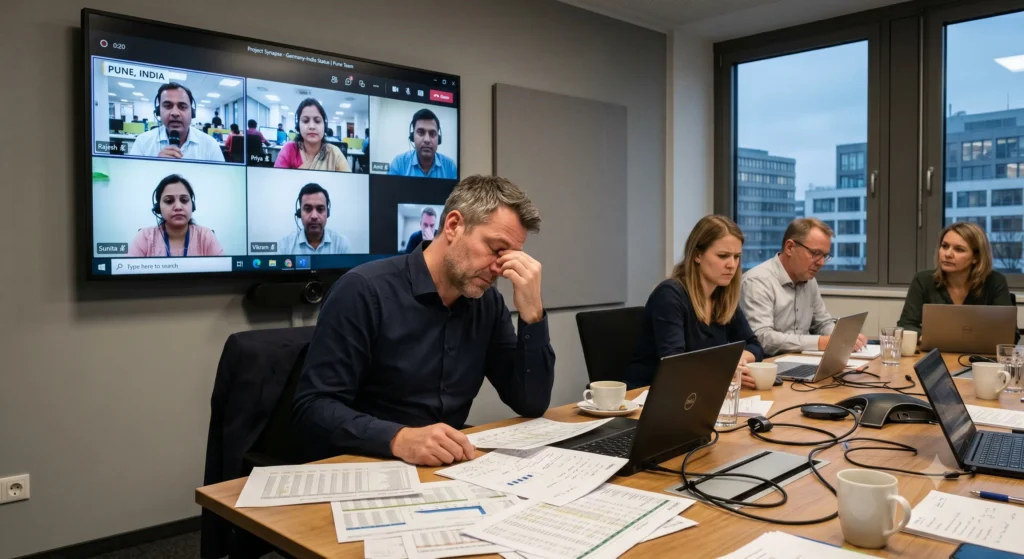
Perhaps you are the plant manager squeezed between a German headquarters sending directives and a Slovak team executing them differently than intended, navigating what BYG calls the Green-Melon Effect: a dashboard showing green while the real risk has been visible to three people in the room for weeks. Or the R&D director in Pune watching an alignment meeting confirm a timeline that everyone in the room knows is fiction, the Indian Yes that costs six weeks and a SOP penalty before the signal surfaces.
Whatever the exact shape of the pressure, the pattern is the same: you have reached the ceiling of what individual technical excellence can achieve. What comes next requires a different kind of work.

The Numbers Behind the Pattern.
A Chief Firefighter Director who resolves five escalations per day, each consuming ninety minutes, loses 37 strategic hours per week. That is the equivalent of a full-time strategic function funded entirely by misallocated leadership capacity. One SOP delay week at a Tier-1 automotive supplier costs an average of 20,000 euros per production-line minute in OEM penalties. One recovered SOP week pays for an entire coaching engagement many times over.

25+ Years Inside the Machine. Then One Day My Assistant Revealed a Secret.
Most executive coaches come from psychology, HR, or organizational consulting. They bring methodology, structure, and genuine skill. What they have not done: approved a production line in Slovakia, stabilized an R&D team in Pune under real SOP pressure, or managed 150 million euros in annual revenue and gained Experience by navigating a matrix of six countries simultaneously.
I have done all of it. From apprentice energy electronics technician in 1999 to Director of Electronics in Prievidza, building the R&D department from zero to forty engineers, to Senior Manager inside the Indian R&D hub in Pune. Germany, Slovakia, India, China, Mexico, the UK. Not visiting. Deciding, building, failing, correcting, and leading.
Through all those years, I believed I had my emotions under control. Then, on my last day in Prievidza, my assistant told me something I had not expected. She had been running a secret chat with the entire department. When she sensed from the way I walked into the building that I was not in a good mood, she sent a message to the team: if you need a decision that can wait, wait. The whole department already knew my emotional state before I had said a word.
That moment changed how I understand self-awareness for leaders. It is not a soft-skills topic. It is the difference between a leader who shapes a room and one who unknowingly poisons it. That shift, from automatic reaction to deliberate action, took months of real work. It is exactly the kind of work that happens inside a coaching engagement.

What Nobody Tells You About the Promotion.
There is a specific psychological phenomenon that organizational researchers call Identity Demotion. When a high-performing technical expert is promoted into management, they are forced to begin again at the bottom of a new competence curve. They leave a domain where they are expert and recognized, and enter one where they are functionally a beginner.
The brain does not tolerate this well. The drive to return to the domain of competence, to the problem you know how to solve, to the technical decision that produces the immediate reward of a closed loop, is not weakness. It is a neurological pull toward the identity that felt solid. Most technical leaders describe it as: it is just faster if I do it myself. That is not a time management failure. That is Identity Demotion in action.
Building the R&D department in Prievidza from zero taught me this from the inside. The moment I stopped being the engineer who could solve the hardware problem and became the director who had to trust someone else to solve it, something shifted. The discomfort of that shift was not a signal that I was in the wrong role. It was the signal that the real leadership work had started.

Michael Watkins’ research on leadership transitions identifies seven structural shifts every technical expert must navigate. Most engineering directors encounter all seven simultaneously, without a map.
The coaching maps where you are in these seven shifts, which is producing the most friction, and what the first structural move is.

The High-Friction High-Performer.
Every technically excellent organization carries at least one: the person whose output is unassailable and whose behavior creates cultural friction that costs, measured carefully, far more than the output produces. Researchers call this archetype the Brilliant Jerk. The standard management response is to tolerate the output and absorb the friction. The cost of that tolerance is diffuse, invisible, and cumulative.
Coaching addresses both sides. For the leader managing the situation: the precise framework for confronting high cultural friction without losing the technical contribution. For the high-performer themselves, where appropriate: the gap between technical credibility and organizational authority, and why intelligence used as a weapon eventually destroys the influence it was meant to build.
Coaching Is Not Mentoring, and the Difference Decides What You Get.
A coaching session does not run on a method. It runs on the right question, asked at the moment you are least able to ask it of yourself. Those questions land because I have stood where you stand: a production line in Prievidza, an R&D team in Pune under SOP pressure, a matrix of six countries pulling in different directions. That lived experience does not become a lecture. It becomes precision about what to ask and when to stay silent.
The 28 BYG methods are real, and they are tested under production pressure. In coaching they stay in the background, shaping the question rather than becoming the answer. The moment I hand you a framework, I have stopped coaching and started teaching, and that line is one I keep on purpose. Coaching builds insight you own. Methods build capability you apply. Mixing the two produces leaders who collect frameworks and change nothing.
When method knowledge and its hands-on application are what your situation actually needs, that is a different room from coaching. The full toolkit and the structured transfer of operational experience live there, not here.
Explore the full Leadership Methods Hub (28 methods) ›
See how Industrial Mentoring transfers the experience directly ›
Where Are You in the Transition?
Five questions, two minutes, a clearer picture of where the pattern is active.
1 of 5: How often do you personally solve technical problems that your team could handle?
2 of 5: When a team member brings you an escalation, what is your first instinct?
3 of 5: How many hours per week do you spend on strategic work vs reactive management?
4 of 5: If you were genuinely unreachable for one week, what would happen to your team?
5 of 5: How would you describe your team members’ autonomous decision-making capability?
Three Situations. One Structural Pattern.
➀ Situation 1: The Calendar That Belongs to Everyone Else.
You have tried time-blocking. You have tried delegating. The list of things that require your specific judgment keeps regenerating at the same rate you work through it. This is not a productivity problem. It is a structural problem in how your team relates to decisions. Coaching builds the precise delegation architecture that creates real team accountability, not the kind that breaks down at the first SOP deadline.
➁ Situation 2: The Team That Waits.
Your team is technically strong and they are waiting for you. Not because they are incapable, but because the system around them has taught them that your judgment is faster and safer than their own. Every time you solve an escalated problem, the lesson is reinforced. Breaking this pattern requires a specific sequence of behavioral changes that go against the technical leader's instinct. Coaching makes that sequence visible and repeatable.
➂ Situation 3: The Cross-Cultural Matrix That Runs on Silence.
The dashboard shows green. Also the SOP is confirmed. Three weeks later, the risk that three people in the room already knew about lands on your desk as a crisis. The Green-Melon Effect is not a communication failure. It is the rational behavior of a team that has learned honest escalation is structurally expensive. Coaching builds the structures that make it safe, before the SOP deadline.

Engineering Leadership Coaching From Someone Who Did the Job.
The distinction that matters: every question I ask in a session comes from a situation I navigated from the inside, not from a framework I studied from the outside.
Credentials and Professional Standard
Verified Results.
FAQ: Direct Answers.
Q1: What makes engineering leadership coaching different from standard executive coaching?
Most coaches bring methodology. This coaching brings methodology and 25+ years of doing your specific job: production decisions, matrix management, cross-cultural team dynamics, R&D-to-production handovers, SOP pressure. These are not case studies. They are situations Andy Balbus navigated at director level with real consequences.
Q2: What is the Expert Paradox exactly?
The point at which the technical expertise that produced your career starts working against your leadership effectiveness. Your instinct to go deep, to solve the problem yourself, to provide the answer, produces a team that stops deciding. The paradox is structural, not personal, and it has a structural solution.
Q3: What is Identity Demotion and why does it matter?
When a technical expert is promoted into leadership, they leave a domain of mastery and enter a new one where they are functionally a beginner. The neurological pull to return to the domain of competence is Identity Demotion. Recognizing it as structural rather than personal is the first step toward moving through it.
Q4: What are Watkins' Seven Shifts?
Seven structural transitions every technical expert must navigate when moving into genuine organizational leadership: Specialist to Generalist, Problem Solver to Agenda Setter, Analyst to Integrator, Tactician to Strategist, Bricklayer to Architect, Warrior to Diplomat, and Supporting Cast to Lead Role. Most engineering directors encounter all seven simultaneously without a map.
Q5: Is this only relevant for automotive leaders?
No. The Expert Paradox appears in every industry where technical excellence is the entry criterion for leadership: aerospace, pharma, industrial automation, software engineering, energy. The DE-SK-IN intercultural dimension is specific to the BYG toolkit, but the leadership transition challenge is universal.
Q6: What is the ROI of this coaching?
The ICF documents a median ROI of 7:1 for structured executive coaching. For engineering leaders, the return materializes in three areas: strategic time recovered through delegation architecture, SOP risk reduced through better cross-cultural communication, and talent retention improved through leadership practices that reduce team frustration. One recovered SOP week pays for an entire engagement.
Q7: Can coaching address the Brilliant Jerk problem?
Yes. Both the management side and, where appropriate, the individual side. This requires behavioral change, not structural change, and coaching is the right instrument for exactly that.
Q8: How long does an engagement typically run?
No fixed program. Some leaders resolve a specific structural challenge in three to five sessions. Others work across an extended engagement during a role change or team transformation. No minimum commitment, no upselling.
Q9: Is the coaching confidential?
Fully and contractually. All sessions under the ICF Code of Ethics. Nothing discussed is shared without your explicit agreement.
Q10: What languages is coaching available in?
English and German. Remote. Worldwide.
Q11: What happens in the 30-minute Reality Check?
A direct diagnostic conversation about the specific structural challenge you are currently facing. No slides, no methodology presentation. By the end, you will have identified at least one structural gap you were not able to see from inside your own system. No commitment required.
Q12: What is the difference between this and a standard leadership development program?
A program delivers content to a group. This delivers precision to your specific situation. The questions that produce real change can only be asked by someone who knows your exact operational context.

The Cross-Cultural Dimension of the Expert Paradox.
In a DE-SK-IN matrix, the Expert Paradox does not operate the same way in every cultural context. In Germany, engineers are expected to bring problems with solutions attached. A leader who does not demonstrate technical mastery can lose credibility quickly. The challenge is calibrating the level of technical involvement: enough to maintain credibility, not so much that you become the bottleneck.
In India, the cultural dynamics of hierarchy and expertise create a different version of the trap. Senior leaders are expected to have the answer. When you do not provide it, the team may interpret this as unavailability rather than as a deliberate development approach. The coaching addresses the specific communication shifts that make the developmental intent visible in each cultural context.
In Slovakia, the pattern depends heavily on team culture and organizational history. Teams that have been led by highly technical directors for extended periods often have deep habits of upward escalation that require deliberate structural work to change. The coaching provides the specific tools for each context, calibrated to the DE-SK-IN triangle from direct operational experience.
The Green-Melon Effect as Expert Paradox Symptom
One of the most consistent symptoms of an advanced Expert Paradox is the Green-Melon Effect: status reports that show green while the real risk has been visible to three people on the team for weeks. When a leader has built the reputation of solving every problem personally, the team learns that bringing an honest escalation creates more work for them, not less. The safer rational behavior is to wait and manage the problem themselves.
Breaking this pattern requires more than communication training. It requires a structural change in how escalation is received and rewarded. Coaching builds the specific behavioral sequence that makes honest escalation structurally safe again, step by step, over weeks of consistent application.
The Map for This Transition Exists.
The 30-minute Reality Check identifies precisely where you are in the seven shifts, which is producing the most friction, and what the first structural move is. Remote. Confidential. In English or German. No commitment required.
Or reach out directly: founder_andybalbus@boost-your-growth.com | WhatsApp: +49 151 4495 7099
Global Reach: Where I Deliver My Services
I built the foundation of my work along the Germany, Slovakia, and India axis. This includes locations in Prievidza and Bratislava, Pune and Mumbai, and across the German industrial belt around Bamberg, Nuremberg, and Zapfendorf, where I made this shift myself.
From there, my reach deliberately extends across the globe:
- Europe: Austria, Spain (Barcelona), the Czech Republic, and Poland.
- Beyond: China (Shanghai), Mexico (Querétaro), and the USA (Pittsburgh).
Whether you need support for one specific service or a combination of them, I am here to help. Because my services are available live online and worldwide, I can support you wherever your matrix sits. For on-site delivery, I come directly to you, and this includes specialized on-site sessions like the one in Bangalore with Ruchikka Kar.

Not the Right Fit?
If the challenge is at the top of the organization:
CEO and Senior Leader Coaching ›
If you are a female director navigating the structural visibility gap:
Systemic leadership does not end after one call.
Follow for unfiltered insights and straight-talk strategies:


