
Your India Hub Is Not the Problem. The 8,000 km Between Stuttgart and Pune Is.
Executive sparring for the DE-IN matrix, from someone who lived inside it. For Indian R&D leaders who are done being treated as an extended workbench. For German leaders who are done receiving green reports that turn red three weeks later.
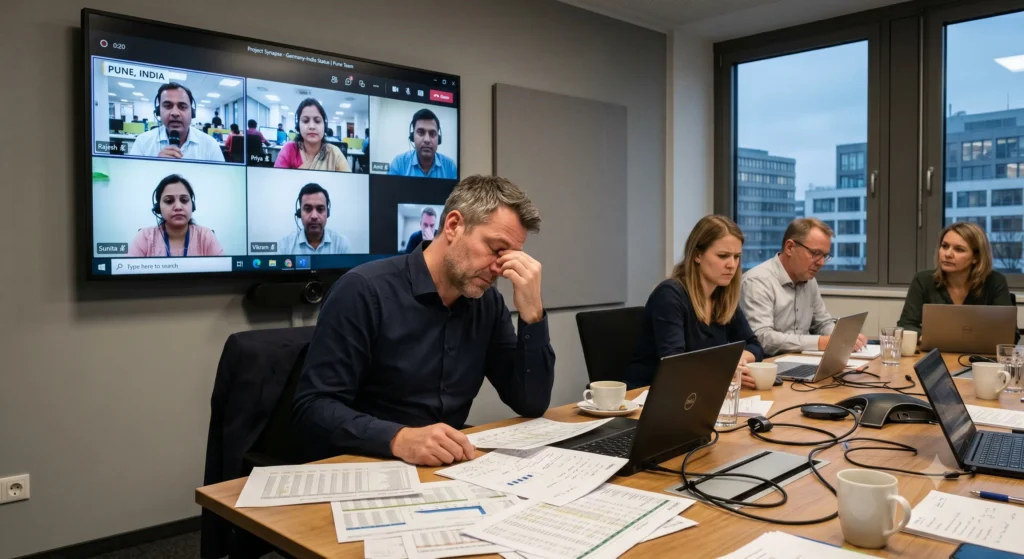
Pune, Bangalore, Delhi, Chennai. Different cities, the same invisible wall. On one side a German headquarters that sends directives, expects precision, and cannot understand why a confirmed SOP is three weeks late. On the other side an Indian engineering team that said yes, meant respect, and has been carrying the gap alone ever since.
This page is for everyone inside that triangle, and the seat barely matters. You may be the President or R&D Director of a hub that is technically excellent, commercially undervalued, and quietly tired of being treated as a cost centre instead of a partner. Maybe you are reading it from Stuttgart, watching the dashboards turn green while your gut says something is wrong. You may be an Indian team lead, not the most senior person in the room, but the one who feels the squeeze first. The friction in the DE-IN matrix does not respect job titles, and neither does this page.

The Project Is on Track. Everyone Said Yes. So Why Does It Feel Wrong?
You just left the alignment call with Stuttgart. The slides were clean, the timeline was confirmed, your team nodded. And still, something does not sit right. You cannot name it yet, but you already sense it is there.
You also already know what it is. The yes in that meeting was not a commitment. It was a signal of respect. In a high-context, hierarchical culture, saying yes to a senior person shows that they were heard. It does not mean agreement, it does not mean the scope was fully understood, and it does not mean the timeline is achievable. This is not a character flaw and it is not a weakness in your people. It is how communication works when psychological safety has not been deliberately built.
This pattern has a name: the Indian Yes. It is the single most expensive cultural misread on the DE-IN axis. Three weeks from now the SOP is at risk, someone manages the fallout quietly, the root cause never reaches the status report, and the next alignment call starts in exactly the same way.


Two Years in Pune. Not a Consulting Assignment. A Real Engagement.
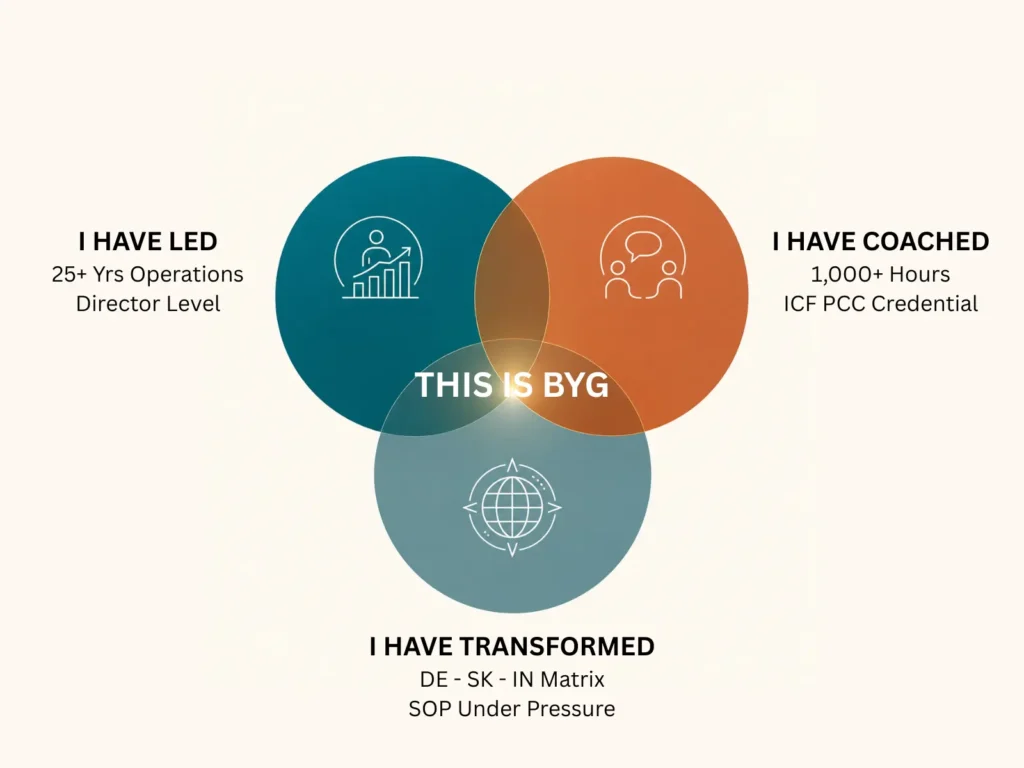
Between 2023 and 2025 I worked on the ground in Pune at Brose India. Not as a visitor flying in for a workshop and out with a report. I was there for the alignment calls that went nowhere. For the project that turned red two weeks before the SOP after three months of everyone saying yes. And for the senior engineer who had the answer the whole time and did not feel safe enough to say it.
I coached 12 leaders during that period: team leads, department leads, and senior experts. Since 2025, I hold the ICF Professional Certified Coach (PCC) credential and have completed MCC-level coach education through Coacharya, with the ICF MCC examination still ahead, which is why I describe myself as on the path to MCC. These are not credentials listed to impress. They are the quality standard that keeps the work rigorous, structured, and measurable, not intuition dressed up as method.
The outcomes of that engagement are documented in an official letter of reference from Vasanth Suratkal Kamath, President of Brose India Automotive Systems Pvt. Ltd., dated 5 February 2025. Ultimately, the letter confirms the coaching of 12 clients in 2024, tangible performance improvements, a shift to a cooperative and open development environment, and a measurable mindset change across the leadership layer. In the DE-IN matrix, proof of results on the ground matters more than any framework. This is that proof.
Vijay and the Helmet. What India Taught Me About Safety Culture.
On one of my first days in Pune, my driver Vijay explained, calmly and with complete sincerity, why he did not need a helmet. As long as he did nothing bad, God would protect him. There was no defiance in it, no laziness. Pure, deep-rooted belief. My first reaction, honestly, was frustration. Then I stopped, and I understood something that changed how I lead in India.

When you grow up believing that harm only comes to those who do wrong, a helmet is not a safety measure. It is a statement of doubt in your own character. No poster, no rule, no German process manual changes that. What changes it is a leader who invests time in understanding the belief before trying to change the behaviour. That is the principle behind every engagement I run in India. Understand the system before you try to fix it. Ask before you instruct. And never mistake compliance for commitment.
The Team Member Who Was Missing Deadlines
One of my team members in India missed several deadlines in a row, and as the workload grew the problem grew with it. I got a call from another location asking what was wrong with my department. After that Call, I went to him. Not to reprimand, to ask. We spent an afternoon together, and in response to open questions he filled a whiteboard with data. What surfaced was that time management, not motivation, not skill, not attitude, was the root cause. With some research, I found the right training, he completed a two-day course, the quality of his deliveries improved and the timing held.
The lesson was not about time management. It was about the difference between asking and shouting. In India, when a leader raises their voice, the conversation is over and the door closes. When a leader asks open questions and listens with genuine interest, the real problem surfaces. Every time. India, for me, was never about Ganesha and a handful of customs. It was ambitious, capable people, and a thousand cultural nuances that reward the leader who takes the time to understand them.

What the Invisible Friction Is Actually Costing You
Cultural misalignment is not a soft HR topic. It is a financial risk with a measurable price, and what makes it dangerous is that it never arrives as one large invoice. It spreads across hundreds of small frictions until it lands on your desk as an OEM penalty or the departure of a key engineer.

Put a Number on What You Are Losing
The cost of underdeveloped international leadership is invisible right up to the week it is not. This calculator does the opposite of a brochure. In five questions it estimates what your matrix loses every year by developing your cross-border leaders with nothing, no Team Charter, no coaching, no mentoring, and then points you to where the leverage actually sits for your situation.
BYG Focus India / Pune / Bangalore
The Cost of Inaction. What underdeveloped international leadership is costing your DE-IN matrix.
Five questions. One honest estimate of what you lose every year by developing your cross-border leaders with nothing, then where to act first.
The India You Are Operating In Today Is Not the India of Five Years Ago
Pune is no longer just the Detroit of India. It sits in the most painful part of the EV transformation, holding combustion lines at full volume while ramping software-defined electric platforms that demand a different engineering DNA. Bangalore is no longer a back-office hub. Global core competencies now live there, AI, software architecture, platform engineering, and the talent market has responded accordingly. Your best people have options they did not have five years ago, and they use them.
Attrition in the 20 to 25 percent band
Turnover in Indian tech and R&D consistently runs in the 20 to 25 percent range. Your strongest people are not leaving because the work is poor. They leave because they feel like a delivery mechanism rather than a strategic contributor, and replacing a specialised engineer is never a small line item.
The extended workbench is driving your best people out
When your hub receives tasks without context, executes without strategic input, and reports without being asked for its judgement, the message is unmistakable: you are here to do, not to think. Your highest-potential engineers will not accept that indefinitely. This is the Extended Workbench Syndrome, and it costs you exactly the people you can least afford to lose.
Leading Gen-Z at 40-Plus: Respect Is the Whole Trick.
Your Pune and Bangalore floors are young, and the engineers you most need to keep are Gen-Z, while the leaders shaping their experience are often 40, 50, or older. I am 50, and I have watched the tension this creates inside companies from up close. The trick is almost embarrassingly simple: treat your Gen-Z people with respect, and their behaviour changes. They open up, and real cooperation becomes possible.
This is not about giving in to Gen-Z. It is about being willing to talk with them on eye level. They grew up in a different time, with different values and different priorities, and that does not make them less committed. It makes them differently motivated. When a Gen-Z engineer is on board with conviction, you do not have a retention problem. You have one of the smartest, strongest contributors on your team. The respect that unlocks that is the same respect this page is built on: ask before you instruct, and never mistake compliance for commitment.

What Executive Sparring for the DE-IN Matrix Actually Is
This is not a cross-cultural training programme. It is not a workshop your team attends before returning to business as usual, and it is not a report that documents the problem and recommends solutions no one implements. It is a direct, one-to-one sparring relationship with someone who has coached Indian leaders inside a German-owned automotive hub, who knows what the Indian Yes sounds like in a status call, and who has built teams in environments where psychological safety had to be constructed on purpose, not assumed.
What Changes Within 90 Days of Starting
No theory, no framework on a slide. Concrete shifts in your daily reality:
- Your Indian leadership escalates risks before they become SOP crises, because a structure now exists that makes honesty professionally safe rather than dangerous.
- The alignment call with Stuttgart produces real commitments, not polite confirmations. You have a protocol that distinguishes I understood from I will deliver by Friday.
- Your attrition has a different character. The engineers who leave are the ones who were never the right fit. The ones who stay feel ownership, not just employment.
- Your German HQ receives honest status reports, including the red ones, because local leadership now has the language and the safety to send them.
- You are no longer the chief firefighter. Local leaders own operational decisions. You manage the system, not the emergencies.
- Your hub has stopped feeling like a delivery unit. It contributes ideas Stuttgart did not ask for, and cannot ignore.
None of this happens because of a methodology. It happens because someone who spent two years inside this exact matrix builds the structure your situation needs, with you. Go deeper on the mechanics: Active Listening, Uncompromising Delegation, and Industrial Conflict Architecture.
What Leaders in the DE-IN Matrix Say

Andy Balbus BYG Consulting operates remotely and works across every time zone you do. The firm accepts mandates and supports clients throughout Germany, Austria, Slovakia, the Czech Republic, Poland, Spain, and across Europe, as well as the USA, Mexico, China, and India. Wherever your headquarters, your plants, or your hubs sit, our consulting travels with you.
FAQ: Unspoken Doubts & Hard Operational Truths
Q1: Why is our Indian hub losing people even though we pay standard corporate salaries?
Because for your strongest engineers it stopped being about the money a while ago. They leave when they feel like a delivery mechanism rather than a contributor whose judgement is wanted. Pay keeps people who have no better option. Mandate, context and the sense that their work matters keep the people you actually want to keep. We work directly on that second layer.
Q2: We have done cross-cultural training before. Why would this be different?
Classic training delivers knowledge and builds no structure. People learn that India is high-context, then sit in the same call on Monday with the same nods. We do not work on awareness, we work on protocols and agreements that hold under pressure, inside your specific DE-IN matrix.
Q3: Is this done remotely or does it require presence in India?
Both work. The sparring runs well fully remote and is scheduled around your operational reality. For a Team Charter Workshop or an acute stabilisation, on-site presence is often worth it, and I travel for that.
Q4: I am the German leader. Is this for me, or for my Indian team?
Both ends sit in the same friction from opposite sides. I work with leaders at either end of the axis, and the fastest progress usually comes when both ends engage at once. The green reports reaching you are filtered, and the structure that lets your team tell you the truth early is built on your side as much as theirs.
Q5: My Indian hub is performing well. Why would I need this now?
Because the best moment to act is before the crisis, not during it. A team that performs while staying silent is the green-melon pattern: strong delivery and hidden red sitting in the same dashboard. Acting while it is still cheap is the entire point.
Q6: Is this not just a generic leadership problem dressed up as an India topic?
The pattern is general, the texture is local. Two years on the ground in Pune taught me how Indian teams actually decide, escalate and go quiet, and how that interacts with a German headquarters. Generic leadership advice misses exactly that texture, and the texture is where the cost lives.
Q7: I am an Indian R&D leader, not a German executive. Is this relevant for me directly?
Yes, and often you feel it first. You are the one translating between two worlds and absorbing the pressure from both. The work gives you the structure to escalate honestly, protect your team without becoming a buffer, and make your hub visible as a strategic partner rather than an execution site.
Q8: My company has frozen salaries and I am losing engineers to competitors. Is there anything I can actually do as a team lead?
Yes. You already know it is not really about the money, you just do not yet have the structure to prove it or act on it. We build exactly that: the case in the language your leadership uses, and the moves available to you now, with the authority your current role gives you, before the next exit becomes inevitable.
Q9: How do we start if the budget is not approved yet?
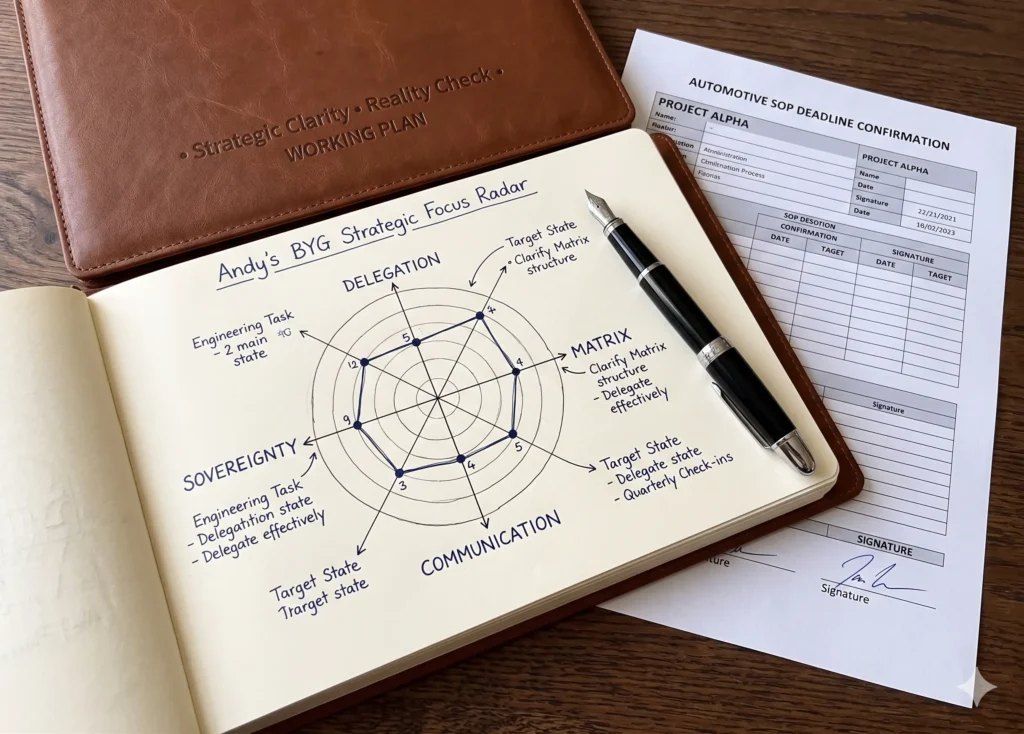
Start with a Reality Check. It costs nothing and gives you something concrete to take internally, whether or not we work together afterwards. Many engagements begin with one leader booking that call before any budget conversation, then framing the business case as operational risk mitigation rather than coaching.
Q10: Our problems feel more about quality than deadlines. Does this still fit?
Very much. Deadline and quality problems share the same root in the matrix: a team that sees a risk early and cannot escalate it safely. The deviation that surfaces later at the OEM was often known on the ground weeks earlier and disappeared into rework and silent workarounds. Make escalation safe and ask for conditions rather than commitments, and you catch the escape before it reaches the line.
Q11: The calendar says 30 minutes. Is that really all it takes to begin?
Yes. The Reality Check is 30 minutes, no pitch and no commitment. We identify the one or two friction points in your specific matrix that are driving the most cost right now. If there is a fit, we explore next steps. If not, you leave with something concrete regardless.
Q12: How is this different from classic management consulting?
Consultants deliver frameworks and slides. I built a department from zero in Slovakia and coached leaders for two years inside Brose India, standing on both sides of the gap. You get no theory, only structures from lived operational experience that hold in your matrix.

Straight Talk From the DE-IN Matrix. Short-Form War Stories.
These videos were recorded for leaders who are done with theory. Each one takes on a specific friction pattern from the German-Indian axis, and each runs under ten minutes.
Why Perfect German SOPs Fail ›
The Next Step Is a 30-Minute Reality Check. No Commitment. No Pitch.
Your own audit told you where the friction sits. The question is not whether the problem is real. The question is whether you address it now or wait for the next SOP crisis, the next exit interview, or the next alignment call that produces commitments no one can keep.
You do not need to be based in India to start this conversation. If you lead from Stuttgart and cannot get an honest picture from Pune, start here. If you are the Indian President who is done absorbing pressure from both sides, start here. The Reality Check works for every seat in the DE-IN triangle. In 30 minutes we identify the one or two friction points in your specific matrix that are driving the most cost right now. If there is a fit, we explore next steps. If not, you leave with something concrete regardless.
Or reach out directly: founder_andybalbus@boost-your-growth.com | WhatsApp: +49 151 4495 7099

Regularly on site: Bamberg, Nuremberg, Zapfendorf, Bratislava, Prievidza, Barcelona, Pune, Mumbai, Shanghai, Querétaro, and Pittsburgh.
Systemic leadership does not end after one call.
Follow for unfiltered insights and straight-talk strategies:


