Green Status Decks, Until the SOP Date Collapses.
This method is part of the BYG Leadership Toolkit: 28 validated instruments for automotive executives navigating the DE-SK-IN matrix.
The Failure of Generic Goal-Setting in Cross-Border Teams
This page is for leaders who agree and own goals across site and culture boundaries. Perhaps you run an R&D department whose tasks are split between the German headquarters, Prievidza, and Pune. Perhaps you are sitting in the annual review, already sensing that the goals agreed today will be forgotten by March. What connects you is the same experience: goals get formulated, signed, filed, and still steer nothing.
You know the picture: annual review meetings where goals are agreed and forgotten by the next quarter. Project status decks that stay entirely green, until the SOP date collapses. Engineers who say “yes, understood” and then deliver what they think is right.
That is not a motivation problem. It is a goal system failure, and it costs more than any P&L line shows.

I Did Not Learn This Goal System in a Seminar. I Built It in Prievidza.
My name is Andy Balbus. I am a Diplom-Wirtschaftsingenieur, ICF PCC certified coach, and bring 25+ years inside the global automotive matrix across Germany, Slovakia, India, China, Mexico, and the UK. In 2019, I joined Brose Prievidza as Director of Electronics with a clear mandate: build a complete R&D electronics department from zero.
The Priority: A Shared Goal Architecture
What I found was typical for fast-growing hubs: individual experts with excellent technical skills, but no shared goal structure. Everyone worked in their own logic. Escalations ran through informal channels, and when key engineers fell ill, their project knowledge disappeared with them.
Do you recognize your own goal system in this description? Let us resolve the gap directly. The Reality Check is a 30-minute diagnostic conversation, no slides, no sales pitch. We identify the most expensive goal-system gap in your matrix.

Why Goal Clarity Is Not a Luxury: The Hard Arithmetic.
Unclear goals are not a soft-skill problem. They are a financial cost risk with direct impact on SOP dates, OEM contractual penalties, and employee retention. These are not motivational numbers; they are the items that appear in your P&L when the goal system fails.

Why “Do Your Best” Systematically Fails in Engineering.
The Goal-Setting Theory of Locke and Latham is among the best-documented models in organizational psychology. Its core finding is unambiguous: specific, challenging goals reliably lead to higher performance than vague instructions. This applies to engineers, project managers, and leaders alike. The mechanism aligns attention, mobilizes persistence, and activates the search for relevant strategies. Vague instructions create interpretation space that everyone fills differently.
The Matrix Interpretation Trap: Same Goal, Four Deadlines
In multicultural engineering teams, this vagueness effect intensifies dramatically:
- German HQ: “Please complete this soon” is intended as a non-binding request.
- India GDC: Interpreted as an urgent three-day deadline.
- Slovakia Hub: Understood as a flexible two-week timeline.
- Operational Result: One vague goal, four countries, four completely different deadlines.

The Five SMART Dimensions and Where They Fail in Practice
Most leaders know SMART as an administrative duty: fill in fields, sign, file. I use SMART as a bilateral leadership contract. Both sides commit visibly to content, timeframe, and escalation path. The aim is not control, but mutual protection.

The 2-of-5 Rule: Redundancy Through Goal Architecture
Classic SMART logic extended with a real-world rule: at least 2 of every 5 SMART goals per employee must be joint goals, achievable only together with at least one other person. Not a diffuse group objective, but a precise target with two accountable owners and one shared deliverable.
Cross-Site Goal Agreement: The Same Mechanic, Applied to the Map
What breaks silos between two groups in Prievidza integrates two sites across the DE-SK-IN matrix. A cross-site goal agreement is a shared goal whose deliverable is only reached when Germany and Pune, or Prievidza and headquarters, actively collaborate rather than merely report. Where pure reporting only exchanges status, a cross-site agreement produces shared accountability.

The Single Point of Failure, and How Goal Architecture Dissolves It
In a growing R&D department in a near-shoring location, or in a hub like Pune with attrition in the 20 to 25% range per year, the biggest risk factor is not a hardware fault. It is knowledge that sits in only one head. When your only electronics developer for Product Line A falls sick two weeks before delivery to a German OEM, what happens? In Prievidza, exactly that happened, more than once.
The answer was not to hire more people. The answer was to structure goals so that knowledge had to be shared structurally. When the department was later restructured as part of an HQ-directed consolidation, the transition held, because the knowledge was never person-dependent. The department still delivers today. That is not coincidence, but the result of a goal architecture that forces redundancy.

The Operational ROI: What a Steering Goal System Directly Protects
- Decision Speed: Eliminating redundant clarification loops because both headquarters and offshore hubs align on identical target definitions.
- Risk Minimization: Surfacing operational deviations early in quarterly reviews while roadblocks remain manageable and correctable.
- Talent Retention: Mitigating leadership alienation in technical hubs, directly addressing a primary attrition driver in CEE and India.
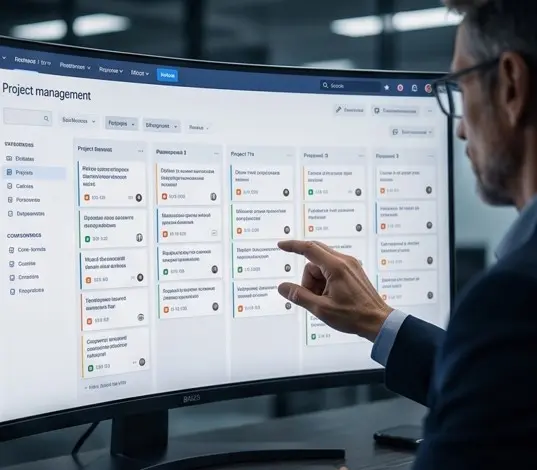
- SOP & Margin Protection: Combining precise goals with a defined review rhythm to stop green status decks from concealing critical delays.
SMART in the SDV Transformation: Why Structured Goals Matter More in 2026
The transition to software-defined vehicle architecture fundamentally changes goal dynamics. Requirements that used to come twice a year now come every two weeks. OEM platform decisions change while projects are running. That sounds like an argument against SMART. It is the opposite.
In volatile projects, the North Star matters more, not less. SMART does not fix what will be delivered at the end, but which process applies when the goal changes. The rhythm becomes change management, every adjustment documented and bilaterally agreed rather than informally shifted.
The alternative is the rolling target: a specification that shifts without formal agreement. The result is what I call the Translation Tax: each side works toward a slightly different goal, and nobody notices until the SOP date arrives.
Cross-Site Goal Agreement as a Stabiliser in Change
In the SDV acceleration especially, the cross-site goal agreement is the most stable anchor. A goal shared across two sites survives a requirement change better than two separate ones, because the adjustment is negotiated around one shared deliverable instead of two diverging specifications.

Frequently Asked Questions: Operational SMART Goal Architecture & Matrix Execution
Q1: Why are joint goals better than classic individual targets?
In global hubs, individual goals create knowledge silos. A single absence, illness, resignation, parental leave, stops the project cold. Joint goals force knowledge transfer as a by-product of normal work. In Prievidza, this stabilised the department through several such absences.
Q2: How do I recognise if my goals are just compliance alibis?
A simple test: can you state without looking it up what your employee must deliver by end of quarter, in one sentence? If not, the goal is not a steering instrument. If your reports are consistently green and you still have a bad gut feeling, you are probably suffering from the Green-Melon Effect.
Q3: Are SMART goals too rigid for agile SDV projects?
No, the opposite is true. In SDV environments with short release cycles, you need precise baseline goals to document changes cleanly. Without SMART you have no baseline, and every change becomes an informal shift that nobody can trace. The rhythm becomes the formal change management process.
Q4: What is the biggest SMART trap in practice?
The attractive dimension. Leaders formulate goals that are attractive for the company, not for the employee. The result is compliance by the letter, not the intent: the goal is met literally, without anyone pursuing the underlying purpose. I ask at every agreement explicitly: what does he or she gain from it?
Q5: How do I prevent SMART goals from ending up in the drawer after the annual review?
Through the rhythm of quarterly review, monthly one-to-one, and an explicit escalation protocol. The goal is not documentation, but a shared operational picture. A team that always knows where it stands needs no reminder email to keep goals alive.
Q6: Does SMART help against the high attrition in India?
Yes, but not in the obvious way. Clear goals reduce leadership alienation, identified in studies as one of the strongest attrition drivers in technical hubs. Someone who knows what is expected and why resigns less often, even when another offer is financially stronger.
Q7: How do I introduce the 2-of-5 Rule without team resistance?
By not introducing it as a new rule, but explaining it as risk protection: “I want to make sure you are not solely liable for critical knowledge, neither toward the project nor toward me.” That is a different message than control. In Prievidza, after the first quarter the team demanded this rule themselves.
Q8: Can I really integrate two sites through shared goals?
Yes, and it is one of the most effective levers for it. A cross-site goal agreement is a goal whose deliverable is only reached when two sites actually collaborate, not just exchange status. In Prievidza, the same mechanic broke the silos between hardware and software. Applied to the DE-SK-IN matrix, it produces shared context and shared accountability across the site boundary, exactly where pure reporting only manages distance.
Q9: I already use OKRs or another goal system. Why SMART?
SMART and OKRs are not mutually exclusive, they operate on different levels. OKRs set direction at the quarterly and company level. The BYG SMART method works at the operational level, where a single goal between two people becomes a contract, including an escalation threshold and, through the 2-of-5 Rule, forced redundancy. Anyone using OKRs but lacking a binding goal architecture at the operational level loses exactly where the SOP date is decided.
Q10: For which leadership level is the method most worthwhile?
Most of all for leaders with distributed operational responsibility: R&D heads, plant and programme owners who must deliver across sites and cultures. At this level the most expensive goal-system gaps arise, and here the 2-of-5 Rule works most directly. For purely local teams without an intercultural interface the effect is smaller, though still present.
Q11: What is the direct financial ROI of this method?
The arithmetic is uncomfortably simple. An OEM line stoppage costs around 2.3M USD per hour according to Siemens. Avoiding a single week of SOP delay caused by a missing goal system refinances a complete engagement many times over. That is not a calculation trick, but the cheapest insurance premium you can buy for your production.
Q12: What is the Reality Check, and how is it different from a discovery call?
A Reality Check is a 30-minute direct diagnostic conversation. No slides, no programme overview, no sales agenda. Andy applies the method to your specific goal-system gap and tells you honestly whether a BYG engagement addresses your highest-cost problem. Both parties leave with a clear assessment. Not a Discovery Call, not a Chemistry Call, a structured diagnosis with a direct outcome.

Stop Reactive Firefighting. Install a Goal System That Steers.
The method is fully documented, and the deep-dive is one click away. Andy takes a limited number of new executive engagements each quarter. The Reality Check is your direct entry point: 30 minutes, zero slides, zero sales pitch.
Use the Reality Check to identify your specific goal-system gap directly with Andy.
- Direct Founder Dialogue: Confidential 1:1 diagnostic conversation directly with Andy Balbus.
- Targeted Gap Identification: Uncovering the exact goal-system bottleneck costing you SOP delays or P&L margin.
- Actionable Next Steps: Walk away with an immediate operational roadmap tailored to your matrix.
Direct Executive Contact:
Email: founder_andybalbus@boost-your-growth.com | WhatsApp: +49 151 4495 7099

Do Not Rely on Theory, Trust in Results
- Diplom-Wirtschaftsingenieur & ICF PCC: Certified Coach (Coacharya Level 2/160h, Level 3 MCC track).
- Brose Prievidza Scale-Up: Built complete electronics department from zero to 40+ engineers and €2M lab.
- Brose India Pune Coaching: Coached 12 senior executives on site in Pune (2023 to 2024).
- €150M Revenue Responsibility: 25+ years operational matrix experience across DE, SK, IN, CN, MX, UK.
The Next Stage: Mentoring Matched to Your Leadership Reality
The SMART method is the operational starting point. Which targeted mentoring stage fits next depends directly on your current leadership reality and matrix complexity.
Executive Mentoring Pathways
- Expert to Leader: Transitioning top technical individual contributors into accountable, self-steering engineering managers.
[Explore Program ›] - Team Lead Scaling: Moving from single-point-of-failure dependencies to strategic process redundancy across sites.
[Explore Program ›] - Director, Strategic Influence: Aligning local plant execution with central German HQ board expectations and P&L targets.
[Explore Program ›] - Lead Without Authority (LWA): Driving cross-functional matrix results and SOP delivery without direct hierarchical power.
[Explore Program ›]
SMART in the BYG Leadership Ecosystem
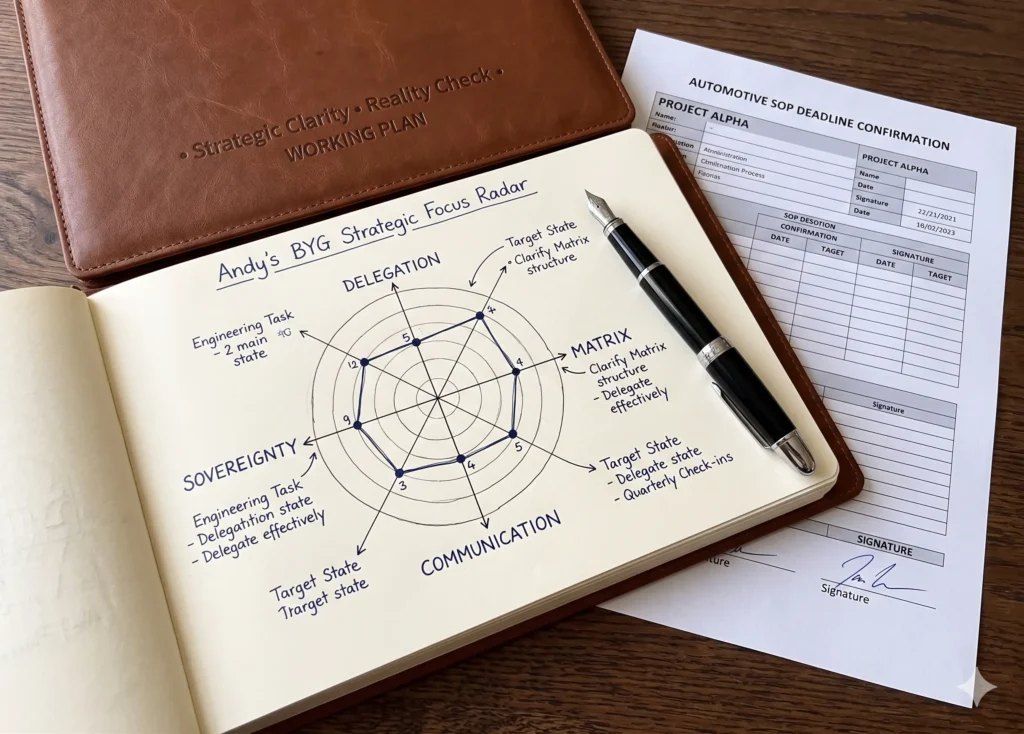
SMART addresses the contractual root of unclear goals. When combined with other validated instruments in the BYG Toolkit, it creates a self-steering leadership matrix:
Program Deployment Matrix
- Intercultural Mentoring: Structured cross-border onboarding and sparring for expats and leaders navigating the DE-SK-IN matrix.
[Explore Program ›] - Team Charter Workshop: Aligning international leadership teams on joint goals, communication protocols, and escalation paths.
[Explore Workshop ›] - Accelerate Now & Executive Sparring: Rapid-response intervention for acute SOP crises, milestone delays, and high-stakes matrix friction.
[Explore Sparring ›] - Legacy & Succession Architecture: Codifying operational know-how and goal systems before founder or key executive transitions.
[Explore Program ›] - Your Power Within (YPW): Specialized peer cohort program for female leaders driving technical deliverables inside complex matrix setups.
[Explore Program ›]
Explore all 28 methods in the BYG Leadership Toolkit ›
Systemic leadership does not end after one call.
Follow Andy on LinkedIn for weekly method publications:


