You know the meeting.
The one where everyone nods, the dashboard shows green, and your gut says something is wrong. You cannot prove it. You cannot name it. Ultimately, you leave with the uneasy feeling that the real conversation happened in the corridor afterward — in a language you were not part of.
Or perhaps you recognise this: you delegated the task. Clearly. Professionally. Two weeks later, you are solving the same problem yourself — and your team has quietly learned that waiting for you is the safest strategy.
Or this: you have invested years becoming the most technically precise person in the room. And now, in the leadership role you worked toward, exactly that precision is the thing holding your team back. Not because you are wrong. Because the system was never built for the leader you are becoming.
This is not a character flaw. It is not a time management problem. It is the Expert Paradox — and it is the most common, most costly transition point in the career of every technically excellent leader in the automotive matrix.
If any of that landed — even a little — you are in the right place.
I know this silence. I was there.
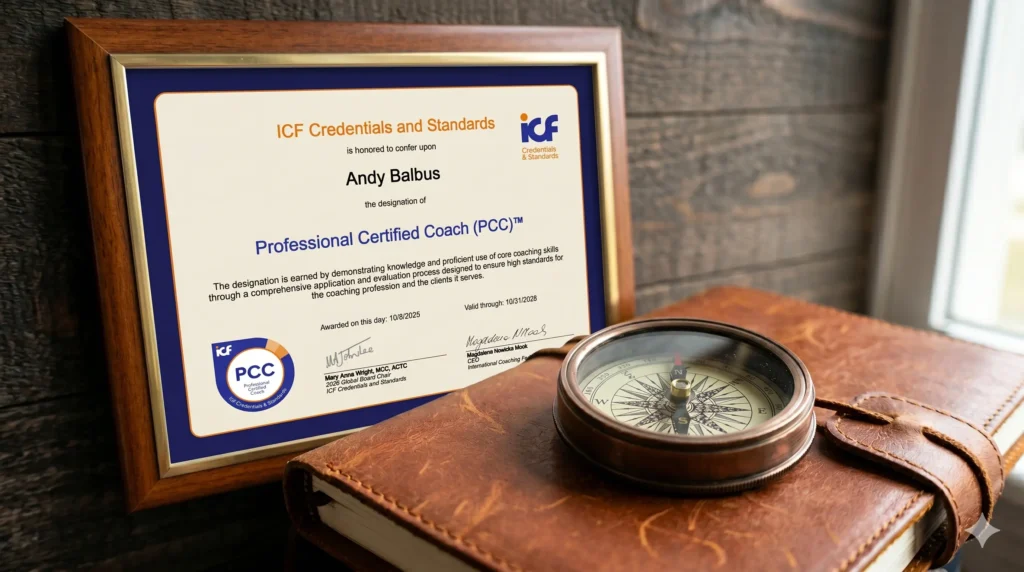
My name is Andy Balbus. I am a German industrial engineer — and for 25+ years I led teams across Germany, Slovakia, India, China, Mexico, and the UK under real OEM pressure, with real SOP timelines, and real consequences when the system broke.

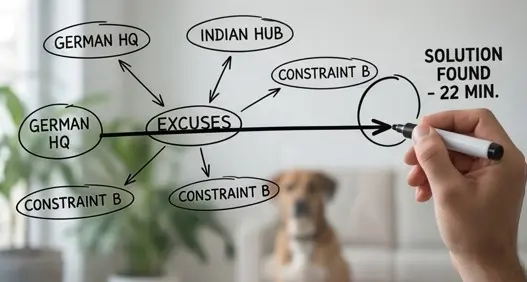
In 2019, I moved to Prievidza, Slovakia — not for a consulting rotation, but to build the complete electronics R&D department at Brose from zero. I hired 40+ engineers. Additionally, I managed a 2 million EUR lab budget. I held full product responsibility for two core platform lines. And I received the same instructions from the German headquarters that you send today — clear, precise, technically correct — and watched them arrive on the Slovak shopfloor as something entirely different.
Later, in Pune, I sat in the alignment meetings where everyone nodded and confirmed the schedule. I knew what that nodding meant. Three weeks later, I watched the same project turn red — because the engineer in that room had known the answer for a month, and had never once felt structurally safe enough to say it. That is the Indian Yes. And it cost that project six weeks. In particular, I did not learn these patterns from a leadership book. I learned them at midnight before a SOP, in a Bratislava conference room, in a Pune stand-up where the problem had been visible for weeks to everyone except the dashboard.
What I built from those years — across those failures and the recoveries — is the 28-method toolkit on this page. These are not academic frameworks. They are the instruments I used, repeatedly, with my name on the outcome.
→ Read Andy’s full story and field record
The Cost of the Gap Is Not Abstract. It Is Measurable.
The patterns that bring leaders to this page have a documented financial cost. These are not motivational statistics — they are the numbers that appear in your P&L when the system operates without the right tools.
Friction Point | Operational Impact | Documented Cost |
|---|---|---|
Communication failures across global teams | 56% of at-risk project budgets jeopardised | Source: PMI Pulse of the Profession |
OEM assembly line stoppage | Single production minute stopped | €20,000 / minute benchmark |
Alignment Tax in matrix teams | 40% slower decision-making | Source: Harvard Business Review |
Average product recall — automotive | Quality escape reaching customer | €10.5M average cost (Source: Allianz Risk Barometer) |
Replacing a specialist engineer | Recruitment, onboarding, ramp-up | 150–200% annual salary (Source: PLOS ONE / Accenture) |
Every method in the BYG Toolkit addresses at least one of these cost categories directly. Furthermore, the methods do not operate in isolation — the compound effect of combined application is where the real return on investment becomes measurable.
28 Validated methods
5 Operational domains
€150M Revenue responsibility
SK + IN 6 Yrs On-Site
6 Countries of operational DNA
Before the Toolkit: A Quick Self-Diagnosis.
Which method fits your leadership situation?
Three steps. Three methods — precisely matched to your situation. With Andy’s personal perspective from 25+ years of automotive practice.
If you recognised more than two patterns — that is not unusual. These failure modes compound. Furthermore, solving one without addressing the system that produces it creates temporary relief, not structural change.
The BYG Leadership Toolkit — 28 Methods. 5 Operational Domains.
The toolkit is organised into five domains that map directly to the structural pressure points of the DE-SK-IN automotive matrix. Methods with a published deep-dive page are linked below. Methods marked [Deep-Dive Coming Soon] are applied in every BYG engagement today — standalone pages are published weekly throughout the next year.
Domain | Methods Included | Primary BYG Failure Mode Addressed |
|---|---|---|
I — Classic Management | Delegation · SMART · Prioritization · MbO · ALPEN · SWOT · Utility Value | Chief Firefighter Syndrome · Expert Paradox |
II — Communication & Conflict | Active Listening · Constructive Feedback · 1-on-1s · 360-Feedback · Conflict Architecture | Green-Melon Effect · Indian Yes · Translation Tax |
III — People & Teams | Situational Leadership · GROW · Tuckman · Psychological Safety · Mentoring · Shadowing | Extended Workbench Syndrome · Talent Drain |
IV — Modern & Agile Leadership | Servant Leadership · Retrospectives · Storytelling · Remote Leadership · Consent Decisions | Malicious Obedience · Alignment Tax |
V — Process & Change | Gemba Walk · Kotter Change Mgmt · Design Thinking · EKS · Resilience · (+ Delegation) | Hidden Factory · Change Failure Rate |
8 Methods — Deep-Dive Pages Live Now.
Each card links to a full deep-dive: scientific foundation, Andy's field story from the specific operational context where the method changed an outcome, documented ROI, and a direct entry point to a 30-minute Reality Check.
🛡️Uncompromising Delegation — End the Chief Firefighter Syndrome
The pain: Every escalation lands on your desk. Your team has learned that you will solve it — and they are right. The cycle is self-reinforcing, and it is quietly dismantling your strategic capacity.
What changes: Recover 8–10 strategic hours per week. Build genuine team ownership that survives your absence — including SOP weeks. Reduce leadership burnout before it becomes a crisis that your organisation feels for months.
Field proof: Applied during the Prievidza R&D scale-up. 40+ engineers. Full project accountability transferred within 18 months without quality regression. (Source: documented Brose Prievidza operations, 2019–2023) → Read the Full Method Deep-Dive
🌱GROW Model — Turn Every Difficult Conversation Into a Coaching Moment
The pain: Your best engineers escalate every decision to you. Each 'quick question' consumes 20 minutes and quietly confirms to your team that independent judgment is optional.
What changes: Eliminate upward dependency loops. Reduce decision escalations by up to 60%. Protect the mental capacity required for genuine strategic thinking — and build the coaching reflex that makes delegation permanent rather than temporary.
Field proof: Core tool across 12 executive coaching engagements in Pune 2023–2024. Measurable shift from approval-seeking to autonomous decision-making within 6–8 structured sessions. (Source: Vasanth Kamath reference letter, Brose India, Feb 2025) → Read the Full Method Deep-Dive
📡Active Listening — Detect What Your Matrix Is Not Telling You
The pain: Your dashboard shows green. Your instinct says something is wrong. That gap — between the formal report and the operational reality — is exactly where the Green-Melon Effect lives.
What changes: Surface technical risks 3–6 weeks earlier. Eliminate the structural silence before it reaches the SOP deadline. Improve talent retention in India and Slovakia by making psychological safety operational. (Source: Harvard, Amy Edmondson — psychological safety research)
Field proof: The primary tool for closing the Indian Yes gap. Applied across 6 countries — from Prievidza assembly halls to Pune R&D stand-ups to Bamberg program reviews where the real problem was that nobody had the structure to name it. → Read the Full Method Deep-Dive
⚡Industrial Conflict Architecture — Stop Managing Symptoms
The pain: In the DE-SK-IN matrix, conflict is rarely visible. It looks like a delayed milestone. A polished status call where everyone agrees. A quality escape that everyone saw coming — except the one person who could have stopped it.
What changes: Eliminate the Alignment Tax — up to 40% of engineering hours consumed by coordination friction, not actual work. (Source: HBR) Reduce SOP penalty exposure. Convert structural silence into the earliest warning system you have.
Field proof: The Translation Tax between German HQ and Slovak execution sites creates exactly this pattern. The BYG conflict framework names and defuses it at the system level — before the crisis lands in the program review. → Read the Full Method Deep-Dive
📊Prioritization & Eisenhower Filter — Reclaim Your Strategic Calendar
The pain: Your most expensive cognitive resource — your focused strategic thinking — is consumed by work your team should own. Every interruption resets the deep thinking that your organisation actually needs from you.
What changes: Recover 10 structured hours per week for strategic leadership. Directly protect EBIT by ensuring your decision capacity is applied where it produces real organisational leverage, not where it produces the fastest visible relief.
Field proof: Applied during 150M EUR annual budget accountability in Prievidza. The single highest-ROI behavioural shift for engineers transitioning into senior leadership roles — confirmed across multiple BYG coaching engagements. → Read the Full Method Deep-Dive
🎯SMART Goals — From Checkbox Culture to Operational Contract
The pain: Goals get confirmed in the Monday alignment call. By Wednesday, three locations have three different interpretations. The Indian Yes confirms the schedule. The Translation Tax converts your suggestion into a mandatory command — or not at all.
What changes: Eliminate goal drift between HQ and international hubs. Convert alignment conversations into binding operational contracts with Joint-Goals that prevent the $20,000/minute SOP penalty risk. (Source: OEM automotive benchmark data)
Field proof: Standard tool in all BYG mentoring engagements. Applied in the Slovak R&D context where HQ requirements consistently arrived as suggestions and were executed as optional — until the SMART contract closed the gap. → Read the Full Method Deep-Dive
🏭Evidence-Based Gemba Walk — Surface the Hidden Factory
The pain: You walk the floor. Nothing changes. Your team shows you what they believe you want to see — and the Hidden Factory, the unofficial workarounds and the suppressed deviations, never surfaces until it is a quality escape.
What changes: Reduce lead time by up to 90% through early identification of systemic bottlenecks. (Source: Lean manufacturing benchmark data) Eliminate the Hidden Factory that consumes 15–30% of production capacity in sites operating under high hierarchy pressure.
Field proof: Applied on Brose Prievidza production and R&D floors. The difference between a ritual walk and a diagnostic walk is one question: 'What is preventing you?' instead of 'How is everything going?' → Read the Full Method Deep-Dive
🧭Mentoring Method — Structured Transfer of Industrial Knowledge
The pain: Informal mentoring depends on relationship chemistry and available bandwidth. In a DE-SK-IN matrix with engineer turnover rates of 150% replacement cost per specialist, that is not a retention strategy. It is a structural risk.
What changes: Reduce specialist replacement cost — which can reach 150% of annual salary per lost engineer. (Source: PLOS ONE, Accenture retention research) Build the knowledge transfer infrastructure that survives personnel transitions and leadership changes.
Field proof: Deployed as the structural backbone of the Prievidza R&D scale-up. 40+ engineers onboarded with systematic knowledge transfer from German HQ. The department delivers today, under Andy's successor, without regression. → Read the Full Method Deep-Dive
20 Methods — Deep-Dives Published Weekly. Applied in Every BYG Engagement Today.
These methods are already deployed in Executive Coaching, Mentoring, and Accelerate Now engagements. Each standalone deep-dive page will be published within that year — follow Andy on LinkedIn for publication announcements, or check back directly here.
🔒Psychological Safety — Make Honest Escalation Structurally Safe
[Deep-Dive Coming Soon]
The pain: Your team knows the real problem. They confirm the plan anyway. Not because they are dishonest — but because your system makes honest escalation feel like a career risk.
What changes: Eliminate the Green-Melon Effect at its root. Surface problems 3–6 weeks earlier. Directly reduce OEM penalty exposure and quality escape risk. (Source: Edmondson, Harvard Business School — psychological safety research)
Domain: Communication & Conflict — Domain II
💻Remote Leadership — Lead Across Distance Without Losing Reality
[Deep-Dive Coming Soon]
The pain: Your matrix runs across three time zones, two cultural frameworks, and one shared dashboard that nobody fully trusts. Physical distance becomes operational distance becomes strategic blindness.
What changes: Reduce the Alignment Tax in distributed teams. Build synchronisation protocols that replace presence-dependency with system-dependency. Protect EBIT from the hidden cost of asynchronous misalignment. (Source: HBR, distributed team research)
Domain: Modern & Agile Leadership — Domain IV
🤲Servant Leadership — Remove Obstacles, Not Make Decisions
[Deep-Dive Coming Soon]
The pain: Your team waits for your approval before moving. You have become the bottleneck you were trying to prevent — and Malicious Obedience has quietly taken root in the layers below.
What changes: Build the leadership model that produces autonomous teams without losing accountability. Retain high-potential engineers who leave organisations where they feel like execution resources, not strategic partners.
Domain: Modern & Agile Leadership — Domain IV
🔄Change Management (Kotter 8-Step) — Make Change Stick Beyond the Workshop
[Deep-Dive Coming Soon]
The pain: You ran the initiative. The workshop produced energy. Three months later, the Hidden Factory returned. The Malicious Obedience pattern re-established itself — silently.
What changes: Embed change at the system level, not the event level. Reduce initiative failure rate. Protect the investment in culture change from the organisational immune system that rejects surface-level interventions.
Domain: Process & Change Management — Domain V
👥Situational Leadership — Match Your Style to Their Readiness
[Deep-Dive Coming Soon]
The pain: You lead your senior engineer the same way you lead your new hire. One feels micromanaged. The other feels abandoned. Both underperform — for entirely different reasons.
What changes: Accelerate individual performance curves. Reduce talent attrition caused by leadership style mismatch. Build the diagnostic reflex that reads team member readiness before applying pressure or removing support.
Domain: People & Team Development — Domain III
💬1-on-1 Conversations — Your Earliest Warning System
[Deep-Dive Coming Soon]
The pain: You meet your directs in team calls. You discover the real problem three weeks after it started. Structured 1-on-1s are not small talk — they are your primary intelligence channel in a high-context matrix.
What changes: Surface risks 2–4 weeks earlier. Reduce surprise escalations. Build the trust infrastructure that makes the Indian Yes visible and the Slovak silence speakable — before the SOP timeline is at risk.
Domain: Communication & Feedback — Domain II
🪞360-Degree Feedback — See the Leadership Gap Before It Becomes a Crisis
[Deep-Dive Coming Soon]
The pain: You lead confidently. Your team experiences something different. The gap between your self-perception and your team's reality is the most expensive blindspot in technical leadership.
What changes: Identify specific leadership behaviours that drive disengagement, silent underperformance, or Expert Paradox patterns in high-potential engineers. Convert feedback into targeted development rather than generic reflection.
Domain: Communication & Feedback — Domain II
🏗️Tuckman Team Development — Navigate Forming to Performing Deliberately
[Deep-Dive Coming Soon]
The pain: Your new cross-border team is stuck. Germans push for structure. Indians wait for hierarchy signals. Slovaks execute quietly without questioning. Each is behaving rationally — collectively producing friction.
What changes: Accelerate team integration in greenfield and matrix environments. Reduce the productivity loss of mismanaged Storming phases. Build the shared language that converts cultural difference from friction source to strategic asset.
Domain: People & Team Development — Domain III
🗺️MbO — Management by Objectives — Align Strategy to Daily Execution
[Deep-Dive Coming Soon]
The pain: Strategy is clear at the top. At execution level, three sites are pursuing three interpretations of the same objective. The Translation Tax turns alignment calls into rework cycles.
What changes: Create a binding cascade from strategic objective to individual deliverable. Eliminate goal fragmentation driving SOP delays in multi-site operations. Ensure every engineering hour maps to a validated organisational priority.
Domain: Classic Management — Domain I
🔍SWOT Analysis — Diagnose Before You Intervene
[Deep-Dive Coming Soon]
The pain: Interventions that skip diagnosis produce solutions to the wrong problem. In a DE-SK-IN matrix, the visible weakness is rarely the structural root cause.
What changes: Build the diagnostic discipline that prevents expensive misdiagnosis. Align leadership interventions to actual leverage points — not the problem that appeared most recently in the status report.
Domain: Classic Management — Domain I
🕯️Constructive Feedback (WWW Model) — Feedback That Actually Changes Behaviour
[Deep-Dive Coming Soon]
The pain: You give feedback. Nothing changes. Either it lands too softly to register, or too directly to be received. In high-context cultures, the delivery format determines whether feedback creates change or creates distance.
What changes: Build a feedback architecture that works across cultural contexts — including the DE-SK-IN matrix where power distance, hierarchy sensitivity, and face-saving dynamics make standard feedback models structurally ineffective.
Domain: Communication & Feedback — Domain II
📋Retrospectives — Build the Continuous Improvement Reflex
[Deep-Dive Coming Soon]
The pain: Problems recur. The same friction pattern re-emerges after every handover. Without a structured learning loop, your team optimises for delivery — not for system improvement.
What changes: Embed the operational learning cycle that prevents Hidden Factory re-emergence. Build the psychological safety infrastructure that makes honest retrospection possible — not just formally scheduled.
Domain: Modern & Agile Leadership — Domain IV
📋Consent-Based Decision Making — Decisions That Actually Stick
[Deep-Dive Coming Soon]
The pain: You make the decision. The team nods. Execution diverges. Either the decision was wrong — or the buy-in was performative. In a hierarchical culture, you will not be told which.
What changes: Build decision architecture that converts performative agreement into genuine commitment. Reduce the silent implementation drift that produces the Green-Melon Effect at the project level.
Domain: Modern & Agile Leadership — Domain IV
📅ALPEN Method — Daily Time Architecture for Strategic Leaders
[Deep-Dive Coming Soon]
The pain: Your calendar is managed by other people's urgency. Your most important work — the thinking, the system-building, the strategic preparation — has no protected space.
What changes: Build the daily operating discipline that protects strategic capacity. Reduce reactive time consumption. Create the structural conditions for consistent high-quality leadership under sustained OEM pressure.
Domain: Classic Management — Domain I
⚖️Utility Value Analysis — Rational Decision-Making Under Complexity
[Deep-Dive Coming Soon]
The pain: Complex decisions in a matrix with multiple stakeholders, competing priorities, and incomplete data tend to default to politics rather than logic.
What changes: Build a transparent decision framework that reduces political decision-making, shortens alignment cycles, and produces decisions that hold under scrutiny from multiple cultural and organisational perspectives.
Domain: Classic Management — Domain I
🌟Leadership Storytelling — Make Your Vision Impossible to Misinterpret
[Deep-Dive Coming Soon]
The pain: You present the strategy. It is precise, logical, and complete. Three weeks later, your teams in Slovakia and India are executing three different versions of it.
What changes: Build the narrative architecture that transmits strategic intent across cultural and hierarchical distance. Reduce interpretation variance. Make the Translation Tax structurally impossible for your most critical messages.
Domain: Modern & Agile Leadership — Domain IV
👣Shadowing — See What Your Direct Reports Actually Do
[Deep-Dive Coming Soon]
The pain: You delegate. You review outputs. What happens between the two — the decisions, the workarounds, the informal authority — is invisible. And that invisible layer is where most of your Hidden Factory lives.
What changes: Surface the actual operating model of your team versus the designed one. Identify delegation gaps, bottlenecks, and informal power structures that no KPI or status report will reveal.
Domain: People & Team Development — Domain III
🏔️Resilience as Role Model — Lead Under Pressure Without Transferring It
[Deep-Dive Coming Soon]
The pain: You absorb the pressure from above and protect your team below. Eventually, the pressure you absorb becomes visible — in your decisions, your tone, your patience. Your team reads it. They respond with caution.
What changes: Build the stress architecture that sustains high performance under OEM pressure without transmitting anxiety downward. Protect team psychological safety during SOP crises. Reduce burnout risk for yourself and your direct reports.
Domain: Process & Change Management — Domain V
💡EKS (Constraint-Focused Strategy) — Solve the Right Bottleneck First
[Deep-Dive Coming Soon]
The pain: You improve many things. The system does not get faster. In a globally distributed operation, optimising everything equally is a strategy for optimising nothing strategically.
What changes: Identify the single constraint limiting total system throughput. Redirect engineering capacity to the leverage point that produces compounding improvement — not distributed marginal gains that cancel each other out.
Domain: Process & Change Management — Domain V
🎨Design Thinking — Solve Problems Your Team Has Stopped Seeing
[Deep-Dive Coming Soon]
The pain: Your team has been solving the same class of problems for years. They are fast, expert — and structurally blind to solution spaces outside their established mental models.
What changes: Build structured innovation capacity for recurring friction patterns. Particularly relevant for DE-SK-IN integration challenges where the obvious solution has already been tried — twice.
Domain: Process & Change Management — Domain V
Which Method Addresses Your Highest-Cost Problem Right Now?
Use this routing table to identify your entry point. No method operates in isolation — the compound effect of combined application is where the real ROI lives.
If your problem is... | Start with... | Compound with... |
|---|---|---|
SOP delays and filtered reporting | Active Listening | GROW + Conflict Architecture + 1-on-1s |
Chief Firefighter Syndrome | Delegation | GROW + Prioritization + Servant Leadership |
No strategic time — calendar owned by others | Prioritization | Delegation + SMART + ALPEN |
Indian Yes / Green-Melon Effect | Active Listening | Psychological Safety + 1-on-1s + SMART |
Translation Tax (HQ to SK or IN) | SMART Goals | Conflict Architecture + MbO + Storytelling |
Malicious Obedience in team | Psychological Safety | Servant Leadership + GROW + 1-on-1s |
Greenfield ramp-up / hub scaling | Gemba Walk | Delegation + SMART + GROW + Tuckman |
High-potential retention risk | Mentoring Method | GROW + Delegation + Psychological Safety |
Cross-cultural team integration | Active Listening | Tuckman + Servant Leadership + 1-on-1s |
Expert Paradox — engineer to leader | GROW Model | Delegation + Prioritization + Servant Leadership |
Change initiative failed to stick | Kotter Change Mgmt | Retrospectives + Psychological Safety |
Team conflict suppressed and invisible | Conflict Architecture | Psychological Safety + Active Listening + GROW |
What Leaders Say After Working With Andy.
These are not edited testimonials. They are the words of leaders who brought a specific operational problem — and left with a structural change. Verified, named, unaltered.

"He is very good at asking the right questions that make you think deeply and discover for yourself. Every session, the focus was always on the needs of the participant. I gained great insights from the coaching sessions."— N.R. Krishna, Leader, coached in Pune 2023–2024 (Google Review)
"He has a unique ability to simplify complex leadership situations and offer practical guidance tailored to individual needs. His mentoring style is both supportive and genuinely challenging."— Vinayak Gaddam, Deputy Manager, Brose India (LinkedIn Recommendation)
"He focused on the currently important subjects and kept an eye on the future. Andy has always been a precious mentor I could rely on — who just understood."— Manuel Prando, Mentor Engagement, BYG Consulting (Google Review)
"His insights on intercultural collaboration were valuable and directly actionable. Outstanding mentor and coach — especially for professionals who work across multiple geographies."— Vasanth Suratkal Kamath, President, Brose India Automotive Systems Pvt. Ltd. (Official Reference Letter, Feb 2025)
"His strong engagement, genuine enthusiasm, and truly proactive approach consistently create a positive atmosphere. Andy's ability to combine strategic thinking with hands-on problem-solving makes him an exceptional mentor."— Andrei Andreev, Colleague & Mentee, Brose (Google Review)
Frequently Asked Questions.

01
Neither, and the transparency matters. The scientific foundations — Edmondson on psychological safety (Harvard), Kotter on change management, Spreitzer on psychological empowerment, Ward et al. on active listening, Deci & Ryan on autonomy — are established and credited on every deep-dive page. What is proprietary is the application layer: specifically how each method is calibrated to the DE-SK-IN automotive matrix, the exact failure modes each method addresses in that context, and the field stories that prove the method under real OEM pressure. The BYG Toolkit is not a repackaging of theory. It is 25+ years of applied judgment on top of validated science.
02
Because depth matters more than breadth. Every published method page is built to a consistent standard: scientific foundation, BYG application layer, Andy's field story from the specific operational context where the method produced a measurable change, documented ROI data, and a structured FAQ. Building 28 pages to that standard simultaneously would produce 28 mediocre pages. Consequently, one method is published weekly — which means the full toolkit will be documented by Q2 2026. Follow Andy on LinkedIn for weekly publication announcements, or check back directly here.
03
The scientific foundations are sector-independent. However, the application layer — specifically calibrated to SOP timelines, OEM penalty structures, and DE-SK-IN cultural asymmetries — is automotive-specific. That said, if you lead a globally distributed organisation with comparable communication asymmetries (high-context versus low-context cultures, hierarchical versus flat structures, remote versus co-located teams), the methods transfer directly. The core patterns — Green-Melon Effect, Malicious Obedience, Expert Paradox — are not automotive-exclusive. They are universal failure modes of technically-led organisations under sustained performance pressure.
04
Start with one — the one that addresses your highest-cost current problem. Attempting to implement 28 methods simultaneously is itself a prioritization failure, and the Eisenhower Filter (Method #05) would flag it immediately. The most common BYG entry sequence: Active Listening first (to understand what is actually happening in your matrix), then Delegation (to stop being the operational bottleneck), then Prioritization (to protect strategic capacity). GROW and Psychological Safety follow naturally once those three are operationally embedded. The routing table above gives you the precise entry point for your specific situation.
05
Every BYG engagement — Executive Coaching, Industrial Mentoring, Accelerate Now, Team Charter Workshop, and the Global Automotive Engine Masterclass — draws from this same 28-method toolkit. Specifically, the method pages are the intellectual foundation you can evaluate before committing to a structured engagement. They answer: does Andy's approach have the depth and specificity to address my operational challenge? The service pages answer: how does Andy apply these methods in a structured, accountable engagement with measurable outcomes?
06
A Reality Check is a 30-minute direct diagnostic conversation. There are no slides, no programme overview, and no sales agenda. Andy reviews one specific operational challenge you are currently facing and tells you honestly whether a BYG engagement can address it — and if so, which methods apply first. It is called a Reality Check because both parties leave with a clear assessment, not a follow-up proposal unless the fit is genuine. Exactly, it is not a Discovery Call. It is not a Chemistry Call. As a result, it is a structured professional diagnostic with a direct outcome.
07
Andy has direct operational experience in six countries: Germany, Slovakia, India, China, Mexico, and the United Kingdom. The DE-SK-IN axis is the primary focus of the BYG Toolkit because it represents the most common and most costly matrix configuration in the current automotive tier-1 and tier-2 landscape. However, the core failure modes — Green-Melon Effect, Malicious Obedience, Translation Tax — manifest in every cross-cultural engineering matrix with comparable hierarchy asymmetry and communication distance. Andy applies the same diagnostic framework to other matrix configurations with the same structural rigour.
08
Yes — each deep-dive page is designed to be immediately applicable: read the scientific foundation, understand the BYG application layer, and use the method in your next relevant operational context. Furthermore, the 30-part Global Automotive Engine Masterclass on YouTube provides video-based application for many of these methods — free, under 10 minutes per episode. The difference between self-application and a structured BYG engagement is depth, accountability, and contextualisation to your specific organisational situation and cultural matrix.
Stop Managing the Matrix. Start Architecting It.
The methods are documented. Finally, the deep-dives are one click away. However, if you want a direct diagnostic conversation about which method addresses your highest-cost operational problem right now — the Reality Check is 30 minutes. No slides. Absolutely, no pitch. Just your situation, and an honest answer.
👉 Book Your Reality Check — 30 minutes, no pitch, just your situation
Or explore the BYG programmes that deploy this toolkit in a structured engagement:

Executive Coaching → Executive Coaching for Automotive Leaders
Industrial Mentoring → Industrial Mentoring (DE-SK-IN)
Accelerate Now → Accelerate Now — Executive Sparring
Team Charter Workshop → Team Charter Workshop
Masterclass → Global Automotive Engine Masterclass — Free on YouTube