You Built It. Now the Hardest Part Is Letting It Go.
The Legacy Program: structured executive sparring for business owners and senior leaders who carry everything themselves. This is not succession brokerage and it is not finding a buyer. It is the structural work that makes your business independent of the owner, so what you built becomes transferable, holds its value, and can outlast you.
Letting go is not the end of your work. It is the last and largest thing you will ever build: the successor who carries your life’s work into the next generation. This page is about doing that now, at full strength and on your own terms, instead of later, when the decision is made for you.
Andy Balbus BYG Consulting operates remotely and works across every time zone you do. The firm accepts mandates and supports clients throughout Germany, Austria, Slovakia, the Czech Republic, Poland, Spain, and across Europe, as well as the USA, Mexico, China, and India. Wherever your headquarters, your plants, or your hubs sit, our consulting travels with you.

There Are Two People This Page Is For. Both Carry the Same Weight.
Both situations share one root: the fear of letting go. And both need the same answer: build the structure that makes letting go possible, while you still have the strength to build it well.

Business Succession from the Inside: Built and Deliberately Handed Over, Every Time.
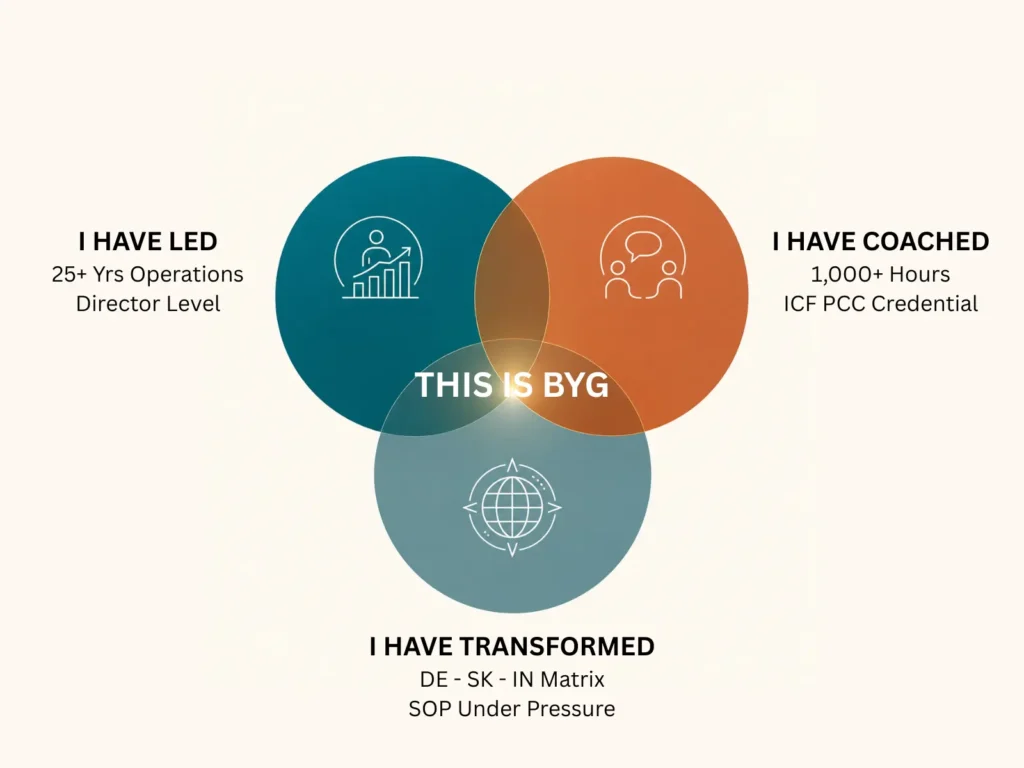
In more than twenty-five years inside Brose, I never moved into a new role until it was clear who would carry the work I was leaving. That was not caution. It was discipline. From the day I stepped into a role, I spread the work across several shoulders, deliberately, so the team could run and so I could take a holiday without the world collapsing behind me. Two principles guided every one of those moves: trust and delegation.
When I moved from Prievidza to India, the company decided centrally that Maik, who led Motor Development, would take on Electronics as well. He was not a successor I had chosen. So I did the part that was mine to do. I spent months making sure that for every single one of my people, Maik knew the agreements, the plans, and the context, so that nothing those engineers had been promised fell through the gap. A handover is not a document. It is making certain the work holds when you are no longer in the room.
Where I did build a successor from the ground up was in India. I hired Priti Shahane to lead the Brose Pune Training Academy and spent a year developing her into the role, until the function was fully hers. That is the discipline the Legacy Program transfers: not a theory of succession, but the lived practice of building people who can carry what you built, and then stepping back so they do.
The Core Legacy Transition Framework
- Actionable Execution: Replacing abstract succession theory with structured, hands-on sparring built on 25+ years of operational leadership.
Business Succession Value Transfer: The Numbers Behind the Decision.
The instinct that makes you hold on is real. So is the cost of holding on too long. The data on what happens to companies and organizations that never built structural independence is not ambiguous.
Now turn it around. A successor you build well secures the value of the company, keeps it running past you, and turns a fragile structure into one that compounds. That is the return on this work: your life’s work, protected in hard numbers and carried forward in living people.

How dependent is your company on you?
Five questions, two minutes. An honest read on key-person dependency, the gap between a company that needs you and one you have made independent of the owner.
Question 1 of 5
Succession
Who leads your company if you are unavailable for six months?
Not who would step in, but who could do it today.
Second line
A real decision needs to be made and you are not reachable. What happens?
Knowledge
How much of what makes the business work lives only in your head?
The absence test
When did you last take two uninterrupted weeks off, fully unreachable?
Readiness
Your honest plan for building a successor right now is…
The Legacy Program: One Day to Find the Root, One to Three Years to Change It.
The Legacy Program is not a workshop. It is structured executive sparring across a sustained engagement of twelve to thirty-six months. The opening day finds the root. The long engagement is where the real change happens: turning insight into behavior that holds under the pressure of daily operations.

Succession for Owners, a Second Line for Senior Leaders: Two Contexts, Two Outcomes.
Shadow Founder Syndrome: The Problem Is Not Succession, It Is the Fear of Letting Go.
Behind every failed succession, behind every director who carries everything alone, there is a belief that has never been examined. It sounds like a strength: “I built this, only I understand it fully, if I step back something will break.” That belief is not wrong. It is an accurate description of a system built to depend on one person. It is also the description of a structural fragility waiting to be tested, not a monument to capability.
The Legacy Program does not ask you to stop caring. It asks you to build the structure that lets someone else carry what you built, with the exact same care you brought to it.
And here is the reward almost no one says out loud: no matter how long you have after the handover, you will be able to look at the company you made and know that it stands without you, that the people who work there have a livelihood you secured, and that your life’s work moves forward. That is not stepping down: that is completion.

Succession Advisory and Sparring on Equal Footing: Why Andy Balbus, and Why This Experience Matters.
Most succession consultants advise on process. They design frameworks, facilitate workshops, and deliver reports. What they rarely bring is the experience of having built something, handed it over, and watched it keep running without them.
The Best Time to Build a Successor Was Five Years Ago. The Second Best Is Now.
Every leader who has successfully handed over something they built says the same thing: they wish they had started earlier. Not because the transition was hard, but because it was harder than it needed to be, and it was harder because they waited.
“Two or three more years” is the most expensive sentence an owner can say. It quietly trades a transition you design for one that gets forced on you, and by the time it is forced, the strength to build it well may already be gone. The Legacy Program is not for leaders in crisis. It is for leaders who recognize, while they still have time and full power, that the structure they built around themselves has to outlast them, and who choose to shape how that happens. You go at this now, at the height of your strength, not at the end of it.
Executive Succession FAQ: Direct Answers for Owners & Senior Leaders
Clear, unfiltered answers on structural independence, valuation protection, second-line development, and long-term executive sparring.
Q1: Why do 70 percent of business successions fail even with a perfect legal contract?
Because the contract transfers ownership, not the company. The relationships, the instincts, the decision-making logic, and the trust the organization runs on cannot be signed over. When only the legal layer changes and the structural one does not, the business loses the very thing that made it work. The Legacy Program builds the structural handover, which is the part that actually decides survival.
Q2: My team is loyal, but there is no second line. Why can’t they simply take over?
Loyalty is not the same as readiness. A team that has learned to wait for your decision has been trained, by the structure, not to make it. That is not a failing of theirs, it is a property of the system you built. The work is to rebuild the structure so the right people can carry real responsibility, and to develop them deliberately into it, rather than hoping loyalty converts to capability on the day you step back.
Q3: I am not a business owner. I am a director at a large company. Is the Legacy Program relevant for me?
Yes, directly. If you are the single point of accountability in a structure that was never designed to run without you, you have the owner’s problem without the owner’s title. The program builds you a functioning second line and a team that decides what is theirs to decide, so the organization stops depending on your presence and you get your strategic calendar back.
Q4: What is the difference between the Legacy Program and Executive Coaching?
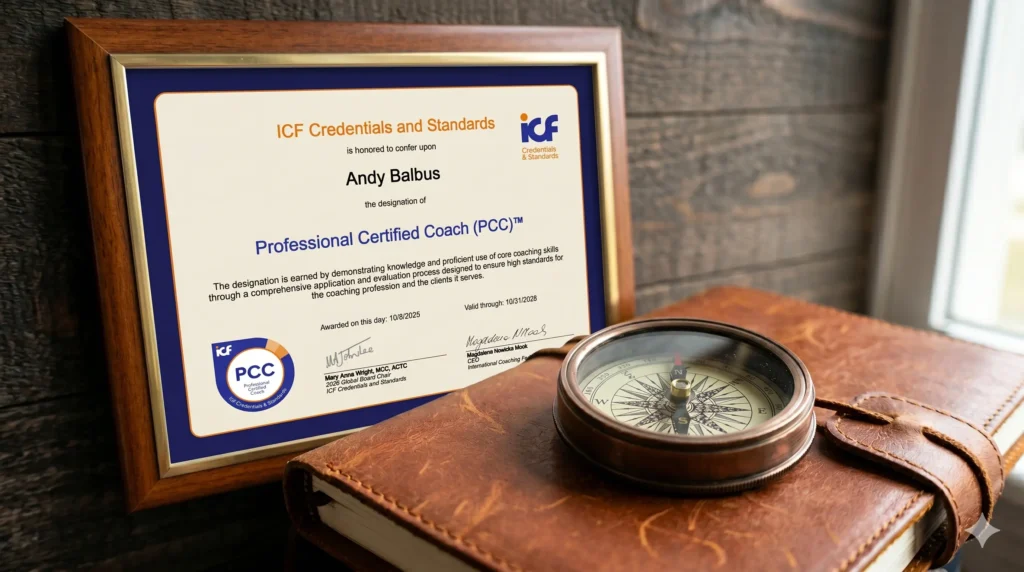
Executive Coaching, in the ICF sense, draws answers out of you without giving direction. The Legacy Program is structured sparring: I give direct guidance, challenge your assumptions head-on, and define concrete next steps every session, over twelve to thirty-six months, until the transition is structurally irreversible. Coaching is non-directive by design. This is deliberately directive, because succession needs accountability, not only insight.
Q5: I have been considering this for years. Why now?
Because the cost of waiting compounds. Every year without a second line, the organization grows more dependent and the tacit knowledge grows harder to transfer, which means the transition gets harder, not easier, the longer you wait. Starting now, at full strength, lets you design the handover. Waiting until it is forced means someone else designs it for you.
Q6: What does the twelve to thirty-six month engagement actually involve?
A one-day strategic intervention to find the root, a structural gap analysis to map who can carry what, direct work on the assumptions that keep the current structure in place, and then individual sparring sessions over the following months that hold you and the organization accountable to the changes, until the new structure holds on its own under real pressure.
Q7: Is this available online or only on site?
Both. The opening day works on site or fully online, and the long-term sparring runs in regular individual sessions that fit a senior leader’s calendar across locations, including across the DE, SK, and IN matrix.
Q8: Isn’t admitting I need to build a successor a sign of weakness?
It is the opposite. The leader who cannot be replaced is not indispensable, they are a liability, and a team that depends entirely on one person is fragile, not loyal. Building someone who can carry what you built is the highest form of leadership there is. It takes more strength to make yourself replaceable than to stay irreplaceable.
Q9: What does the Legacy Program cost?
It depends on scope, the length of the engagement, and whether it runs on site or online. There is no fixed list price, because the work is built around your specific situation. We define the scope and the investment together in the Reality Check, with no obligation.
Q10: What if I genuinely have no one internally who could be the successor?
That is a common and solvable starting point. The structural gap analysis separates what can be developed internally from what has to be brought in from outside, and the program is built to develop a successor deliberately over time, as I did in Pune, rather than assuming one already exists. Not having an obvious candidate today is a reason to start now, not a reason to wait.
Q11: I am close to retirement. Is it too late to start?
If you still have time to shape the transition rather than have it forced on you, it is not too late, and starting now is far better than leaving it to chance or to a crisis. The sooner the successor is built and tested while you are still present to guide them, the more of your standards and judgment transfer intact.
Q12: How is my confidentiality protected?
Completely. The work is one-on-one and private by design, and the most sensitive conversations, about the business, the family, and your own readiness, stay between us. Nothing is shared with your team or board unless you decide it should be.
Q13: How do I prevent losing key OEM customers during the ownership transition?
Key customers attach to relationships, not contracts. We build the handover so the successor grows into the OEM relationships early and visibly, while you are still there to vouch for them. That keeps the supply relationship stable instead of wobbling at the moment of change.
Q14: How much authority should a new managing director get in the first year?
Enough to truly decide, and a clear framework to decide within. Too little authority keeps them in your shadow, too much without a framework overwhelms the organization. The structural gap analysis sets which decisions sit with the successor from day one and which transfer in steps.
Q15: Is this succession advisory or M&A? Do you find me a buyer or a successor?
Neither. This is not brokerage and it is not a search mandate. I do not find you a buyer and I do not place an external candidate. The Legacy Program is the structural work that makes your business independent of the owner, so that whoever takes over, family, an internal successor, or a buyer later, inherits a company that runs without you. Transferability comes first. The transaction, if there ever is one, comes after and is worth far more once the company no longer depends on you.
Q16: How do I actually make my business independent of the owner?
You reduce owner dependency in the places it actually lives: decisions, knowledge, and relationships. We map where the company still routes through you, then move each dependency deliberately onto a second line, into documented process, and into a successor developed for the role. It is not one handover event. It is a structured sequence over twelve to thirty-six months, until the company holds under real pressure without you in the room.
Q17: How do I build a real second line of leadership, not deputies on paper?
Deputies on paper exist because the structure never handed them real decisions. We change the structure first: which decisions move to them, the framework they decide within, and the accountability that holds without you stepping back in. Then we develop the people into that authority deliberately, the way I built a successor in Pune over a year, rather than hoping loyalty converts into capability on the day you step back.

How ready is your company to outlast you?
Four dimensions, two minutes. A structured read on whether your company is transferable yet, or still depends on you. This maps to the exact gaps the Legacy Program closes.
Dimension 1 of 4
Successor
Who leads your company if you are unavailable for six months?
Not who would step in, but who could carry it today.
Knowledge transfer
How much of your company’s critical knowledge lives only in your head?
Client relationships, process knowledge, the informal shortcuts.
Values & culture
How confident are you that your culture and values survive a handover?
Values that live only in the founder’s head are a dependency, not a culture.
Timing
When do you think building the successor should seriously begin?
There is no wrong time, except too late.
Build the One Thing That Outlasts You.
You spent years, maybe decades, building something real. The last and greatest build is the structure that lets it stand without you, and the successor who carries it forward. Do it now, while you have the strength to do it well, and turn the hardest part of letting go into the proudest.
The Reality Check is thirty minutes, no commitment, a direct executive conversation about your current situation and whether the Legacy Program is the right fit for where you are now.
Direct Contact: founder_andybalbus@boost-your-growth.com | WhatsApp: +49 151 4495 7099
Global Presence: On site regularly in Bamberg, Nuremberg, Zapfendorf, Bratislava, Prievidza, Barcelona, Pune, Mumbai, Shanghai, Querétaro, and Pittsburgh.

Systemic Leadership Does Not End After One Call.
Follow for unfiltered matrix insights, lateral leadership frameworks, and straight-talk execution strategies:


