
You run the project. You do not own the people. And somehow, you are still expected to deliver.
The meeting ends. Everyone nods. The deadline is clear. And three days later, the engineer you depend on is deep inside a priority set by a line manager who has never heard your project name.
You have no disciplinary role, no performance lever, and no formal mandate over the people your project depends on. What you have is expertise, a delivery commitment, and a team that technically belongs to someone else.
This is not a gap in your skills. It is the structural reality of lateral leadership in the automotive matrix: you are accountable for an outcome without disciplinary authority over the people who deliver it. And it is one of the most demanding leadership disciplines in the industry, one that almost nobody trains you for explicitly.
Andy Balbus BYG Consulting operates remotely and works across every time zone you do. The firm accepts mandates and supports clients throughout Germany, Austria, Slovakia, the Czech Republic, Poland, Spain, and across Europe, as well as the USA, Mexico, China, and India. Wherever your headquarters, your plants, or your hubs sit, our consulting travels with you.

Why This Mentoring. Why Andy and why Now.

Manjusha: Influence Without Disciplinary Power
The decision that changed how I understood influence without authority.
Manjusha was one of our engineers in India. Her husband was transferred, and she would have to relocate to follow him. Under the standard rules of the organization at that time, her options were limited.
I went to the development manager in India and argued for something that had never been done before in that structure: full-time remote work for a permanent employee. Not a temporary arrangement. A real solution that would keep a skilled engineer and send a signal about what kind of workplace we were building.
It took me many conversations. What made it possible was not a policy, not a precedent, and not my job title. It was trust. I trusted Manjusha completely. The development manager trusted me. Without that chain of trust, the answer would have been no.
She stayed with us. She delivered software for our projects. And the team saw exactly what kind of leader operates without formal power: one who fights for the people, not just for the project. That reputation is not built through a single decision. It is built through decisions like that one, made consistently, over time.

Lateral Leadership: The Pattern Nobody Names
Most leaders without formal authority share the same trajectory. In the beginning, the freedom is genuine. Nobody micromanages your methods. You are trusted to deliver. You build credibility through results.
The Weight of Non-Disciplinary Accountability
Then the weight accumulates.
Because when there is no disciplinary role, escalation is harder. A colleague who does not deliver leaves you without a formal conversation to hold them accountable. A cross-functional team member pulled in another direction creates a gap you absorb personally. And when the project falls behind, your name is on the slide.
Breaking the Single-Point-of-Failure Trap
The response most coordinators develop is to take everything on themselves: “If nobody else will own it, I will.” This works. Until it does not. Until the coordinator becomes the single point of failure for every deliverable, and the team has quietly learned that they do not need to be responsible because someone will always cover.
I learned this the hard way. The freedom I was given, I filled with ownership that should have been distributed. Learning what not to carry was the hardest part of that role.

How Strong Is Your Coordination Leadership?
Five questions, two minutes, a clear picture of where the structural gap is.
1 of 5: When a cross-functional team member does not deliver on a commitment, what is your typical response?
2 of 5: How sustainable is your current workload over the next two years?
3 of 5: How would you describe the quality of commitments made in your project meetings?
4 of 5: How well do you understand what each team member is dealing with outside of your project?
5 of 5: If a competitor offered your most important team member 30% more salary, how confident are you they would stay?
The Overload Trap of Lateral Leadership: The 23:00 Session and the Price I Paid
The project was burning. I was the firefighter. Nobody asked me to work those hours. I chose to, because the alternative felt like failure.
There were months during my coordination years when I worked evenings and weekends as a matter of routine. Not because the project required it structurally, but because I had not yet built the structure that would have made it unnecessary. The gaps in the team's accountability were real, and filling them personally felt like the responsible thing to do.
What I did not see clearly at the time was the price.
In those phases, I was sick more often than in any other period of my career. My weight climbed by up to ten kilograms. My energy was depletable in a way that rest alone could not repair, because the source of the depletion was not the hours. It was the structural position: being the single point of failure for everything, including things that had nothing to do with my actual expertise.
The shift did not come from deciding to work less.
It came from learning two things simultaneously. First: that a project team has exactly the level of accountability that the coordinator has deliberately built into it. If I was absorbing everything, it was partly because I had trained the team to let me. Second: that the methods existed to change this, specifically, SMART goal contracts that transferred real ownership, Active Listening that surfaced what the team actually knew but was not saying, and delegation frameworks that distributed responsibility without requiring constant oversight.
Once those methods were operational, the evenings opened up. Not because the projects became easier. Because the team became genuinely capable of carrying them. The output did not decrease. In several cases it improved, because engineers who own their work produce better results than engineers who execute while someone else worries.
This is one of the most direct transfers the mentoring makes: not just what to do differently, but the specific methods that make it operationally possible to lead without carrying everything yourself. SMART goal architecture distributes accountability. Active Listening surfaces risks before they become crises. Delegation frameworks transfer real ownership. Together, they replace the 23:00 session with a team that carries its own weight.

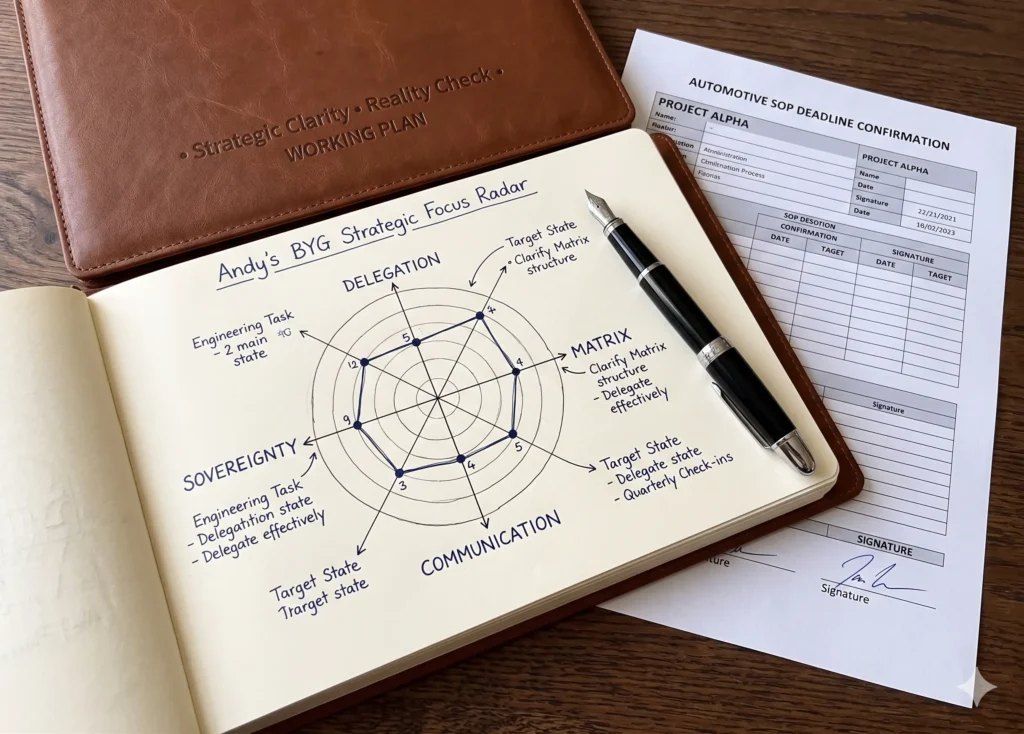
Leading without formal authority and without burning out requires more than determination. It requires a specific set of operational tools that create accountability where the disciplinary lever is absent. Three methods are central.
Why This Role Is Harder in a DE-SK-IN Matrix.
The lead-without-authority challenge is more complex in a cross-cultural matrix than in a single-location context. Cultural dynamics around authority, deference, and escalation behavior differ significantly between Germany, Slovakia, and India.
Germany: Technical Competence & Direct Execution
In Germany, technical expertise is respected and expected. A coordinator who demonstrates deep technical competence can build credibility relatively quickly, provided the communication is direct and the deliverables are precise.
India: Relationship Infrastructure Before Authority
In India, the relationship has to be established before the authority is granted. You cannot lead from the first meeting. You lead from the twentieth, once the relationship has depth and the trust has been tested. The SMART goal that works in a German engineering context needs to be preceded by a genuine investment in the relationship before it will be honored in an Indian one.
Slovakia: Informal Hierarchies & Unwritten Power
In Slovakia, the dynamics depend heavily on organizational culture and individual personality, but the coordinator who invests in understanding the informal hierarchy, who knows which engineer has the informal authority that does not appear on the org chart, operates with a significant advantage.

What the Mentoring Builds.

Lateral Leadership Is Not a Promotion Track. It Is a Discipline.
Some mentoring programs treat the coordinator or project lead role as a stepping stone, a phase before the title arrives. That framing misses the reality for many of the best leaders in the automotive matrix.
Technical coordination and project leadership are disciplines in their own right. An engineer who has led cross-border development projects for fifteen years has built something real. For many, the role deepens with each project cycle. Not as a stepping stone to something else, but as a discipline worth mastering deliberately, in a way that is sustainable over years, not just deliverable in the next sprint.
Core Mindsets of the Lateral Discipline
- Mastery Over Title: Building deep operational authority through cross-functional credibility rather than relying on org-chart hierarchy.
- Systemic Longevity: Designing project execution frameworks that survive multi-year development cycles without personal burnout.
- Cross-Border Leadership: Steering international engineering hubs across DE, SK, and IN through influence, alignment, and trust.
The Cultural Dimension of Building Credibility.
Building credibility without a title operates on fundamentally different timelines in different cultural contexts. In Germany, demonstrating technical competence early and consistently is the primary credibility signal. Competence is assumed but not sufficient.
In India, the relationship has to precede the authority. A coordinator who arrives with technical expertise but without established personal relationships will be respected but not followed in an Indian context. The investment in individual conversations, in understanding each team member's context and priorities, in being present as a person before being present as a project coordinator, is the foundational work that makes the rest possible.
In Slovakia, the informal hierarchy and organizational history both matter. Teams that have operated under strong technical authority for extended periods often need explicit signals that the coordinator's judgment is worth following before they will redirect their priorities. Understanding who has informal authority within the team, and building the relationship with that person first, accelerates the credibility sequence considerably.

The Accountability Conversation Without the Lever.
Most coordinators without formal authority have never been explicitly taught one specific skill: the accountability conversation. How to address a missed commitment from a team member you have no disciplinary power over, without damaging the relationship you need for the next project.
Four steps make this conversation work:
- Step 1: Document in Writing: Document the original commitment precisely in writing during the meeting where it was made. Not your interpretation, but the exact words and date.
- Step 2: Direct 1:1 Address: Address the miss directly in a private one-on-one conversation (never in a group setting) with a curious framing: what happened?
- Step 3: Reset Commitment: Secure a new, specific commitment with a clear date within the very same conversation.
- Step 4: Supportive Check-in: Follow up before the new deadline with a supportive check-in: "I am here if you need anything to land this."
Over time, this behavioral pattern, consistent documentation and consistent follow-through, establishes a working relationship where commitments are taken seriously even without the disciplinary lever.
What Leaders Say.
Q1: What is lateral leadership, and why is it so demanding in the automotive matrix?
Lateral leadership means being accountable for an outcome without disciplinary authority over the people who deliver it. In the automotive matrix this is the norm, not the exception: you coordinate engineers who formally belong to a line manager, often across sites and cultures. It is demanding because none of the classic levers apply. You cannot direct, you have to align. You cannot sanction, you have to make commitments binding. That discipline is the entire focus of this mentoring.
Q2: How do I lead a team I have no authority over?
Through three structures that replace the missing lever. Binding SMART commitments turn a vague intention into a traceable contract with a date and a defined outcome. Active Listening surfaces risks early, before they become a crisis only you can absorb. Genuine delegation transfers ownership without an implicit fallback to you. A leader who works without authority and builds these three structures replaces personal absorption with a team that carries its own weight. That is exactly the architecture this mentoring transfers.
Q3: Is this mentoring or coaching?
Mentoring. I share direct experience, give concrete guidance, and define next action steps. Coaching follows your problem through questions. For the lead-without-authority challenge, direct operational experience is more useful than self-awareness work alone. The Reality Check clarifies which fits your situation.
Q4: How is this different from a leadership training course?
A training course builds frameworks for the average situation. This gives you guidance built for your specific matrix, your specific stakeholders, and the specific cultural dynamics you are navigating. The experience I transfer comes from the same operational environment.
Q5: I have been in this role for years. Is there still value?
Usually more value, not less. The longer you have operated without formal authority, the more specific and deep the patterns become. Some are serving you well. Some have become blind spots. The most experienced coordinators I have worked with consistently report that the value of mentoring increases with the complexity of the role.
Q6: I work most evenings and weekends to keep the project moving. Is this sustainable?
No. And the pattern is almost always structural, not circumstantial. The evenings are not caused by project complexity. They are caused by the absence of the three structures that distribute the load: SMART commitments that transfer real accountability, Active Listening that surfaces risks before they become crises, and Delegation that gives team members genuine ownership. When those structures are in place, the project does not need your evenings. The mentoring builds exactly those structures, from direct experience of the same pattern and its consequences.
Q7: What are the health consequences of long-term overload in this role?
Chronic overload in a coordination role without formal authority produces a specific kind of exhaustion: not the tiredness of hard work, but the depletion of being structurally responsible for outcomes you cannot structurally control. In my own experience this manifested as frequent illness and significant weight gain during the most intense phases. The body signals what the mind is not yet ready to admit: this architecture is not sustainable. The solution is not rest. It is structural change, building the team architecture that distributes the load before it concentrates on one person.
Q8: Which specific methods help with capacity protection?
Three methods are central and directly linked from this page: SMART Goal Architecture, which creates binding accountability before the work starts. Active Listening, which surfaces risks early before they become coordinator-owned crises. Uncompromising Delegation, which transfers real ownership without implicit override. All three are available as deep-dive method pages on the BYG website and are covered directly in the mentoring engagement.
Q9: Do I need an acute problem to start?
No. The best time to develop the competency is before the crisis, not during it. The coordinators who benefit most from early mentoring are the ones who recognize the pattern before it has fully formed, while there is still structural capacity to change it.
Q10: How long does an engagement typically run?
Six to twelve months. Initial sessions establish baseline and identify the most important leverage points. From there, the work alternates between new input and structured reflection on real situations from your current projects.
Q11: Can this run alongside an active project?
Yes. The engagements are designed for leaders who are fully operational. Most clients find that active project challenges become the primary material for the mentoring work.
Q12: Is this relevant outside the automotive industry?
The lead-without-authority challenge exists in any matrix organization. The intercultural layer adds significant complexity in the DE-SK-IN context, but the core competency is universal.
Q13: What is the difference between influence and manipulation?
Influence is building genuine relationships and framing your requests in terms of what matters to the other person. Manipulation is disguising your actual interests. The mentoring works entirely in the influence domain. The distinction is both ethical and practical: manipulation destroys the relationships you need. Influence builds them.
Q14: What happens in the Reality Check?
Thirty minutes. I ask about your current situation, the patterns you are navigating, and the outcomes that matter most. At the end, I tell you directly whether this track fits and what the engagement would look like.

The automotive matrix runs on people who can align teams they do not own. That is not a compromise. It is one of the most sophisticated leadership disciplines in the industry. And it is sustainable when it is built on the right structure, not on one person's willingness to absorb everything alone.
If the 23:00 session has become a habit rather than an exception, the structure needs to change, not the hours. The Reality Check is the right first step.
Or Directly: founder_andybalbus@boost-your-growth.com | WhatsApp: +49 151 4495 7099
Regularly on site: Bamberg, Nuremberg, Zapfendorf, Bratislava, Prievidza, Barcelona, Pune, Mumbai, Shanghai, Querétaro, and Pittsburgh.
Related Methods
- Define your SMART Goals:
Explore SMART Goal Architecture › - Start to listen, not to respond:
Explore Active Listening in the DE-SK-IN Matrix › - Uncompromising Delegation BYG:
Explore Delegation Method ›
Other Mentoring Tracks
- Building strategic redundancy as a team lead:
Explore Team Lead Mentoring › - Transition from technical expert to first formal leadership role:
Explore Expert to Leader Mentoring › - For Directors and Executive Leadership:
Explore Director Level Mentoring ›

Systemic leadership does not end after one call.
Follow for unfiltered matrix insights, lateral leadership frameworks, and straight-talk execution strategies:


