
The Gap Between What You Are Capable Of and How the Organization Responds to You Is Not a Character Issue.
You are a strong leader. Possibly an exceptional one. And something is not adding up. The coaching does one thing: it finds the precise location of the gap, names it, and closes it.
That gap looks different depending on where you are in your career and what the organization is asking of you. Three situations. Three distinct structural challenges. One methodology: systemic leadership coaching.
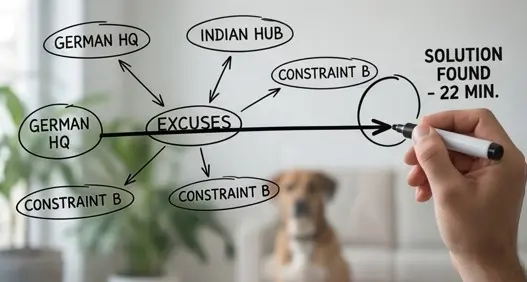
A months-long strategic challenge, resolved in 22 minutes.
Three Questions. Your Situation. Your Path.
Less than 90 seconds, no email required, scroll to your section below.
What is the dominant challenge you are facing right now?
How would you describe your current position?
What is the question you have not been able to ask anyone in your organization?
The Three Executive Coaching Situations. Read the One That Is Yours.
Each section below describes one structural challenge in precise detail. If the widget pointed you here, you already know which one to read.
Path 1: Directors, R&D Leaders and Senior Managers in Technical Organizations
Every escalation lands on your desk. Your team has quietly learned that waiting for your answer is faster than deciding themselves. The strategic work you were hired to do keeps getting pushed to next week.
You are not bad at your job. You are caught in the Expert Paradox: the technical excellence that built your career is now the exact behavior blocking your next level of impact. Every problem you solve personally teaches your team to bring you the next one. Every calendar slot you fill with technical work is a slot that does not exist for the organizational work the role requires.
This is not a time management problem. It is not a motivation problem. It is an identity transition, from the person who has the answer to the person who builds the team that has the answer, that nobody in your organization can help you navigate. Because they are inside the same system.
Engineering leadership coaching built on 25+ years inside the same machine: the seven structural shifts required, the precise methods that close the gap, and field proof from someone who did this job. Not as a consultant who observed it. As the director who lived it.
A team of 40 engineers built from zero in four years. The department still delivers today, without its founder in the room.

Path 2: CEOs, Founders, Company Presidents and C-Suite Executives
The organization runs. The numbers hold. And a question has been growing in the space behind all of it that nobody in your orbit has the distance to ask.
Everyone around you has too much at stake to be honest. Your direct reports need your approval and your continued investment in their careers. Board members carry fiduciary accountability that makes genuine challenge expensive. Peers are navigating their own version of the same matrix. The result is a slow, systemic narrowing of honest input at exactly the moment when the decisions get harder.
More than 50% of CEOs report profound feelings of isolation in their role. 61% say it directly impairs their decision quality. That impairment does not show up in the quarterly review. It shows up in the decisions that were never challenged before they were made, in the pivots that happened three months too late, in the talent that left because the room had become too expensive to be honest in.
CEO coaching as agenda-free executive sparring: the one room where the real question gets asked, by someone with no stake in the answer. Not visiting the machine. Having been inside it, with full accountability, for 25+ years.

Path 3: Female Directors, R&D Leaders and Senior Executives in Tech, Pharma and Industrial Environments
Your output is unassailable. The projects land. And in the rooms where careers are made, someone else is being named. You have watched this happen often enough to know it is not about the quality of your work.
The informal rules of visibility, sponsorship, and influence in this system were written before you were in it. The McKinsey and LeanIn 2025 data is unambiguous: only 31% of entry-level women have a sponsor, compared to 45% of men. For every 100 men promoted to manager, only 81 women are promoted. Employees with sponsors are promoted at nearly twice the rate of those without. The gap is not in the women. It is in the access to the informal mechanisms that translate output into advancement.
Perhaps you have tried asserting yourself more directly and been told you were aggressive. Perhaps you have softened your approach and been told you lack conviction. The feedback does not add up because the system is measuring you against a standard that was never written down and was not designed for you.
Female executive coaching: not to change who you are. To give you the operational map for the system you are already operating in.

Every Question I Ask Comes From Having Done Your Job.
Most executive coaches have studied organizational dynamics, read the research, built frameworks around the patterns. That is genuine skill. What they have not done: approved a production line under SOP pressure in Slovakia, managed 150 million euros in annual revenue and gained Experience across six countries, watched a senior developer say 'I forgot' in a crisis taskforce and decided in two seconds what to say next.
I have done all of it. 25+ years at director level inside the same automotive and industrial machine that produced the situation you are in. Germany, Slovakia, India, China, Mexico, the UK. Not visiting. Deciding, building, failing, correcting, and leading.
For directors and R&D leaders: the coaching draws on the methods built for the DE-SK-IN matrix. The Green-Melon Effect and the Indian Yes in your reporting chain are the starting point, not a case study.
For CEOs and founders: the work is a confidential, agenda-free space outside the political field of the organization.
For female executives: the coaching maps the informal mechanics from the inside of the decision-making machinery, not the outside.
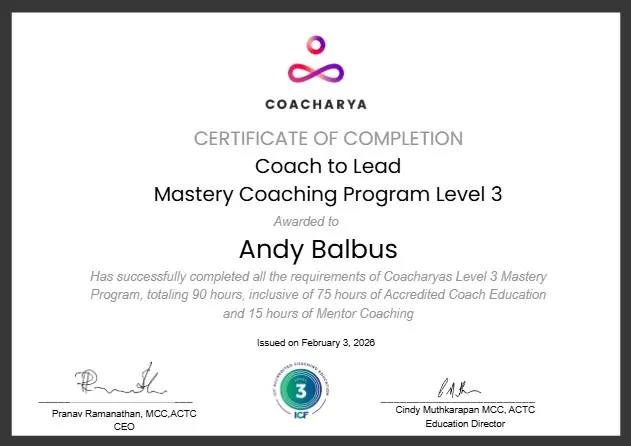
Credentials
The Structural Problem Does Not Respond to Effort. It Responds to Precision.
The most common mistake leaders make when they feel the gap is to work harder. More hours, more meetings, more personal accountability. The effort is real. The structural problem does not move.
A Chief Firefighter Director who resolves five escalations a day, each consuming ninety minutes, loses 37 strategic hours per week. Not because they are not working. Because the system around them is producing the wrong work. One coaching engagement that closes that structural gap pays for itself in the first recovered month.
The ICF documents a median ROI of 7:1 for structured executive coaching. That return materializes in three areas: decision quality, strategic time recovered, and the ability to influence outcomes without direct authority.
Regularly on site: Bamberg, Nuremberg, Zapfendorf, Bratislava, Prievidza, Barcelona, Pune, Mumbai, Shanghai, Querétaro, and Pittsburgh.

What Changes After Executive Coaching.
12 executives coached through a critical growth phase. The Brose Training Academy in Pune built from scratch.
Professional boundaries set clearly. Not one relationship lost.
FAQ - Frequently Asked Questions
Q1: What makes coaching with Andy different from any other executive coach?
Most executive coaches bring methodology built from observation. Andy brings methodology built from doing. Director of Electronics in Prievidza. Senior Manager in Pune. Ten years as a technical coordinator building teams across India, Mexico, and China without a single disciplinary report.
He has been the engineer who could not let go, the coordinator who worked through the night to save a project, the director who learned the hard way that the schematic does not open the headcount line. That operational depth is not a credential on a slide. It is the source of the question in the session that changes something. The coach who has been in your exact room asks a fundamentally different question than one who has studied it from the outside.
Q2: What is ICF certification and why does it matter for me?
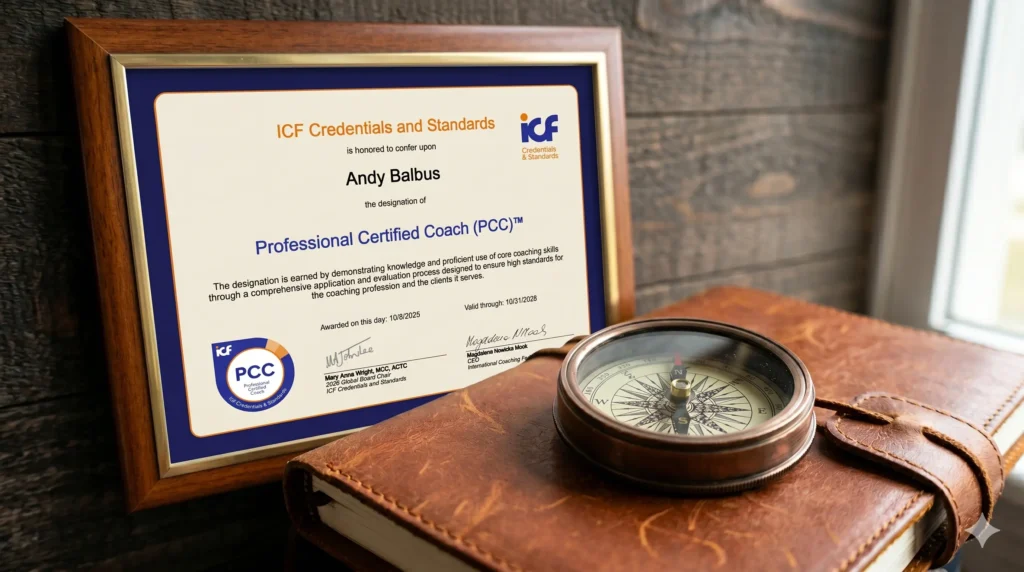
The International Coaching Federation is the global professional standard for executive coaching, covering ethics, methodology, and documented coaching hours. ICF PCC, Professional Certified Coach, requires a minimum of 500 documented client hours, 10 hours of mentor coaching, and a rigorous performance evaluation against ICF competencies.
Andy holds PCC and is on the path to MCC, Master Certified Coach, the highest ICF designation. This matters to you for one concrete reason: the ICF Code of Ethics is the contractual framework that protects your confidentiality. Nothing discussed in a session can be shared without your explicit consent. The credential is not a quality signal in the abstract. It is a structural protection for the kind of honest conversation that is not possible in any other room in your organization.
Q3: What is the actual value of coaching? What will be different after?
The clearest way to describe the value is in terms of what stops costing you. A director still carrying every escalation personally is spending 30 to 37 strategic hours per week on work the team should own. A CEO making decisions without an honest sounding board is systematically narrowing their best thinking at exactly the moment the stakes are highest. A female executive absorbing the Emotional Tax of constant perception management is running a second cognitive job alongside the actual work. Coaching closes each of these structural gaps precisely.
After: the calendar has strategic time in it. The decisions have been genuinely challenged before they were made. The boundary holds without relational cost. None of these are soft outcomes. They are measurable changes in how you operate, visible to the people around you within weeks.
Q4: Andy has an engineering and director background. Can he really coach a CEO or a female executive?
The relevant question is not the background. It is the intersection. Andy has operated at the coordinator level, where authority has to be earned without a title. At the director level, where resources are political and the team depends on your ability to navigate a matrix. And at the personal edge, where the question of what actually matters broke through the operational noise after a health crisis in January 2024.
That intersection, of technical precision, organizational navigation, intercultural intelligence, and the personal experience of having paid a real price for ignoring the signals, is what makes the questions in a session land differently. A CEO who has never had someone in the room who understands what it costs to build something from zero in three countries is missing a specific kind of challenge. That is what Andy brings.
Q5: Why does intercultural experience matter in executive coaching?
Because the patterns that produce leadership gaps look different in different cultural contexts, and a coach who does not know the difference will miss the actual problem. The German director whose Slovak team confirms everything and delivers something different is not facing a delegation problem in the generic sense.
They are facing the Green-Melon Effect, a specific cultural dynamic in which honest escalation is structurally expensive for the person who speaks it. The female executive navigating a German-Indian matrix faces a double layer: the gender dynamics of visibility and sponsorship, plus the intercultural dynamics of deference, hierarchy, and what counts as assertiveness in each context. Andy has lived and worked in Germany, Slovakia, and India. Not as an expat visiting the local office. As the person responsible for building teams, delivering results, and navigating the informal power structures of each. That is a different kind of intercultural intelligence.
Q6: What is the difference between coaching and the Expert Paradox mentoring?
Coaching is a structured process that builds your own awareness and insight through questions. The coach does not advise, direct, or transfer experience. Mentoring is structurally different: the mentor shares what worked, what failed, and what they would do in your exact situation. Both are rigorous disciplines. Andy offers executive coaching under ICF standards for the three paths on this page. He offers industrial mentoring for the four transition tracks on the mentoring hub. The Reality Check identifies which format fits your specific situation.
Q7: How do I know which path is mine?
The widget at the top of this page identifies it in three questions. If you want the direct answer: Director or R&D leader carrying too many escalations is Path 1. CEO or founder with the question that nobody asks is Path 2. Female leader whose output does not translate into advancement is Path 3. If you see yourself in more than one, the Reality Check is the right next step.
Q8: Is coaching confidential?
Fully and contractually. All sessions are held under the ICF Code of Ethics and the PCC professional standard. Nothing discussed is shared without your explicit agreement. This is not a preference or a promise. It is a professional obligation with consequences for the coach's certification if violated.
Q9: What languages is coaching available in?
English and German. Remote. Worldwide.
Q10: How long does an engagement typically run?
No fixed program. Some leaders resolve a specific structural challenge in three to five sessions. Others work across an extended engagement during a role transition or team transformation. No minimum commitment, no upselling.
Q11: What happens in the 30-minute Reality Check?
A direct diagnostic conversation about the specific structural challenge you are currently facing. No slides, no methodology presentation. By the end, you will have identified at least one structural gap you were not able to see from inside your own system. Andy tells you directly whether and how coaching addresses it. No commitment required.

The Blind Spot Is Visible From the Outside. Thirty Minutes Is Enough to Name It.
The structural gap that is costing you strategic time, influence, or career trajectory is almost never visible from inside the system producing it. The 30-minute Reality Check is the conversation where it gets named.
No slides, no methodology presentation, no sales agenda. By the end, you will have identified at least one structural gap you were not able to see from inside your own system.
No commitment required. Confidential. Available in English and German. Remote. Worldwide.
Or directly: founder_andybalbus@boost-your-growth.com | WhatsApp: +49 151 4495 7099

The Reality Check is remote and works across every time zone you operate in. Across three dedicated pathways e.g. for CEOs, Directors, and Female Leaders, the practice supports executive leaders and decision-makers throughout Germany, Austria, Slovakia, the Czech Republic, Poland, Spain, and across Europe, as well as the USA, Mexico, China, and India. Wherever your headquarters, your plants, or your hubs sit, the room travels with you.
Systemic leadership does not end after one call.
Follow for unfiltered insights and straight-talk strategies:


