
You Are Not Here to Be Fixed. You Are Here to Get the Map the System Never Gave You.
Your output is unassailable. The projects land. Your team trusts you. And still, in the meetings that determine who leads what next, someone else is being named. You have watched this happen often enough to know it is not about the quality of your work.
The informal rules of this system (who gets visibility, who gets sponsored, who gets heard) were written before you were in it. Coaching does not change you to fit the system. It gives you the precise structural map to navigate, influence, and lead on your own terms.
Target Audience: Directors, R&D Leaders & Senior Executives in Tech, Pharma & Industry
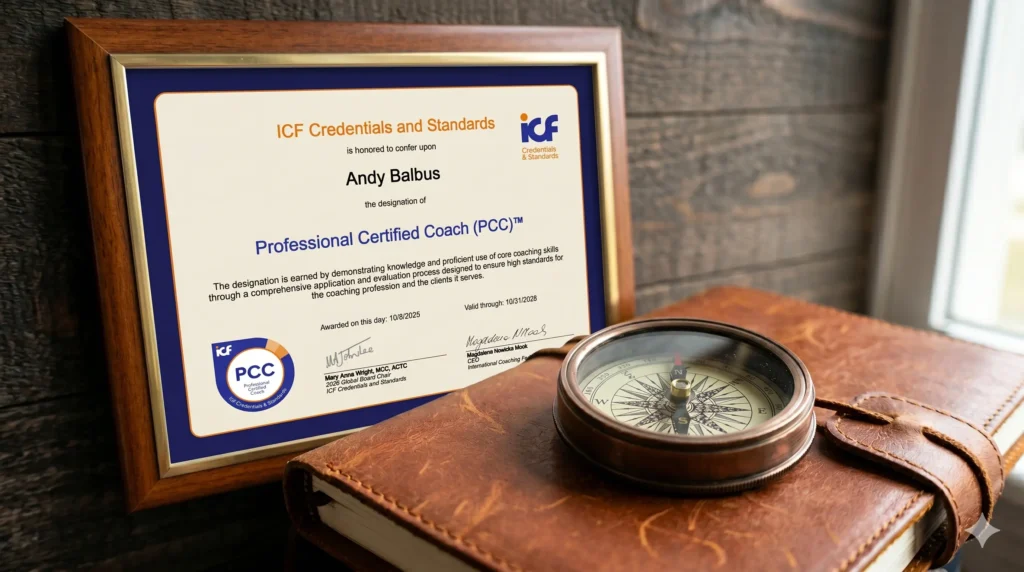
Credential: ICF PCC Certified | 25+ Years Director-Level Operations Experience
Setup: 100% Confidential | Remote & Worldwide Delivery
The clarity that years inside a demanding organization had not produced.
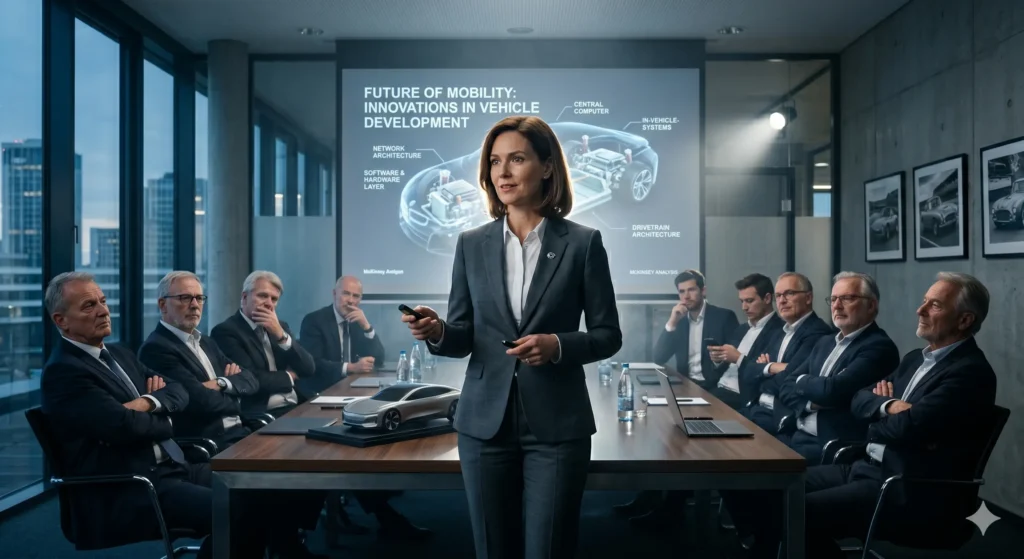
Which Situation Is Yours?
Three very different women read this page. Their situations are different. The structural cause is the same.

You Know Which Room This Is.
When Your Best Ideas Are Only Heard When Spoken by Someone Else
A decision already made before the agenda item was opened. The pre-meeting that happened before the meeting. The moment someone restated your exact point and the room responded as if it was the first time the idea had been spoken.
Too Aggressive vs Lacking Conviction
Perhaps you have tried asserting yourself more directly and been told you were aggressive. Perhaps you have softened your approach and been told you lack conviction. The feedback does not add up because the system is measuring you against a standard that was never written down and was not designed for you.
The Chief Firefighter Trap: Why Saying No Costs You More
Or the pattern is quieter: you are absorbing tasks that belong to colleagues because you have learned, through a hundred small signals, that the cost of saying no is higher for you than it is for the person next to you. The Chief Firefighter pattern is slowly consuming the bandwidth that belongs to your actual work.
Why Honest Escalation Costs Female Leaders Career Years
Or it shows up as Malicious Obedience: following directives you know are wrong because the room has made honest escalation structurally expensive. The same Green-Melon dynamic that costs engineering teams SOP weeks costs female leaders career years when the cost of honest escalation falls disproportionately on the person who speaks.
It Is Not a Confidence Deficit: You Need a Structural Map
This is not a personality problem or a confidence deficit. It is the Second-Generation Gender Bias that Harvard Business Review has documented precisely: organizational structures and informal networks built for someone else. Coaching does not fix you. It gives you the structural map.

The measurable ROI of structural executive coaching, backed by McKinsey, LBS, and ICF research.
The Emotional Tax alone, the cognitive overhead of managing how you are perceived while doing the actual work, is the equivalent of running a second job without pay or recognition. Removing it does not just feel better. It frees bandwidth that becomes available for strategic thinking, for visibility, for the conversations that actually move careers.

Transatlantic Strategic Reach for International Executives Built for female leaders navigating cross-continental growth and international teams, our coaching adapts seamlessly to your global schedule. We empower executives with active mandates across Spain, Europe, the USA, and Mexico, partnering both remotely and on site from strategic hubs like Barcelona to industrial centers like Querétaro and Pittsburgh.
This Is Not a Program to Help You Fit In.
There is a category of coaching and leadership programs for women that rests on an implicit assumption: that the problem is in the woman, and that success means learning to behave more like the dominant group. Management publications call this the Fix the Women trap.
You do not need to be more assertive in a different way, more strategic in a different tone, or more visible through a different persona. You need the precise operational intelligence about how this specific system actually works: who makes the informal decisions, where the sponsorship is actually built, what the unwritten rules are and who enforces them. That intelligence lets you move through it deliberately, as yourself.
That intelligence comes from someone who was inside the decision-making machinery for 25+ years. Not observing it. Making hiring decisions, promotion decisions, and structural decisions inside it. That is a different kind of knowledge, and it is the source of the questions this coaching asks.
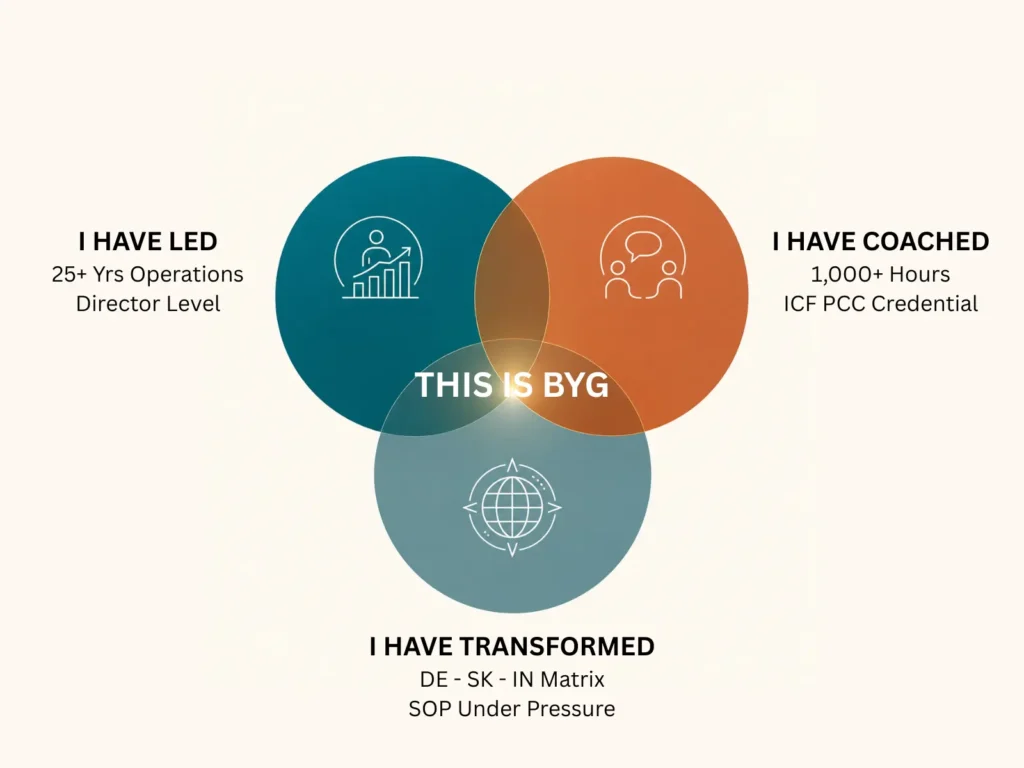
25+ Years Inside the Machine. What I Watched Happen.
Why an Executive Insider Perspective Matters for Female Leaders
Let me be upfront: I am a man. While this is certainly not a qualification for the work I do now, it remains a highly relevant fact that I want to address directly.
For over 25 years, my career was built at the decision-making level within the automotive and industrial sectors. Whenever crucial hiring choices were on the table, I was in the room. Long before the official gatherings began, I participated in the pivotal pre-meetings. Ultimately, I witnessed firsthand how strategic decisions were truly shaped behind closed doors in executive boardrooms and at informal dinners.
The Structural Gap Between Doing the Work and Getting the Credit
I watched a Serbian project engineer in Prievidza carry a project that a German male project leader was formally responsible for. No leadership title, no formal mandate. What she had was initiative, supplier relationships she had built herself, and a willingness to work the hours nobody asked her to work. She tracked down the missing deliveries, managed the suppliers directly, and brought the project back on track. When the project closed successfully, her name was not the one that appeared in the debrief.
Decoding How Informal Networks Translate Female Output Into Trajectory
I watched technically excellent women be consistently underread across six countries and over two decades. Not because their output was weaker. Because the informal mechanisms that translate output into visibility, into sponsorship, into career trajectory, were calibrated for someone else. I could not fix the system from inside. But I understood it precisely. That understanding is what I bring into this coaching work.
The Physical Mechanics of Executive Presence in Male-Dominated Rooms
Beyond the operational knowledge: as a competitive dancer, I learned the precise mechanics of asserting presence against physical and hierarchical superiority. How authority is established through timing, through the claim of space, through the body before words are spoken. Leadership presence in male-dominated environments operates on the same mechanics. The coaching makes those mechanics visible, learnable, and yours.

What Changes When the Boundaries Are Clear.
Michaela, Project Manager, automotive OEM Slovakia.
The Quiet Burden of the Chief Firefighter Pattern
Technically strong, reliable, deeply committed to the work. When colleagues in her project did not do their part, she did not push back. She took it on herself instead. Quietly, without drama, she solved what others had left unsolved. The project moved forward. The weight was entirely hers.
Why Absorbing Workload Replaces Direct Confrontation
This is the Chief Firefighter pattern as it manifests for women in technical environments. The path of least resistance is to absorb rather than confront, because the cost of confrontation falls disproportionately. The result is a workload that belongs to everyone else’s failures, and a growing exhaustion that has nothing to do with the actual job.
The Specific Language of Setting Clear Boundaries
What the programme gave Michaela was the specific language to hold a boundary, communicate it professionally, and maintain the relationships that mattered while doing it. In her own words: she learned to set professional boundaries and present them clearly, without apology and without losing a single relationship.

What Changes When You Stop Managing Yourself and Start Leading.
Ioana, Your Power Within alumna.
The Hidden Cost of Managing Your Own Perception
The pattern Ioana brought into the programme was not unusual for women in technical leadership. She was performing at a high level. She was also spending a significant amount of her cognitive bandwidth managing her own perception in every room, every meeting, every conversation. Not because she was insecure. Because the system had trained her to.
From Unnamed Pressure to Strategic Control
Six weeks of structured work in a cohort of women navigating the same dynamics changed the relationship to that pattern. Not by eliminating the pressure, but by making it visible and named. A named pressure is a pressure you can choose a response to. An unnamed one simply operates.
A Safe, Structured Space for Real Executive Growth
Ioana described what followed not as a confidence improvement but as a space: the safe, supportive environment surrounded by women who understood the specific pressures, combined with the structured framework for understanding her own patterns and changing her response to them.

Four Specific Structural Challenges. One Coaching Framework.

Where Are You in the System?
These five questions are not about friction. They are about mapping the specific structural gaps that are costing you visibility, sponsorship, and advancement in your specific organizational context.
Where Is the Real Friction?
Five questions, two minutes, a clearer picture of which structural gap is costing you most.
1 of 5: How frequently is proper credit given for your individual contributions during organizational discussions?
2 of 5: To what extent are you integrated into the informal, behind-the-scenes decision-making networks within your organization?
3 of 5: What proportion of your cognitive bandwidth is allocated to impression management, distinctly separate from executing core responsibilities?
4 of 5: To what extent are you supported by a high-level sponsor who actively champions your career trajectory behind closed doors?
5 of 5: How do interpersonal dynamics within your workplace typically evolve after you enforce a firm professional boundary?
The Imposter. The Perfectionist and the Avoider.
Drawing from Shirzad Chamine’s Positive Intelligence framework, we call these internal critics "Saboteurs." No high-performer is completely immune to them. For women leading in male-dominated technical fields, however, three specific profiles dominate the landscape.
Common Career Saboteurs for Women in Technical Leadership
The Perfectionist Saboteur in Female Technical Leadership
Driven by an unreachable bar of excellence, the Perfectionist convinces you that your work is never quite flawless enough to present. This dynamic guarantees unacknowledged overdelivery: your baseline output already exceeds expectations, yet the transformative work that would actually elevate your profile remains permanently stuck in draft mode.
The Avoider Saboteur: Deferring Executive Salary & Conflict
Deferring tough conversations and salary negotiations indefinitely, the Avoider doesn't act out of avoidance, but rather from a calculated risk assessment that speaking up is more dangerous than staying quiet. The danger here lies in the compounding effect of time; a necessary dialogue skipped in 2022 quickly turns into a severely compromised negotiation in 2024.
The Imposter Saboteur: Overcoming the Re-Entry Barrier
Convinced that everyone in the room will instantly spot a career pause or a gap in technical expertise, the Imposter is exceptionally loud during re-entry phases. While this voice almost never tells the truth about your actual competence, it provides an invaluable roadmap for where our coaching focus needs to be.
Executive Coaching: Transforming Reactions into Leadership Presence
Far from being the enemy, your Saboteurs are simply obsolete emotional armor. Because they cannot be permanently silenced, our coaching focuses on empowering you to identify them, call them by name, and consciously pivot. Making that crucial leap from knee-jerk reaction to intentional choice is what fundamentally changes your outward leadership presence.
Why Operational Intelligence Matters More Than Sympathy.
Overcoming the Stigma of "Asking for Help"
There is a specific resistance many technically excellent women carry into the question of coaching. Not about money or time. About what asking for support signals in a system that has taught, through a hundred small signals, that needing anything is a liability.
From "Requesting Help" to Acquiring Strategic Intelligence
That resistance is worth naming directly, because it is itself one of the structural patterns coaching addresses. Recognizing coaching not as a request for help but as the acquisition of strategic intelligence about an environment you are operating in changes the frame entirely. The executives who perform best in complex organizational systems are not the ones who figure everything out alone. They are the ones who build the most precise map with the most reliable inputs.
The Identity Workspace: Why Advice and Community Are Not Enough
Harvard Business Review research on Identity Workspace shows that female leaders navigating transitions in historically male environments need a specific kind of structured space: confidential, outside the organizational hierarchy, designed to build a leadership identity that is genuinely their own rather than an adaptation of the dominant model. Mentors give advice. Peer networks give community. Coaching gives the Identity Workspace.
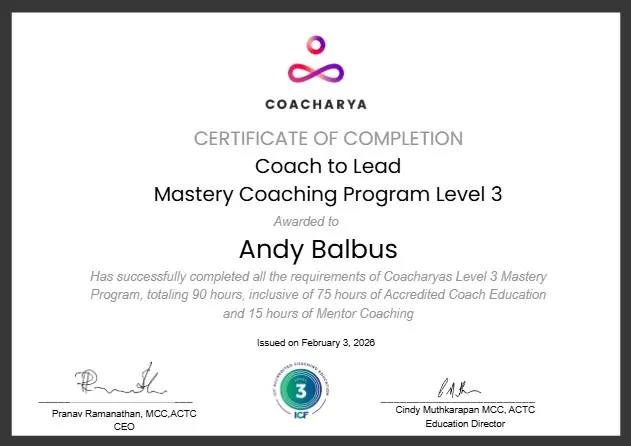
A Word About Working With a Male Coach.
This is a legitimate question and you should ask it directly rather than carry it as an unspoken hesitation.
The Executive Insider Advantage: 20+ Years in Decision-Making Rooms
Navigating complex corporate systems requires someone who has spent more than two decades operating at the highest decision-making levels. Throughout my career, I was in the rooms where crucial choices regarding hiring, promotions, and structural changes affecting women’s careers were made. Because I was part of the very group operating within these structures, I know exactly where the informal networks truly thrive. My firsthand participation in cultivating sponsorships means I can share the precise blueprint of how they are formed.
Operational Intelligence Over Sympathy
That is not sympathy. It is operational intelligence. And operational intelligence is more useful to you than sympathy.
Absolute Transparency: Individual Sparring and Female Co-Facilitation
What I do not bring is the lived experience of being a woman in these systems. Where that lived experience matters, my colleague Lucica Ibanescu, ICF ACC, brings it in the Your Power Within group programme, which I co-facilitate with her. Individual coaching is with me. If you are looking for a female coaching partner for the individual track, the Reality Check is the right conversation to have that directly.

Individual Coaching or Your Power Within?
Track 1: 1-on-1 Executive Coaching (Confidentiality & Maximum Depth)
Individual coaching is one-to-one, fully confidential, built entirely around your specific organizational situation. It is the right choice when the structural challenge is specific to your context, when confidentiality is paramount, or when the depth of work required is beyond what a group format can hold.
Track 2: Your Power Within (6-Week Peer Cohort & Community)
Your Power Within is a structured 6-week cohort programme, co-facilitated with Lucica Ibanescu, ICF ACC. It addresses the structural challenges of female leadership in technical environments through a combination of Positive Intelligence methodology and group peer learning. The cohort dimension adds something individual coaching cannot: the recognition that comes from a room full of women navigating the same dynamics. Maximum eight participants per cohort.
Flexible Entry: No Fixed Sequence Required
Some women come to individual coaching first and find the programme a useful complement for community and peer learning. Others start with the programme and move to individual coaching for depth on their specific situation. There is no required sequence.

What the Coaching Actually Looks Like.
Zero Fluff: No Worksheets, Just Precise Operational Diagnostic
Every session begins with a precise, open question about what is actually in the way. No worksheet, no framework presentation, no personality assessment delivered in advance. A question that someone who has been inside your system for 25+ years knows to ask, and that you have probably not been asked before.
100% Confidential, Remote, and Available Worldwide
Sessions are 60 to 90 minutes, remote, confidential, available in English and German. Nothing discussed leaves the room without your explicit agreement. ICF PCC standard, worldwide.
Flexible Engagement Pace for Transitions, Re-Entry, or Acute Friction
The engagement has no fixed length and no fixed program. Some leaders work through a specific structural challenge in four to six sessions. Others work across an extended engagement during a role transition or a re-entry. The pace and focus are set by what is actually in the way.
A Note for HR Directors: Systemic Friction Over Personal Gaps
If you are reading this on behalf of a high-potential female leader in your organization: the structural challenges described on this page are not individual development gaps. They are systemic patterns with measurable career costs. The investment in individual coaching or the Your Power Within programme is the most precise and cost-effective instrument available for closing the sponsorship gap and reducing the Emotional Tax on your female talent pipeline. The Reality Check conversation can be initiated by HR on behalf of the leader, or directly by the leader herself.
FAQ: Direct Answers to the Questions Executive Leaders Ask.
Q1: Why work with a male coach on this topic?
25+ years of operating inside these systems at decision-making level produces operational intelligence that is directly relevant. I was making the hiring decisions, the promotion decisions, the pre-meeting alignments. I know how the informal network functions from the inside. That is not sympathy or solidarity. It is structural knowledge. Where the lived experience of being a woman in these systems matters, my colleague Lucica Ibanescu brings it in the Your Power Within group programme.
Q2: Is this coaching only for women in automotive?
No. The structural patterns it addresses appear across tech, pharma, financial services, and any industrial or technical environment where leadership was historically male-dominated.
Q3: I have been away from work for a year or more. Is this coaching right for re-entry?
Yes. Re-entry after a career pause is one of the most specific situations this coaching addresses. The Saboteurs, especially the Perfectionist, the Avoider, and the Imposter, are typically loudest in re-entry situations. The coaching builds the specific map for your re-entry context: where your actual re-entry point is, what the informal system looks like now, and how to navigate the first conversations without the Saboteurs driving the decisions.
Q4: What is the Second-Generation Gender Bias?
Research from Herminia Ibarra at London Business School defines it as organizational practices that equate leadership with behaviors culturally associated with men. Not open discrimination, but informal networks, sponsorship patterns, and visibility mechanics built before women were in the room.
Q5: What is the Emotional Tax?
Emotional Tax is Catalyst's term for the burden of staying on guard against bias at work and the toll it takes on wellbeing and the ability to thrive. For women in male-dominated technical environments, it shows up as the cognitive bandwidth spent managing perception in every room. It does not appear in performance reviews. It appears in the gap between what you produce and what you have to show for it, and in burnout statistics and exit interviews.
Q6: What are Saboteurs and how does coaching address them?
In the Positive Intelligence framework, Saboteurs are the inner patterns, Perfectionist, Avoider, Imposter, Hyper-Rational, and others, that undermine performance and wellbeing. Coaching builds the capacity to recognize them when they activate, name them, and choose a deliberate response rather than an automatic one. In a re-entry context or a high-visibility transition, this shift is often the most immediate source of relief and behavioral change.
Q7: How does coaching address the sponsorship gap?
The mechanics of moving from mentored to sponsored are learnable and specific. Coaching maps the specific relational strategy for your organizational context: who holds real sponsorship power, where the access points are, and how to build the relationships that produce active advocacy rather than passive goodwill. The 2025 McKinsey data is clear: employees with sponsors are promoted at nearly twice the rate of those without.
Q8: I already have a mentor. How is this different?
Mentors give advice. The McKinsey 2025 data is precise: having a mentor is not the same as having a sponsor, and it is sponsors, not mentors, who drive promotion. Most women in technical environments have more mentors than they need and fewer sponsors than the situation requires. Coaching builds the specific relational strategy that closes that gap.
Q9: What is the difference between individual coaching and Your Power Within?
Individual coaching is one-to-one, fully confidential, tailored entirely to your specific situation. Your Power Within is a 6-week structured group programme co-facilitated with Lucica Ibanescu, ICF ACC. Both address the structural map. The group programme adds peer connection and the specific Positive Intelligence methodology for working with Saboteurs. The Reality Check clarifies which fits your current situation.
Q10: What is the investment?
The commercial conversation happens in the 30-minute Reality Check, where both parties understand what the work involves before any commitment is made.
Q11: What languages is coaching available in?
English and German. Remote. Worldwide.
Q12: What happens in the 30-minute Reality Check?
A direct diagnostic conversation about what is actually in the way. Not a sales call, not a chemistry test. By the end of it, you will have at least one question you have not been asked before. No commitment required.

The Structural Map Exists. Let Us Put It in Your Hands.
You have been navigating this system long enough to know that more effort does not close the gap. Whether you are delivering at the level of the next title... or returning from a pause: the structural intelligence about your specific situation exists. The coaching puts it in your hands.
The 30-minute Reality Check is where we start mapping it. Remote. Confidential. English or German. No commitment required.
Or Directly: Email: founder_andybalbus@boost-your-growth.com | WhatsApp: +49 151 4495 7099
Looking for a Different Executive Track?
When transitioning from technical expert to people leader:
Engineering Leadership Coaching: Overcoming the Expert Paradox ›
When navigating board-level responsibility and top-level governance:

Systemic leadership does not end after one call.
Follow for unfiltered insights and straight-talk strategies:


