
Someone Falls Out. The Load Lands Entirely on You. That Is Not Leadership. That Is a Diagnosis.
Friday afternoon. Your strongest engineer just called in sick for next week. The customer review is on Wednesday. And there is no one, not one single person on your team, who can hold the thread.
The Structural Exposure of the “Hero” Leader
Specifically, that moment is not a crisis; it is a structural exposure. The team you built, with real capability and real commitment, has one critical dependency: you. You are the backup for every workstream, the escalation target for every decision, and the institutional memory that holds the thread when it frays.
However, nobody asked you to build it that way. It happened gradually, while the team grew and the role expanded around you.
When Small-Team Instincts Become the Bottleneck
Consequently, you have probably stopped counting the evenings. You tell yourself it is temporary, until this one project ships or until that one position is filled. But the next peak arrives before the last one fades. Instead of resolving, the weight you carry becomes invisible because it has become the norm. That is the quiet exhaustion that produces no sick note and no award.
The instinct that made you excellent as a small-team leader is now the structural problem. Knowing every detail, being the person with the answer, and carrying the load personally creates a bottleneck. Ultimately, the longer it runs uncorrected, the more expensive the next absence becomes.

The Day the Competition Bought My Team.
I did not learn that this dependency is real from a management book. Specifically, I learned it in a single quarter in Prievidza, Slovakia.
The Poaching of a Functional Cluster
A direct competitor made an offer nobody could refuse and began systematically recruiting from my department. Not one engineer. Not two. Engineer after engineer left until an entire functional cluster had accepted offers. The compensation packages were extraordinary, and I was not angry with a single person who left. They made the right decision for their families.
However, I faced a massive project portfolio that still required delivery, while the engineers who built the technical foundation now worked for someone else.
The Power of Cross-Departmental Networks
Peter was the quality manager in a different department. He had nothing formally to do with my electronics projects. But he understood the work, he understood the urgency, and he was willing to step across the departmental boundary. Consequently, his team covered the critical gaps while I rebuilt my own structure.
Building Structural Resilience
The lesson was not about crisis management. Instead, it was about something I had not invested enough in before the crisis hit. I lacked relationships outside my own silo. The leaders who survived that period in Prievidza were not the ones with the deepest technical expertise within their own team. They were the ones who had built real relationships with peers who had no obligation to help but chose to anyway.
After that, I fundamentally changed how I built teams. I stopped focusing purely on technical capability within the department. Ultimately, I prioritized the network outside it, fostering relationships that would hold under heavy pressure and developing deputies who could carry the thread. That specific shift made the department structurally resilient in a way that pure technical depth never could.

The Numbers Behind the Pattern.
Personal experience has a measurable, financial side. Specifically, these four figures come from public, checkable sources, and they explain why a single point of failure is not a feeling, but a quantifiable corporate risk.

How resilient is your team without you?
Five questions, two minutes. A clear picture of how much runs through you alone, and where the first structural move is.
1 of 5: If your strongest engineer called in sick for a week, what happens to the critical workstream?
2 of 5: How many people outside your department would genuinely step in for you under real pressure?
3 of 5: How many decisions in your team ultimately route back through you?
4 of 5: How often do evenings or weekends disappear because you absorb what the structure cannot hold?
5 of 5: When you hand your team real decision-making authority, how do they respond?
The Right Instrument for This Transition.
Mentoring, Not a Course or a Book
A leadership course gives you a framework for the average team lead. A book gives you principles for a generic situation. Neither knows your team, your matrix, or the specific engineer who is about to leave if the structure does not change in the next three months.
Mentoring is structurally different. In every session, the work starts with your specific situation: the escalation that landed on your desk this week, the deputy who is not yet ready, and the peer relationship you have not invested in. You leave every session with concrete, actionable next steps, not abstract principles.
What Andy's Experience Gives You
You get a mentor who has navigated every level you are currently facing and knows from the inside what each level costs when structures are not built deliberately.
As a team lead, he carried the same load you carry now: every escalation, every absence, and every decision queued at his desk. When you describe the Friday afternoon where a key engineer called in sick, he does not need an explanation because he has been in that room.
Battle-Tested R&D Scale-Up & Structural Leadership
Engineering Redundancy and Cross-Border Alignment Across DE, SK, and IN
- 90-Day Redundancy Architecture: Built concrete delegation structures that allowed an electronics department to survive when competitors poached half the team.
- DE-SK-IN Matrix Expertise: Absorbed the cross-cultural intelligence across Germany, Slovakia, and India that matrix leads never receive explicitly.
- Decoding Alignment Nuances: Knowing exactly when an Indian colleague's yes means commitment versus when it signals hierarchy pressure.
The Cost That Never Reaches a Spreadsheet
The figures above are the visible half. However, the other half never reaches a spreadsheet, and it lands on you personally.
The constant vigilance of being the backup for everything consumes attention that is never booked as effort. It shows up in Sunday-evening irritability, the sense of never truly being off, and the slow erosion of enthusiasm. That is not the cost of leadership; it is the cost of a structure built without purpose.
Every month without a deputy is a month where the next absence exposes full structural vulnerability. The investment in the right structure is therefore not measured against the cost of mentoring. It is measured against the cost of the crisis that arrives before the structure is ready.

Why the DE-SK-IN Matrix Adds Structural Complexity.
If you lead across borders, you carry a redundancy risk that purely local teams do not: the cultural and geographic dimension of absence. In Germany, engineers sometimes come in mildly unwell because they feel the obligation to be present. The risk there is different: the colleague who should have stayed home spreads the problem across the team.
Cultural Logic and Absence Dynamics in Germany vs. India
In India, the dynamic is structurally different. When a parent or family member requires care, the work is genuinely secondary. This is not a reliability issue. Specifically, it is a value system in which family comes before project milestones, and it is consistent and predictable once you understand it. However, the team lead who has built genuine redundancy navigates this without a crisis. The one who has not absorbs the collapse personally.
Understanding the cultural logic behind absence patterns, escalation behavior, and accountability signals in each country is not optional knowledge for a team lead in a DE-SK-IN matrix. Consequently, it is the operational intelligence that makes redundancy planning actually work, feeding directly into the core mentoring framework.

What the Mentoring Builds.
Tactical Guidance, Absolute Mentee Ownership
A head coach can analyze the opponent, design the strategy, and build personal resilience. However, the coach never steps onto the pitch to score the goal.
Mentoring operates on the exact same reality. You receive battle-tested frameworks, strategic clarity, and an unfiltered sounding board. Specifically, the execution, decision-making, and ultimate ownership remain entirely in your hands.
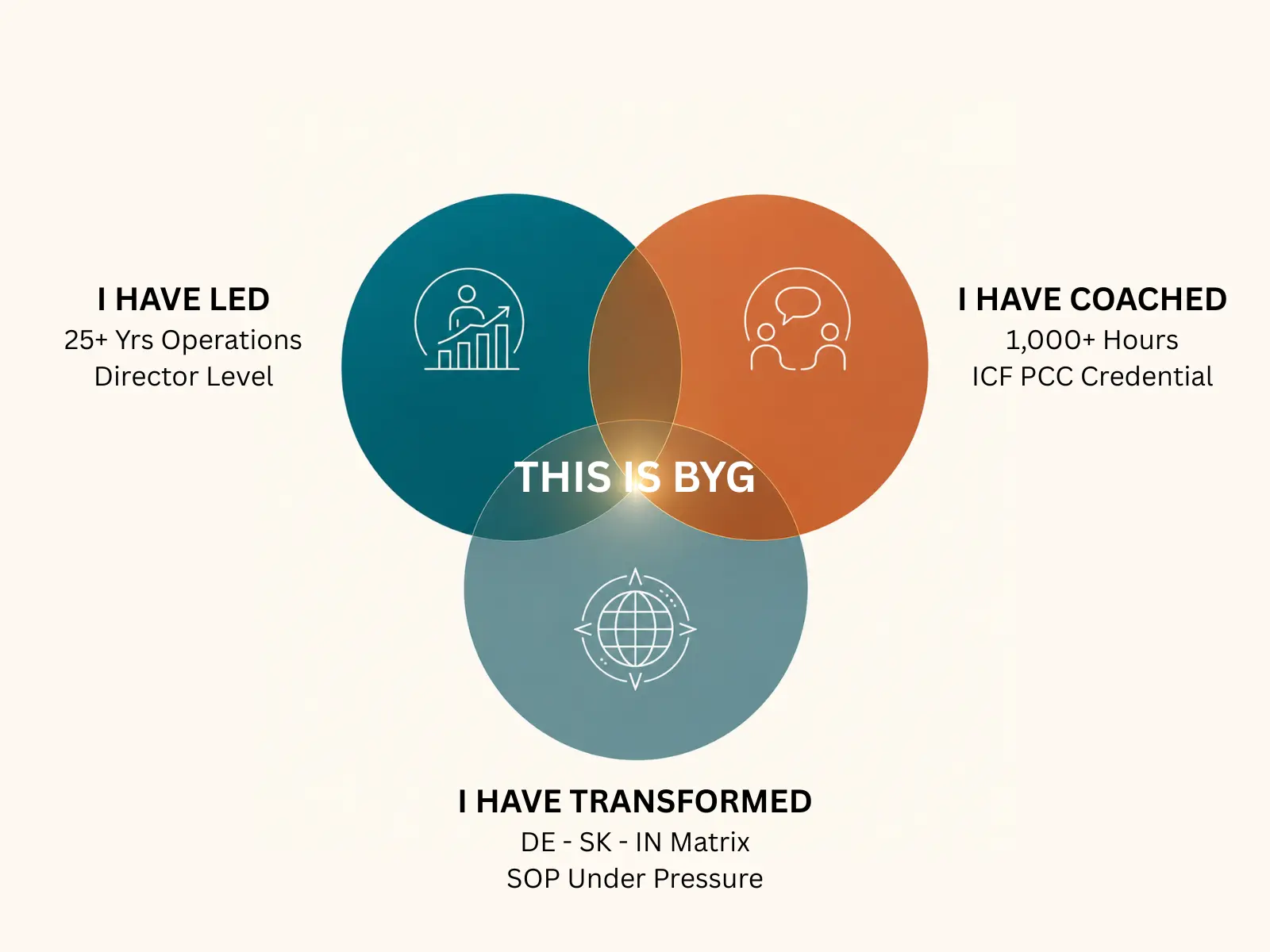
Why BYG Consulting: The Intersection of Three Worlds
Internal mentors are often constrained by organizational politics. Generic coaches, on the other hand, lack real director-level operational power.
Andy Balbus BYG Consulting delivers what neither can provide: the exact intersection of operational director experience, certified coaching methodology, and deep intercultural matrix leadership. Having lived, worked, and led across distinct cultures (Germany, Slovakia, and India), Andy bridges local operational realities with global headquarters strategy. Consequently, you get an unvarnished, objective perspective that internal peers simply cannot offer.
Verifiable Track Record & Client Endorsements

The 90-Day Redundancy Plan.
The most practical starting point for building strategic redundancy is a structured 90-day plan. Specifically, it identifies, develops, and stress-tests a qualified deputy for each critical workstream.
Structured Execution: The 3-Phase Delegation Framework
- Phase 1: Days 1 to 30 (Diagnostic & Decision Mapping)Mapping every decision type that currently requires your personal judgment. Consequently, we identify one high-potential engineer per workstream to hold future authority.
- Phase 2: Days 31 to 60 (Deliberate Ownership Transfer)Transferring ownership of lower-stakes decisions deliberately to identified deputies. This includes explicit conversations about authority boundaries and clear escalation triggers.
- Phase 3: Days 61 to 90 (Controlled Stress Testing)Creating conditions where deputies carry authority alone. By being genuinely unavailable for specific decision types, we observe how the structure holds. Ultimately, what breaks during a controlled test is far cheaper to fix than what breaks in a real crisis.

Building the Network Beyond Your Silo.
The most resilient teams are not the ones with the deepest internal capability. Specifically, they are the ones whose leader has built real relationships with peers across the organization. The Prievidza experience proves that cross-silo network investment is what saves a department under pressure.
Three Habits for Cross-Silo Resilience
- Proactive Peer Visibility: Building consistent visibility with leaders who work on adjacent operational problems.
- Bilateral Resource Alignment: Maintaining regular dialogue with peers whose capacity you might need during an escalation.
- Deliberate Follow-Through: Ensuring peer support is acknowledged and reciprocated so that relationships have a proven track record.
Delegation as an Architecture, Not a Task
Delegation is not a one-time action. Instead, it is a practice requiring a structured framework, defined accountability, and the patience to let someone work through a problem. The mentoring transfers the exact delegation architecture built when scaling an R&D department without becoming its permanent technical bottleneck.

What happens when a team member brings you a problem they could solve themselves?
When you delegate, do you transfer the strategic context, the Why this task is critical for the SOP or OEM goal?
Do your delegated tasks carry three non-negotiable guardrails: time limit, resource limit, escalation trigger?
If your most important delegate is absent tomorrow, who takes over their tasks without production loss?
If you were unreachable for three months, would your team continue independently and without critical errors?
Does your team make decisions independently, or does it wait for your approval?
I was that manager myself. At 11 PM I sat at my laptop doing tasks my team in Slovakia should have owned. When I later spoke with them, I realised I had delegated the What but never the Why. The real question was not how to let go better, but why I had built a system that did not work without me.
What Distributed Leadership Actually Feels Like.
Leaders who have built genuine strategic redundancy describe the transition in consistent terms. Specifically, the journey moves through four distinct operational phases.
The 4 Milestones of Autonomous Leadership Transformation
- Sign 1: Productive Discomfort
Watching someone make a decision differently than you would have, and choosing deliberately not to intervene. This is uncomfortable for a technically precise leader, yet essential for growth. - Sign 2: Independent Crisis Management
The first operational crisis the team handles without your direct intervention. Not perfectly, but competently and without escalating to your desk. - Sign 3: Emerging Team Innovation
Realizing your team has developed a creative solution you would not have found yourself, simply because they were given the autonomy to explore it. - Sign 4: Reclaimed Strategic Capacity
Escalations drop significantly, strategic calendar space opens up, and Sunday evening finally feels like a Sunday evening again. The buried enthusiasm returns because the structure no longer hangs on one single person.

Frequently Asked Questions: Executive Mentoring & Matrix Leadership
Q1: My team is still small. Is this relevant now?
The structural habits form early. A team lead with five people who has not built redundancy will scale those habits to fifteen, then thirty. The investment in changing the pattern now costs a fraction of what it costs to correct at scale.
Q2: How is this different from a delegation workshop?
A workshop gives you a framework for a generic situation. The mentoring gives you that framework applied to your specific team, your specific people, and the specific situations you are currently navigating. The transfer is operational, not conceptual.
Q3: What if my team is not ready to take more ownership?
That is the most common starting point. Readiness is not a fixed property. It is built through deliberate development, clear accountability, and the leader's willingness to let people work through problems independently. We address this directly in the first sessions.
Q4: What about the cross-cultural dimension in a DE-SK-IN matrix?
The cultural dimension adds significant complexity to delegation and redundancy. What works for a German engineer does not automatically work for an Indian or Slovak colleague. The mentoring is specifically calibrated for the DE-SK-IN triangle from direct operational experience in each.
Q5: How long does an engagement typically run?
Six to twelve months. Initial sessions establish the structural baseline. From there, the work moves through specific situations from your current reality. Within weeks, the 90-day redundancy plan provides the first structured framework you can apply immediately.
Q6: Can I do this while managing an active project?
Yes. The engagements are designed for leaders who are fully operational. Most clients find that active project challenges become the primary material for the mentoring work.
Q7: Is this only for automotive leaders?
No. The team lead scaling challenge appears in every technical industry. The DE-SK-IN intercultural dimension is specific to the BYG toolkit, but the structural challenge of building redundancy and distributed ownership is universal.
Q8: What is the difference between a deputy and a backup?
A backup covers tasks. A deputy carries decision-making authority. The mentoring builds deputies, not backups. The distinction matters because backups extend your dependency. Deputies reduce it.
Q9: What happens when the team resists having someone else make decisions?
Resistance is usually about clarity, not authority. When people understand what they are responsible for, how they will be supported, and what the limits of their mandate are, resistance decreases significantly. We build the specific conversation and structural framework for that transition together.
Q10: How do I convince my organization to invest in this?
Part of the mentoring is building the internal business case together. A cost-of-failure analysis, using Gallup's 200% replacement cost benchmark, typically makes the investment case straightforward. Most organizations that resist are simply not aware of the actual cost of the alternative.
Q11: What happens in the Reality Check?
Thirty minutes. I ask about your current situation, the structural gaps you are navigating, and the outcomes that matter most. At the end, I tell you directly whether this track fits and what the engagement would look like. No commitment required.

Build the Team That Does Not Need You for Everything.
Not because you are not needed, but because you have built a self-sustaining architecture. This frees you to focus on high-impact leadership: developing talent, building cross-silo networks, and driving strategic execution. The 30-minute Reality Check identifies your specific structural gaps and defines your immediate first move.
Direct Executive Contact:
Email: founder_andybalbus@boost-your-growth.com | WhatsApp: +49 151 4495 7099
Related Leadership Methodologies
- Active Listening: Reading the cultural yes before it turns into an operational delay.
- Uncompromising Delegation: The structural framework behind true ownership transfer.
- SMART Goal Setting: Turning delegated authority into clear, measurable delivery agreements.
Alternative Mentoring Tracks
- Director Mentoring: For leaders focused on building multi-team redundancy and distributed ownership.
- Expert to Leader Mentoring: For senior specialists transitioning from technical expert to first leadership role.
- Mentoring for Natural Authority: For project leads and department coordinators managing without formal rank.

Systemic Leadership Does Not End After One Call.
Stay connected for unfiltered executive insights, cross-border matrix strategies, and operational leadership frameworks.


