
Looking away is not an option: your most expensive cost driver sits in your meetings, not in your P&L.
This method is part of the BYG Leadership Toolkit: 28 validated instruments for automotive executives navigating the DE-SK-IN matrix.
This page is for leaders in the automotive matrix who know that unresolved tension in a team is not a soft HR topic, but a hard economic risk. R&D leaders, plant managers, HR directors, and expats of global teams.
One thing up front, unambiguously: engaging in conflict is rarely pleasant. But as leaders, we have a duty to act. Looking away is not an option. The responsibility to protect team culture and collaboration lies with us, and it is not delegable. This conflict leadership responsibility is part of the role, not a question of character.

The Silent Loss: What Conflict Really Costs
Unresolved conflict in technical teams costs automotive companies more than money. It destroys strategic knowledge, lowers implementation speed, and endangers EBIT security. Systematically, daily, unnoticed.
The real problem is often invisible. Your senior engineer does not resign after ten years because he is overpaid, but because he can no longer stand the alignment chaos in the global team. When he leaves, your company loses more than an employee. It loses Industrial DNA that no onboarding program in the world can replace.

What I Learned: A Dismissal That Saved the Team
My name is Andy Balbus. In one of my teams, an employee treated my assistant so aggressively that he brought her to tears. I learned of it not through a formal complaint, but through observation. I immediately brought HR in, and together we opened the conversation.
What we uncovered: behind the behavior sat a deep frustration over unmet salary expectations. The person did the absolute minimum and demanded significantly more pay for it. When we dug deeper, it was clear that not even the hourly contract was being fulfilled. My decision was unambiguous, this person had to leave the company.
Two lessons remain. First, I should have acted earlier, the toxic behavior had already spread to two junior colleagues before I stepped in. Second, the team recovered within days, the energy that had gone into self-protection flowed back into the work.
Do you recognise such tension in your team but have not yet stepped in? Then let us look at it together. The Reality Check is a 30-minute diagnostic conversation, no slides, no pitch. Andy identifies with you the most expensive conflict cost driver in your matrix.

What Conflict Really Costs: The Numbers That Never Appear in a Board Deck
These numbers help decide whether your next SOP date holds. See Effect and Evidence to get Clarity.
From practice in the DE-SK-IN matrix, one thing is hard to capture in a single number: delays at the SOP date more often have an interpersonal than a technical cause. Tension between headquarters and offshore hub, or between R&D and production, are primary drivers of missed milestones and OEM penalties.

The Neuropsychology of Conflict: Why Talking Alone Fails
Conflict does not fail from bad will, but from biology. Under high pressure the brain shifts from the prefrontal cortex to the amygdala, from thinking into fight-flight-freeze mode. That is why “can you please sort this out” mostly does not work, the people involved are not sitting in the rational part of their brain.

The Non-Delegable Leadership Duty
The duty to protect team culture and collaboration cannot be delegated to HR, to a team lead, or to time. HR is an important partner in the process, for legal certainty and fairness, but the responsibility stays with the leader. 70 percent of employees see conflict management as a very or critically important leadership skill (CPP Global 2008), and they rightly expect their leader to exercise it.
Acting does not mean escalating every conflict immediately. It means looking, recognising the pattern, and addressing the structure behind it. Two patterns from the matrix show why the leader is the only one who can.
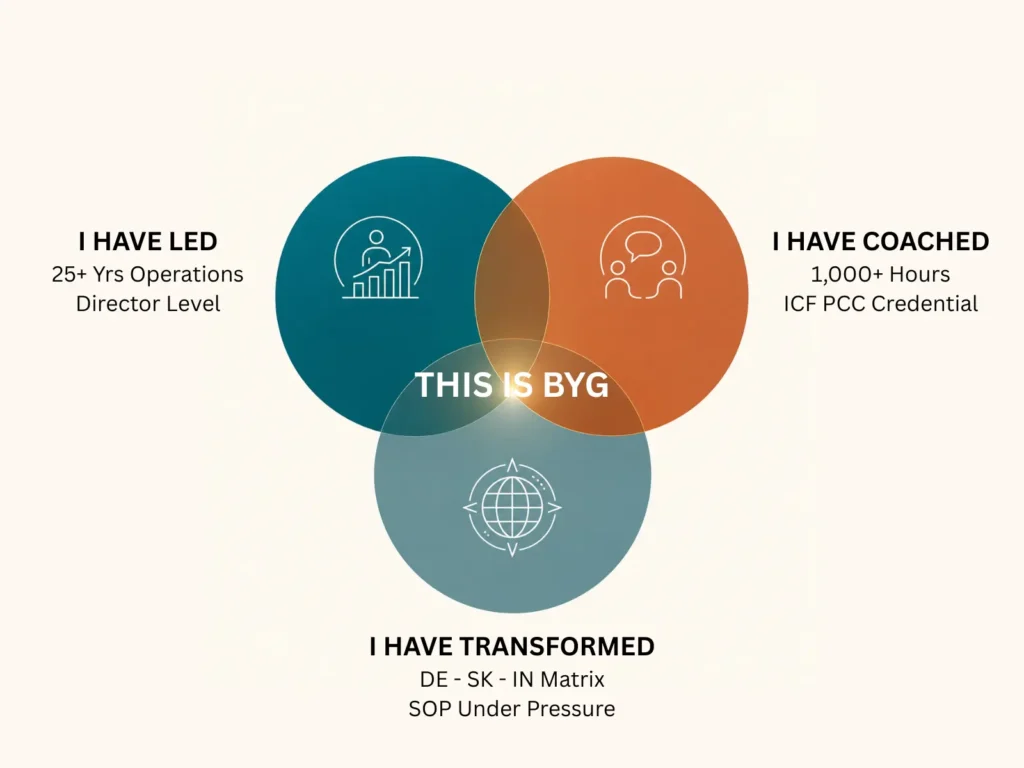
The BYG Conflict Architecture: An Operating System for Alignment
Conflict resolution is not therapy, it is system architecture. Four principles, born from Harvard negotiation research and 25 years of automotive practice and what they will achieve:

What is your true Alignment Tax? Calculate the exact cost in three minutes.
Five targeted questions. Your dominant conflict type. The real operational costs per month.
1. Which scenario best describes your current conflict pain?
Reflect on the most recent situation that actively drained your energy.
2. How long has this specific conflict been ongoing?
Prolonged unresolved friction exponentially increases your monthly operational costs.
3. How much weekly leadership time is consumed managing this conflict?
Honestly calculate all meetings, emails, informal discussions, and off-hour worry time.
4. What represents the most visible operational impact right now?
Consider what your key stakeholders would identify as the primary symptom.
5. Which resolution strategies have you attempted so far?
Evaluate strictly which initiatives have actually generated sustainable improvements.
SDV and 2026: Why Conflict Architecture Matters More Than Ever
Software-defined vehicle architecture sharpens the conflict dynamic. Shorter cycles, more interfaces between hardware, software, and OEM, and permanent change pressure create more friction points, not fewer. The Harvard principle interests instead of positions works especially well here: both sides want to hold the SOP, that is the shared interest. Who is right and whose specification applies are positions. Bring the conversation to the interest level, and many deadlocks resolve within a single session.

FAQ: Frequently Asked Questions around the Conflict Management Method of BYG.
Q1: Is conflict management not a soft-skill topic for HR?
No. In the BYG method, conflict is a technical system failure. Leaders spend 20 to 40 percent of their time managing conflict (Runde and Flanagan). When friction endangers your SOP, that is not a soft topic, it is your P&L.
Q2: Why is "just talk to each other sensibly" not enough for us?
Because biology beats logic. Under pressure the brain switches to amygdala mode. Without a clear system architecture, an agreed escalation protocol, RACI accountabilities, and objective criteria, mere talking often only hardens the fronts.
Q3: What is the Alignment Tax and how do I approximate it?
It is the energy that flows into internal fights instead of solutions. Simplest approximation: employees spend on average 2.8 hours per week on conflict (CPP Global 2008), leaders 20 to 40 percent of their time. Multiply that by the hourly rates of your level and your team, that is your Alignment Tax.
Q4: What happens if we lose experts through conflict?
Knowledge erosion. Recruiting, onboarding, ramp-up loss, and knowledge transfer cost 150 to 200 percent of annual salary (PLOS ONE / Accenture). Not yet counted is the strategic damage when that knowledge goes to the competition.
Q5: Can a leader not simply resolve conflict by decree?
Imposed decisions produce compliance by the letter, not by intent, the team says yes and thinks: let us see how that ends. Real commitment only emerges through interest-based negotiation, where all sides co-own the outcome.
Q6: How does the BYG method differ from classic team building?
Team building treats symptoms. We install an operating system: RACI structures, explicit escalation paths, non-negotiable guardrails. When the foundation is right, many conflicts never arise. For the foundation: the Team Charter Workshop.
Q7: When must leaders actively intervene?
My rule of thumb: as soon as a conflict impairs the performance, safety, or dignity of a person, immediately. Do not observe, do not wait for it to settle. Every week you wait solidifies the defensive schemas of both sides. Looking away is not an option, it is a decision against your team.
Q8: How do we start without disrupting operations?
With the Conflict Architecture Analysis: we identify your specific cost drivers in a structured conversation. No big project, no seminar. A clear picture of what your friction costs, and a concrete way out. Start with the free Reality Check.
Q9: Is this not HR's job? Can I not hand conflict resolution off?
HR is an important partner, for legal certainty, fairness, and process. But the conflict leadership responsibility is not delegable. Protecting team culture and collaboration is part of your role, not HR's. Whoever hands off this responsibility loses exactly the trust that makes honest escalation in the team possible.
Q10: How does Conflict Architecture differ from classic mediation?
Mediation is incident-based and moderated neutrally from outside. Conflict Architecture is a permanent operating system that you as the leader run yourself, with RACI, objective criteria, and defined escalation paths. Mediation heals one incident. Architecture prevents the next.
Q11: For which leadership level is the method most worthwhile?
Most of all for leaders with matrix responsibility across sites and cultures: R&D heads, plant and program owners. There the price of unresolved conflict is highest, because it multiplies across site boundaries.
Q12: What is the Reality Check, and how is it different from a discovery call?
A Reality Check is a 30-minute diagnostic conversation. No slides, no program overview, no sales agenda. Andy looks with you at your specific conflict cost driver and tells you honestly whether a BYG engagement addresses your highest-cost problem. Not a Discovery Call, not a Chemistry Call, a structured diagnosis with a direct outcome.

End the Silent Investment in Friction
If your global system stalls because of friction, you do not have a growth problem, you have a conflict-architecture problem. Looking away only pushes the cost into the future, with interest. Let us analyse what it costs you, and recover a structured system.
Use the Reality Check to identify your most expensive conflict cost driver, directly with Andy.
Or directly: founder_andybalbus@boost-your-growth.com | WhatsApp: +49 151 4495 7099
Global Reach: Where I Deliver My Services
I built the foundation of my work along the Germany, Slovakia, and India axis. This includes locations in Prievidza and Bratislava, Pune and Mumbai, and across the German industrial belt around Bamberg, Nuremberg, and Zapfendorf, where I made this shift myself.
From there, my reach deliberately extends across the globe:
- Europe: Austria, Spain (Barcelona), the Czech Republic, and Poland.
- Beyond: China (Shanghai), Mexico (Querétaro), and the USA (Pittsburgh).
Whether you need support for one specific service or a combination of them, I am here to help. Because my services are available live online and worldwide, I can support you wherever your matrix sits. For on-site delivery, I come directly to you, and this includes specialized on-site sessions like the one in Bangalore with Ruchikka Kar.

The Next Stage: Mentoring Matched to Your Leadership Reality
Conflict management is the starting point. Which mentoring stage fits next depends on your leadership reality.
Expert to Leader, Team Lead Scaling: from single point of failure to strategic redundancy, Director, Strategic Influence, Lead Without Authority (LWA)
Conflict Management in the BYG Toolkit
Conflict Architecture does not stand alone. In compound with other methods:
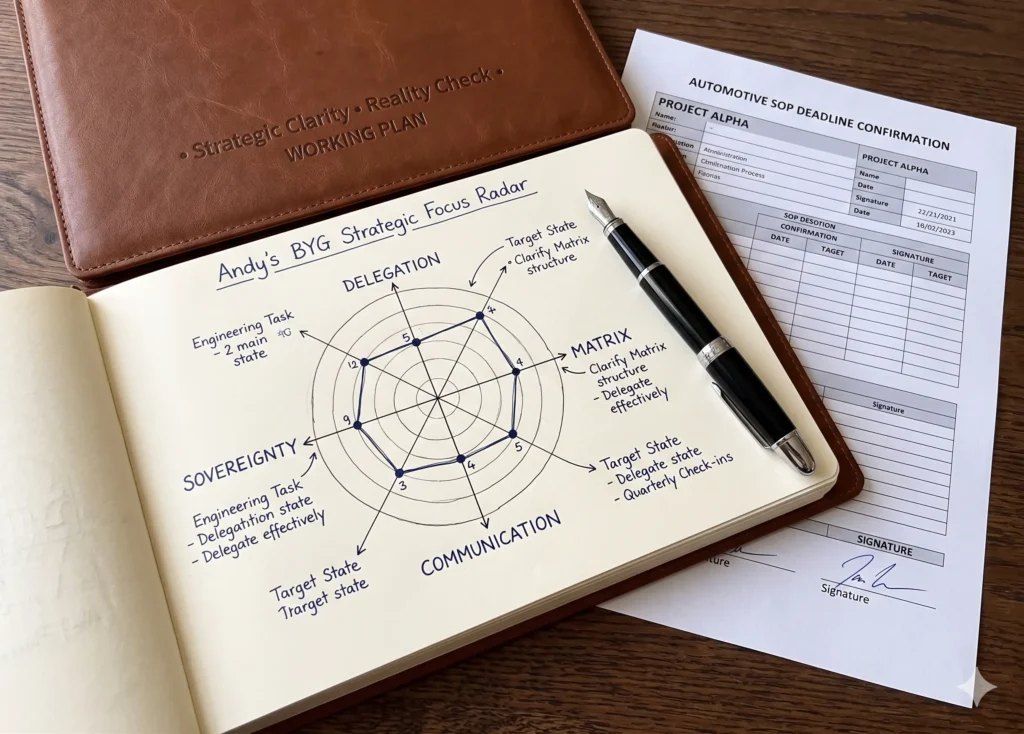
The BYG Programmes That Deploy This Method
Explore all 28 methods in the BYG Leadership Toolkit ›
Coaching follows the ICF standards exclusively.
Intercultural Mentoring (Service): the structured programme for expats and leaders crossing DE-SK-IN boundaries, Team Charter Workshop, Accelerate Now, Executive Sparring for acute SOP crises, Legacy Programme, Succession Architecture, Your Power Within (YPW)
Systemic leadership does not end after one call.
Follow Andy for unvarnished insights from automotive practice:


