
When the Why Is Clear, Prioritization Becomes a Decision, Not a Daily Fight
This method is part of the BYG Leadership Toolkit: 28 validated instruments for automotive executives navigating the DE-SK-IN matrix.
This page is designed for leaders in the automotive matrix whose calendars are ruled by external urgencies. R&D directors, plant managers, and engineering heads frequently absorb operational friction because they believe only personal intervention solves the next crisis.
The Daily Firefighting Pattern
- R&D Email Pressure: Treating every incoming inquiry as Priority 1 leads to fragmented engineering bandwidth.
- Friction Absorption: Patching operational cracks personally creates an invisible bottleneck at executive level.
- Ad-Hoc Escalations: Responding instantly to Sunday shift demands, OEM escalations, and corporate reporting requests drains strategic time.
Strategic direction disappears when daily urgency replaces deliberate decision-making. A full calendar is never a badge of honor in Tier-1 matrix setups.
A full calendar is not proof of impact. It is proof that someone else is setting your priorities.

I Did Not Learn Prioritization in a Seminar. I Fought My Way Back to It After the Crash.
My name is Andy Balbus. As a Diplom-Wirtschaftsingenieur, ICF PCC certified coach, and executive mentor with 25+ years inside global automotive matrix setups across DE, SK, IN, CN, MX, and the UK, I experienced the cost of missing boundaries firsthand. Nearly two decades ago at age 30, I hit the wall with clinical burnout from believing leadership meant outworking everyone.
Prioritization is not a productivity hack. True prioritization demands surgical courage to decide what to let die so that you, your team, and your critical projects survive.
The Matrix Overload Pattern
- Targeted Leadership: Female executives in technical environments frequently carry a disproportionate share of this invisible pressure.
- Friction Absorption: Executive leaders routinely absorb department-wide operational friction, believing personal intervention is the only solution.
- Perfectionism Trap: Internal drivers like perfectionism convert structural matrix flaws into self-imposed personal burdens.
For women in industry who want to stop fixing and start leading: Your Power Within ›
Prioritization is not a productivity hack. It is surgical courage.

Purpose-Driven Prioritization: The Why Defines What “Important” Even Means
The Eisenhower Matrix sorts tasks along two axes: urgency and importance. While urgency is usually self-evident, importance remains an empty category without an explicit reference point. Traditional prioritization fails because it treats importance as a given rather than something that must be defined first.
The Purpose Anchor in Executive Governance
- Core Reference Point: Establishing department vision and product purpose as the non-negotiable benchmark for every task.
- Urgency Theatre: Filtering out artificial operational noise that demands immediate attention without building long-term value.
- Decision Clarity: Evaluating whether an task actively moves the organization closer to strategic goals rather than responding to whoever shouts loudest.
Without a clear why, "important" is just another word for "urgent".
Only the strategic purpose separates the two decision axes in matrix leadership.

Why Clarity About the Why Raises Performance
People perform significantly better when operational purpose is explicitly clear. Gallup engagement research confirms that clear expectations form the single strongest foundation for talent retention and productivity. A shared “why” dramatically reduces steering overhead because aligned teams prioritize correctly without escalating every minor decision upward.
Matrix Alignment Across DE-SK-IN Sites
- Retention Foundation: Establishing clear operational expectations drives up to 59% lower employee turnover in high-performing engineering units.
- Overhead Reduction: Empowering R&D teams with shared purpose eliminates constant managerial steering and daily micro-alignments.
- Cross-Site Synchronization: Uniting German HQ, Prievidza, and Pune under one definition of “important” prevents local priority drift.
59% Lower Turnover | Zero Priority Drift
Research-backed performance gains through shared operational purpose across international engineering sites.
The BYG Filter: The Four Quadrants, Read Through the Why
Standard time management looks only at task deadlines. The BYG Filter evaluates the underlying operational system and core purpose. Importance is defined strictly by what protects SOP execution, engineering capacity, and project margins.
The Four Quadrants of Purpose-Driven Governance
- Quadrant A (Critical): Addressing real SOP risks where no warehouse buffers exist. Validating green status reports continuously prevents the Green Melon Effect.
- Quadrant B (Strategic): Preserving dedicated focus time for team development, technical knowledge, and long-term North Star goals before artificial urgency consumes bandwidth.
- Quadrant C (Delegate): Transforming urgent operational tasks into growth opportunities for junior leads through calibrated timeframes rather than pure task offloading.
- Quadrant D (Eliminate): Eradicating administrative ballast and fake urgency that fail to serve core business objectives.
Important Means Protecting SOP, People, and Margin
Filtering daily matrix demands through system purpose rather than artificial deadline pressure.

The Buffer Test: Making Fake Urgency Visible
Plant managers frequently request Sunday shifts to repair testing equipment. On paper, these requests appear critical. Checking warehouse inventory often reveals a two-week buffer, rendering immediate weekend work an unnecessary liquidation of engineering energy. Enforcing overtime when buffers exist creates systemic waste. Protecting recovery time safeguards precision for Monday production ramps.
Calibrated Constraint Instead of Over-Delivery
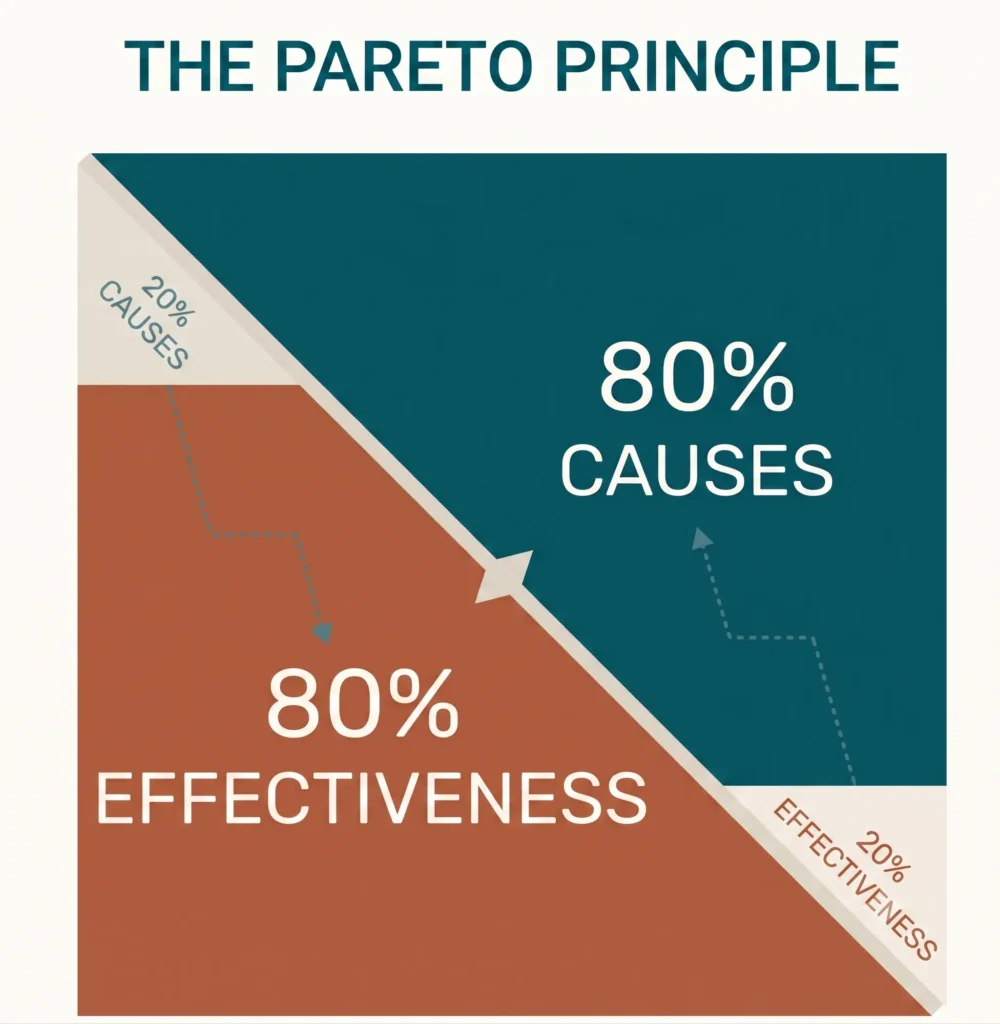
R&D engineering teams frequently struggle with the Pareto Principle because technical specialists naturally pursue perfection. Unbounded intellectual play triggers feature creep, driving SDV project costs into multi-million-dollar overruns. Parkinson’s Law dictates that work expands to fill available time. The BYG formula tightens execution frames based on product complexity and engineer maturity, preserving creative problem-solving while protecting project EBIT.
80% Effectiveness | Calibrated Timeframes
Balancing high-speed technical problem-solving with strict project margin boundaries.
How much Fake Urgency is in your Calendar?
From Systemic Bottleneck to Architect: What Really Happened in Prievidza
Building an R&D electronics department from zero in Prievidza revealed a fundamental leadership hazard: the reflex to secure every operational detail personally. Operating under the illusion that “it is only safe if I do it myself” transforms a director into the primary bottleneck for departmental scaling. The turning point required establishing an uncompromising prioritization filter based on shared purpose and clear boundaries.
Operational Shift in Prievidza
- Verified Performance: Translating structural delegation into official executive evaluations confirming purposeful decision-making.
- Bottleneck Elimination: Measuring every task against department vision to decide whether to execute, delegate, time-box, or eliminate.
- Self-Steering Operations: Transitioning from reactive waiting for corporate direction to actively controlling departmental bandwidth.
From Bottleneck to Architect | Self-Steering Department
Shifting from micromanagement reflexes to strategic departmental autonomy in Tier-1 matrix setups.

The Operational ROI of a Strategic No
Saying “no” to low-impact matrix demands is not a refusal of work; it is an active investment in operational stability, EBIT protection, and technical team bandwidth.
Quantifiable Impact of Strategic Boundaries
- Capacity Recovery: Reclaiming executive focus time by operating direct levers immediately without waiting for administrative approvals.
- EBIT Protection: Routing engineering bandwidth to true Priority-A tasks to prevent costly SOP delays and OEM line stoppages.
- Talent Retention: Shielding technical teams from artificial urgency to protect core domain expertise and prevent quiet quitting.
- Quality Safeguarding: Maintaining engineering precision to catch logic flaws early rather than creating compound errors under burnout.
$2.3M / Hour Line Stoppage Risk | Balance-Sheet Impact
Converting strategic boundaries into measurable EBIT protection and executive capacity.

SDV and 2026: Why the Why Remains the Only Stable Filter
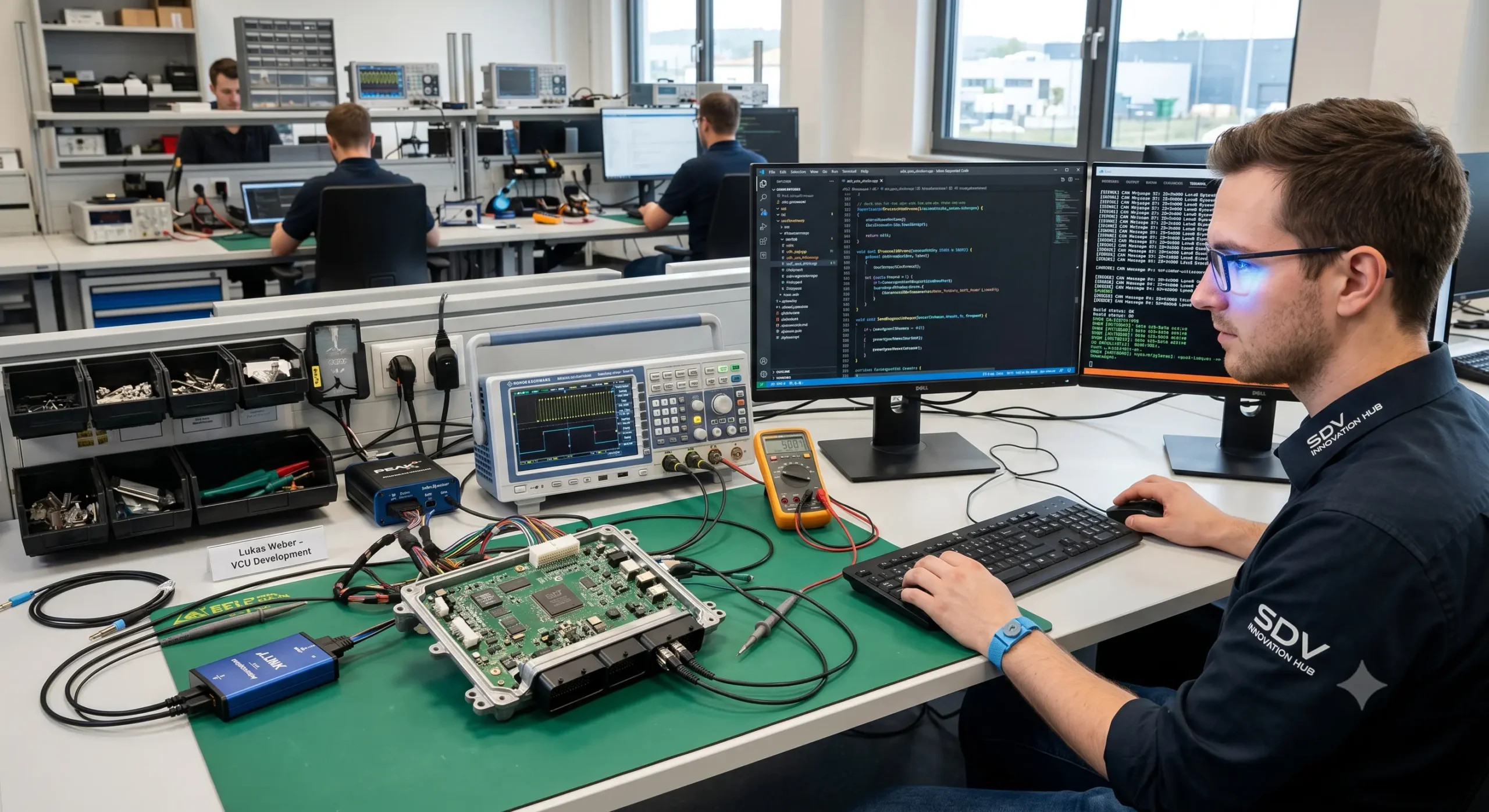
The transition to software-defined vehicle architecture makes artificial urgency a permanent operational state. Requirements arrive in bi-weekly sprints, OEM decisions change mid-project, and every incoming change request looks equally critical. Standard prioritization based solely on deadline pressure fails in agile environments. Establishing an explicit operational purpose serves as the only stable anchor to keep engineering teams focused on true priority-A tasks.
Navigating Agile SDV Volatility
- Purpose Anchor: Evaluating bi-weekly sprint items through long-term system goals rather than deadline noise.
- Software Velocity: Managing continuous requirement updates without fragmenting senior engineering focus.
- OEM Volatility: Filtering changing customer demands against overarching project scope and margin targets.
Software-Defined Velocity | Purpose-Driven Stability
Navigating bi-weekly SDV sprint acceleration through stable system purpose.
Executive Prioritization FAQ & Decision Governance
Q1: Why is the BYG Filter different from online time-management tutorials?
Online models are built for office work. The BYG Filter is built for 150M € revenue responsibility. Tasks are not weighed against arbitrary deadlines, but against the North Star, against OEM penalties, and against warehouse buffers.
Q2: How do I define the why so it works as a prioritization filter?
Concrete and shared. A usable why is not a mission statement on the wall, but a sentence everyone on the team can state without looking it up and that classifies a task unambiguously. If two people rate the same task differently using the why, it is not sharp enough yet.
Q3: How do I tell a plant manager no to the Sunday shift?
With data instead of stance. Use the buffer data to shift the conversation from commitment to resource optimisation. A buffer is not a white space, it is a deliberate decision. The no is then not a retreat, but protection of margin and team.
Q4: Will I lose control if I delegate Quadrant C tasks?
Not with a defined steering rhythm. Executive oversight remains, operational freedom returns. Delegation without rhythm is offloading, delegation with rhythm is development.
Q5: My inner drivers push me to say yes to everything. What helps?
The first step is to recognise the pattern. Perfectionism and the martyr pattern feel like responsibility, but are often just the most expensive way to avoid a no. Once the why is set as a filter, prioritization becomes an act of clarity instead of self-overload.
Q6: Does this work for Pune or Prievidza teams?
Yes. The filter is calibrated for local hierarchies and communication styles, based on direct on-site experience in both locations. Precisely there, a shared why is the strongest lever, because it unifies the definition of “important” across the distance.
Q7: I feel abandoned by IT and HR. What can I do myself?
Radical agency: prioritise only what is within your control first. Waiting for the system is the most expensive form of inaction. The filter begins with the levers you can pull yourself today.
Q8: Is this a soft-skills seminar?
No. It is an operational intervention for SOP stabilisation and EBIT protection. The North Star is not a soft topic here, but the hardest decision criterion you have.
Q9: What is the ROI of a strategic no?
The mitigation of the attrition tax and the SOP risk. You stop liquidating your team’s energy on fake A-tasks that have no real link to SOP or EBIT, and route it to what serves the North Star.
Q10: How is purpose-driven prioritization different from a classic ABCD list?
An ABCD list sorts tasks without asking what for. Purpose-driven prioritization sets the why first and derives the classification from it. That is why it survives a requirement change, while an ABCD list has to be rewritten at every new escalation.
Q11: For which leadership level is the method most worthwhile?
Most of all for leaders with distributed responsibility who constantly navigate other people’s urgencies: R&D heads, plant and programme owners. There the price of a mis-set priority is highest, and there a shared why works most directly.
Q12: What is the Reality Check, and how is it different from a discovery call?
A Reality Check is a 30-minute diagnostic conversation. No slides, no programme overview, no sales agenda. Andy looks surgically at your workload with you and tells you honestly whether a BYG engagement addresses your highest-cost problem. Not a Discovery Call, not a Chemistry Call, a structured diagnosis with a direct outcome.

Your First Quadrant-A Task: Recover Your Sovereignty
Transitioning from a driven expert to a sovereign architect requires a deliberate boundary rather than harder work. Placing operational purpose above daily urgency recovers strategic bandwidth and protects engineering teams from burnout. Diagnostic sparring focuses strictly on SOP pressure, OEM project margins, and physical warehouse buffers to uncover your highest-cost operational bottlenecks.
No Excuses. Results Count. | Recover Strategic Bandwidth
Surgically analyzing your current workload to eliminate fake urgency and protect R&D margins.
Use the Reality Check to identify your most expensive piece of artificial urgency, directly in a 1:1 diagnostic conversation with Andy Balbus.
30 Minutes | 100% Confidential | Direct C-Level Sparring
Direct Contact:
founder_andybalbus@boost-your-growth.com | WhatsApp: +49 151 4495 7099

Do Not Rely on Theory, Trust in Results
Practical matrix experience beats academic theory. Over 25 years of direct line leadership in Tier-1 automotive setups guarantee methods forged under real SOP pressure rather than textbook concepts.
Verified Industry Track Record
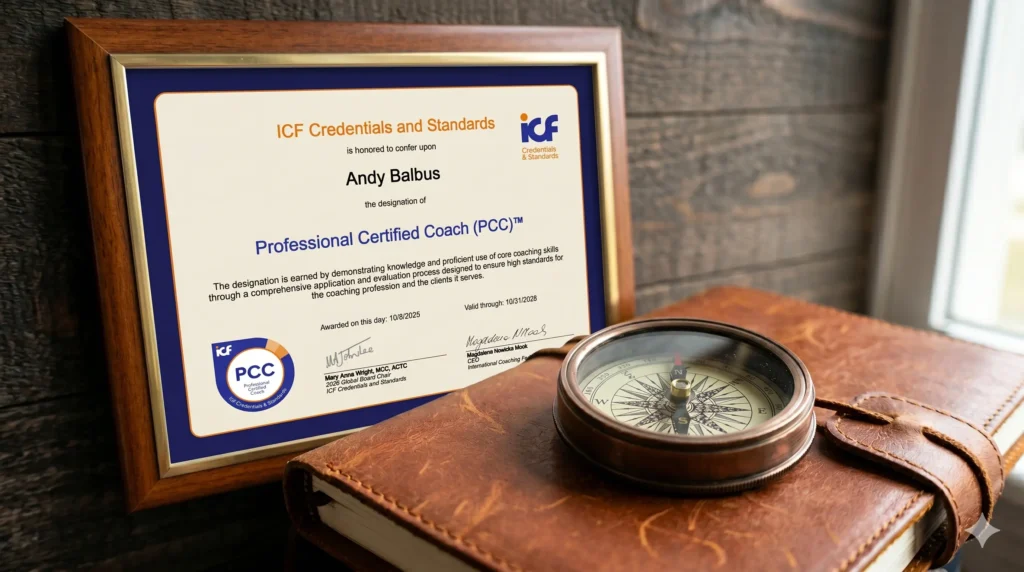
- Academic & Coaching Credentials: Diplom-Wirtschaftsingenieur (HFH Hamburg) and ICF Professional Certified Coach (PCC), Coacharya Level 2 and Level 3 on the MCC track.
- R&D Department Construction: Built the complete electronics department at Brose Prievidza from zero to 40+ engineers with 15M € annual project budget and full product responsibility.
- Cross-Border Mentoring: Mentored 12 executive leaders at Brose India Pune in cross-cultural matrix execution.
- Corporate Hierarchy Mastery: Navigated German corporate hierarchies for over 20 years, protecting Quadrant-B strategic focus against daily priority-1 noise.
- Global Revenue Responsibility: Managed 150M € annual operational budgets across Germany, Slovakia, India, China, Mexico, and the UK.
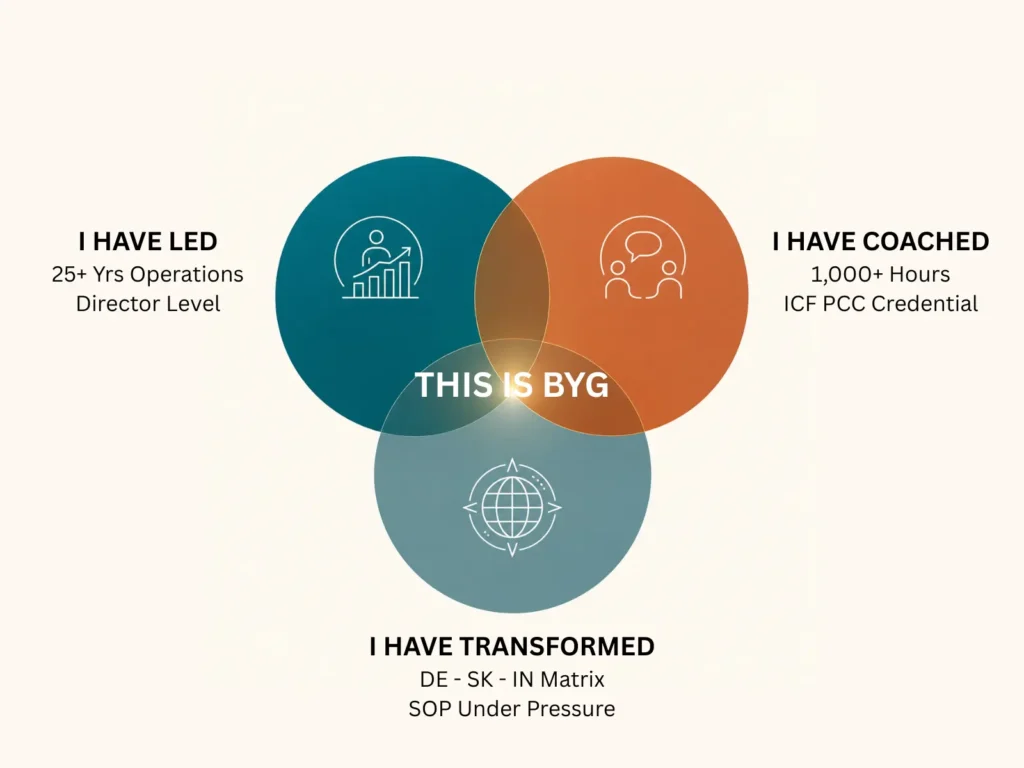
25+ Years Operations | ICF PCC Certified
Combining 25+ years of operational automotive execution with certified executive coaching capabilities.
The Next Stage: Mentoring Matched to Your Leadership Reality
Prioritization is the starting point. Selecting the right mentoring tier depends on your specific span of control and current matrix challenges.
Mentoring Tiers & Executive Architectures
- Tier 1 (Expert to Leader): Transitioning technical specialists into confident, outcome-driven leaders.
- Tier 2 (Team Lead Scaling): Moving from single-point operational failure to strategic redundancy.
- Tier 3 (Director Strategic Influence): Reclaiming executive bandwidth for long-term organizational impact.
- Tier 4 (Lead Without Authority): Driving cross-site matrix project execution without direct disciplinary power.
Prioritization in the BYG Toolkit
Prioritization determines which tasks receive executive focus. Combining the BYG Filter with complementary leadership instruments translates strategic focus into clean operational execution.
Strategic Synergy | Complete Toolkit Integration
Combining prioritization filters with proven behavioral frameworks for seamless matrix execution.
The BYG Programmes That Deploy This Method
All coaching and mentoring engagements follow ICF PCC standards exclusively.
Programmes & Execution Frameworks
- Intercultural Mentoring: Guiding expats and engineering directors navigating DE-SK-IN matrix complexities.
- Executive Sparring: Resolving acute SOP delivery crises, calendar overloads, and fake urgency in direct 1:1 sessions.
- Accelerate Now: Driving rapid operational alignment and decision speed for high-stakes automotive projects.
- Team Charter Workshop: Establishing a shared working foundation and explicit priority rules for distributed units.
- Succession Architecture & Your Power Within: Securing long-term leadership continuity and empowering female executives in technical environments.
Explore all 28 methods in the BYG Leadership Toolkit ›
Systemic leadership does not end after one call.
Follow Andy for unvarnished insights from automotive practice:


