
The execution engine for the global automotive matrix.
This method is part of the BYG Leadership Toolkit: 28 validated instruments for automotive executives navigating the DE-SK-IN matrix.
Explore the full Toolkit ›
This page is for the people who carry the responsibility in the automotive matrix when an SOP date starts to slip. Perhaps you lead an R&D department whose team has been almost finished for weeks. Perhaps you are a plant manager receiving green reports while you already know the line will stop tomorrow. Or you have just taken over your first team as an experienced specialist and notice that technical excellence suddenly works against you. If you recognise yourself, you are in the right place.
You are not the problem. Your system is.
It is 10:30 PM. Your project status report is green. And yet you have that feeling, the one that tells you someone will call with bad news tomorrow morning. Your team confirmed everything is on track in the last alignment call. Your team lead in Pune said yes. Prievidza reports no deviations.
And you know: it is not true.
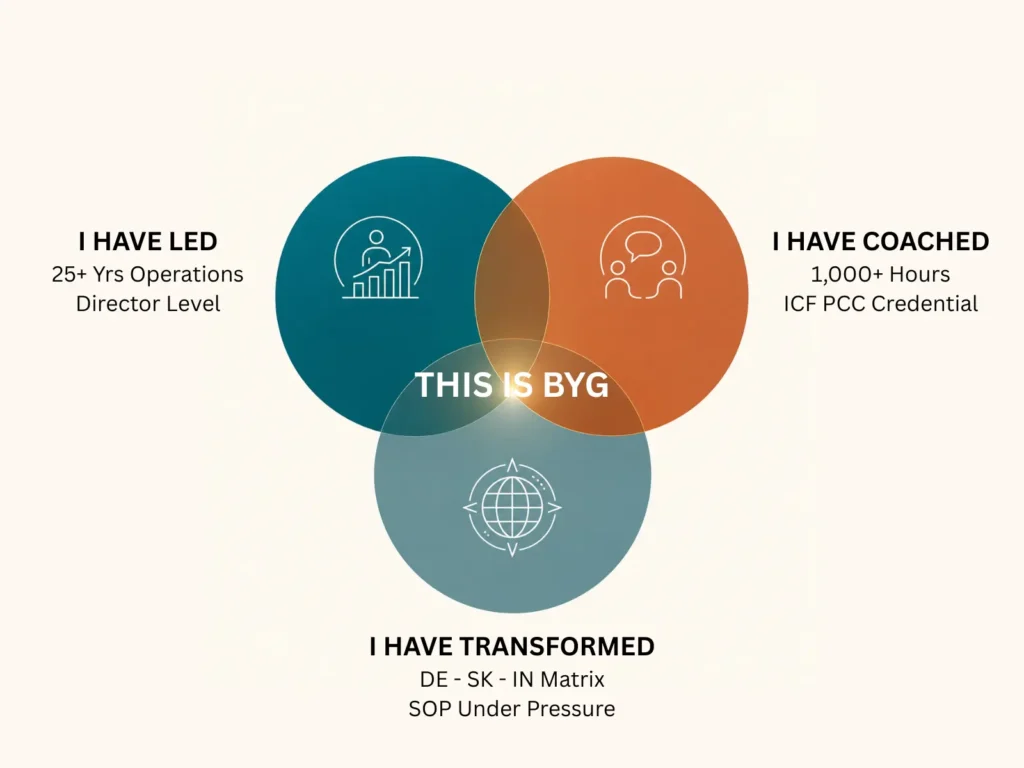
That is not a motivation problem, and not a personnel problem. It is a system failure, one that has a name and a solution. My name is Andy Balbus. I spent 25+ years inside exactly this system: as Director of Electronics in Slovakia, as Task Force Manager in a 50-person crisis, later as mentor to 12 leaders in India. This page is what I actually learned in that time, and the reason my GROW version no longer matches the textbook.
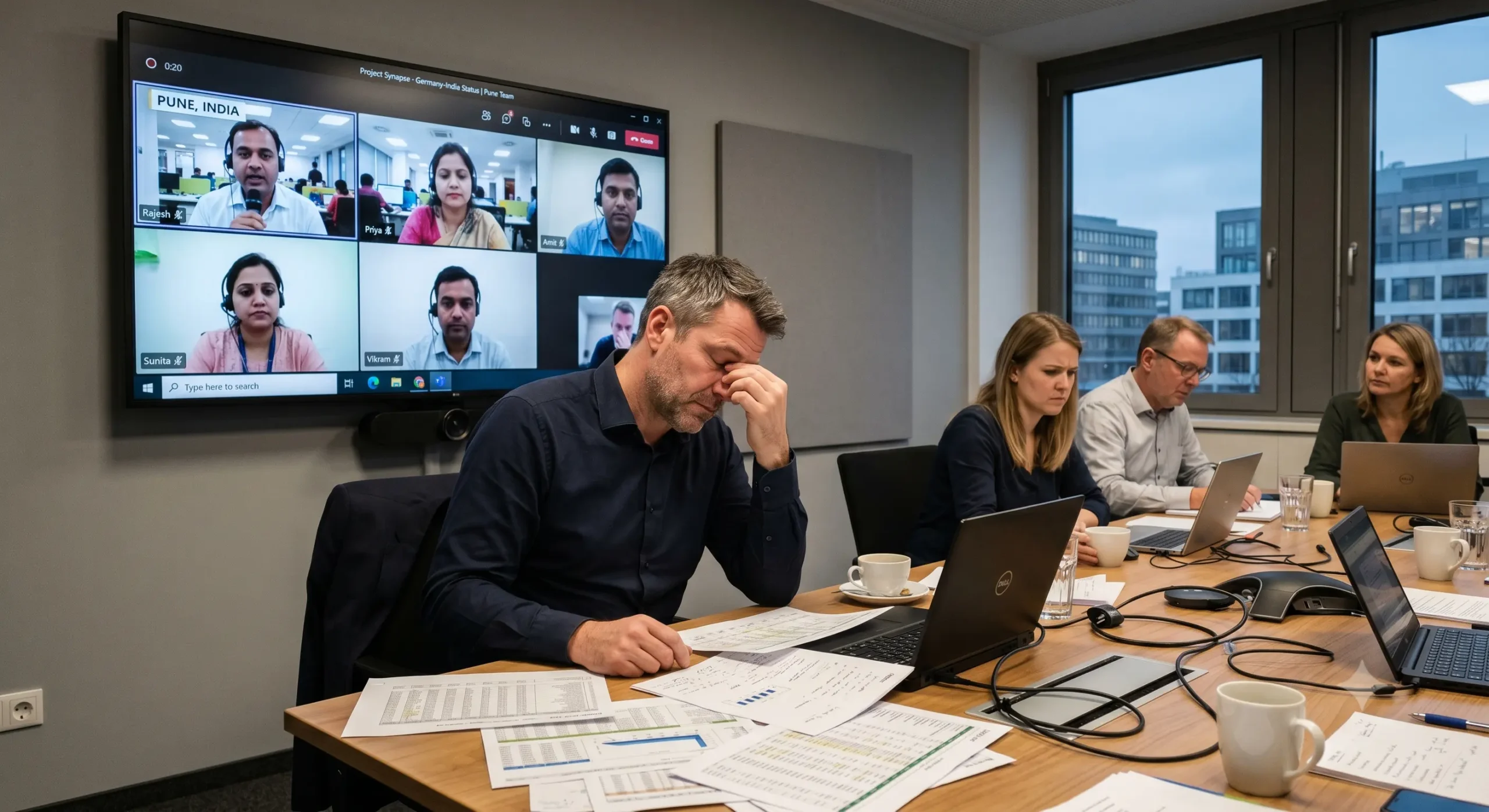
Why Standard GROW systematically fails under automotive pressure.
Sir John Whitmore developed GROW in the 1980s for stable, psychologically safe development conversations. That was not a bad idea. The problem is: the automotive matrix is the exact opposite of that.
Across 25+ years in German headquarters, in the electronics lab in Prievidza, and in R&D alignment meetings in Pune, I have observed four patterns that standard GROW does not solve, and that together put your SOP at risk.
Four patterns that put your SOP at risk

The Dopamine Paradox: Why Your Team Feels Productive, and Ships Nothing.
As an ICF-certified coach (PCC, Coacharya Advanced Program, 160 hours), I have identified a recurring pattern in hundreds of leadership conversations. It has a name: the Dopamine Paradox. And it is the main reason standard GROW fails at the decisive moment in automotive projects.
It is not a motivation problem. It is neurochemistry, and leaders who understand it can structurally disable it.
The Neurochemistry of Pseudo-Progress
When a team sits in alignment meetings, defines ambitious goals, and refines slide decks, the brain releases dopamine. The brain does not distinguish between planning to ship and actually shipping.
Setting a goal delivers the same reward sensation as achieving it. As a result, your engineering team feels deeply satisfied and productive, while the hard binary task (stopping Feature Creep and freezing code for SOP) is delayed.
Breaking the Brain’s Alignment Addiction
Standard GROW reinforces this trap by continually asking for new options and goals, feeding the dopamine loop without requiring closure.
BYG Automotive GROW breaks this cycle. By replacing open-ended goal setting with binary gate criteria, we force the team out of the comfortable planning loop into hard execution friction.

The Paradox Across the Four GROW Phases

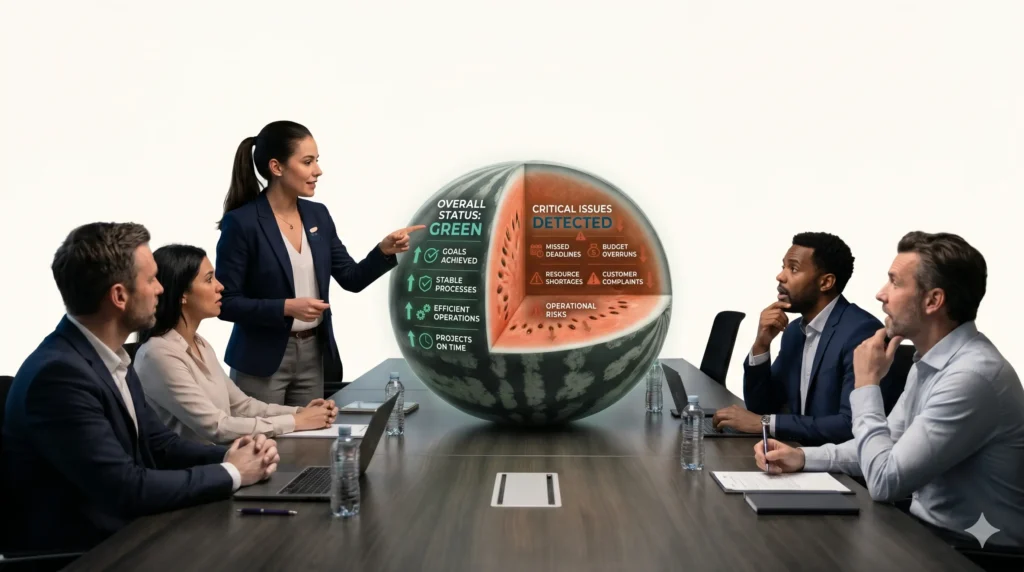
The BYG GROW Method, calibrated for Industrial DNA.
25+ years of operational experience as Director of Electronics and Task Force Manager. Built for exactly the two places where excuses cost millions: the R&D laboratory and the production plant.
The four phases, recalibrated
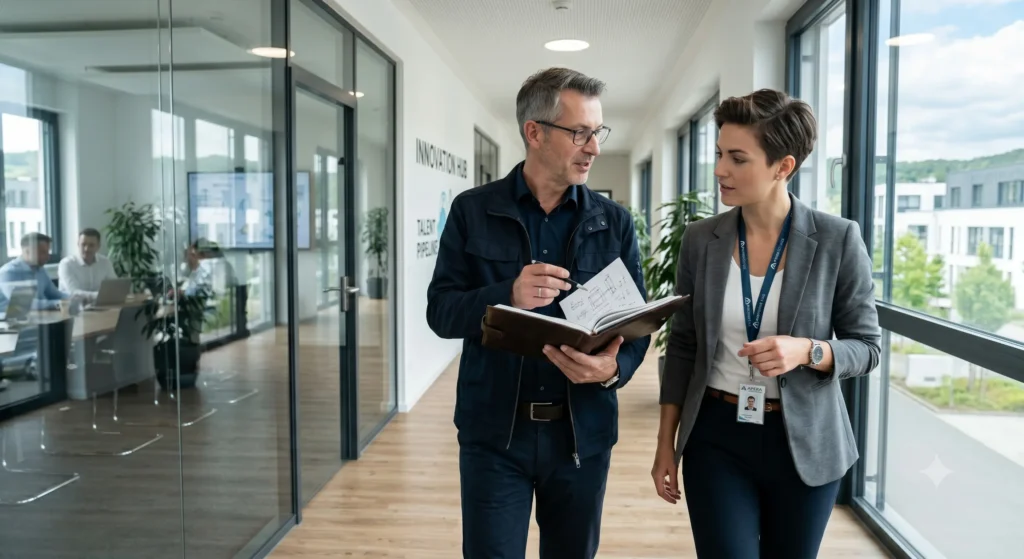

BYG Commitment-Check
Which leak is costing you the most right now?
6 questions. 3 minutes. A clear diagnosis.
What I Actually Learned From a 50-Person Crisis
As a Task Force Manager, I was pushed from zero into a high-value project that had gone off the rails. Without being the developer, supplier, or line manager, my role was protocol owner for over 50 people from multiple countries.
The first thing I did was a mind map: all stakeholders, their accountabilities, their dependencies, including external partners for whom a budget and procurement process had to exist before they could act. That was my RACI before I knew the word RACI.
The W-Step in Practice: Overcoming “I Forgot”
The day came when a senior developer sat in the round and said: “I forgot.” I controlled my reaction, no escalation in front of the group. Calmly I asked: “What does that mean for the overall project?” Together with the group, we documented the impact and defined the path to resolution.
But after the meeting, I went to that person directly. And I made it clear: A Deal is a Deal. What is in this protocol is a valid contract, formulated by you, confirmed by you. I will not accept this a second time.
What happened next: within a few meetings, everyone in the round understood, including senior managers from external partner companies, that commitments are kept. Not because I was loud, but because I was consistent.
The Protocol Principle: Whose Words Are in It?
The decisive difference between a meeting protocol that nobody reads and one that works: I do not write down what I understood. I ask the accountable person: “How should I note this?” And then: “By when will you deliver this?” And then I let the group discuss whether the deadline is realistic.
When a delivery faces the person’s own commitment, formulated in their own words, then “I forgot” is no longer an option. That is the W-step as commitment architecture, not as hope.
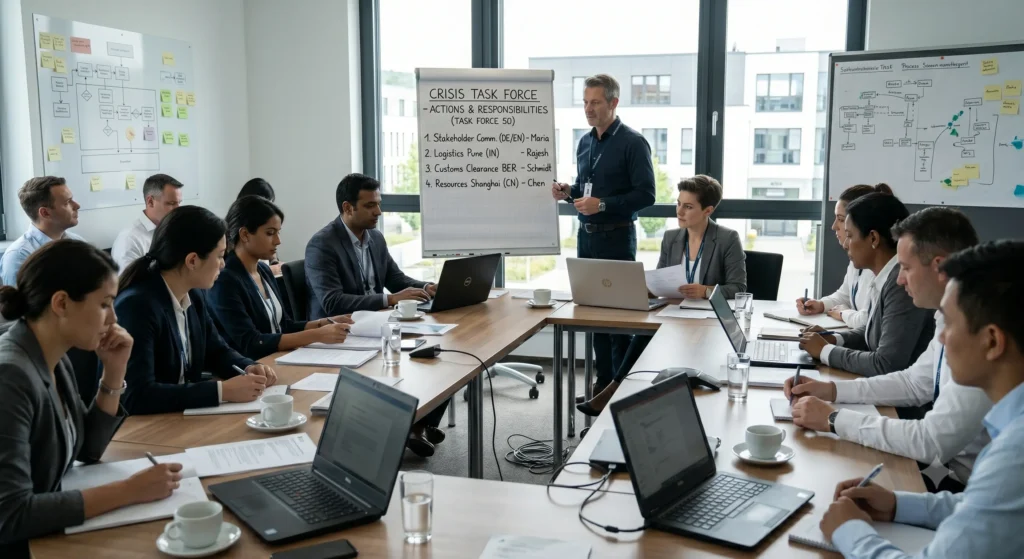
India: When Silence Is Not Failure, It Is Respect
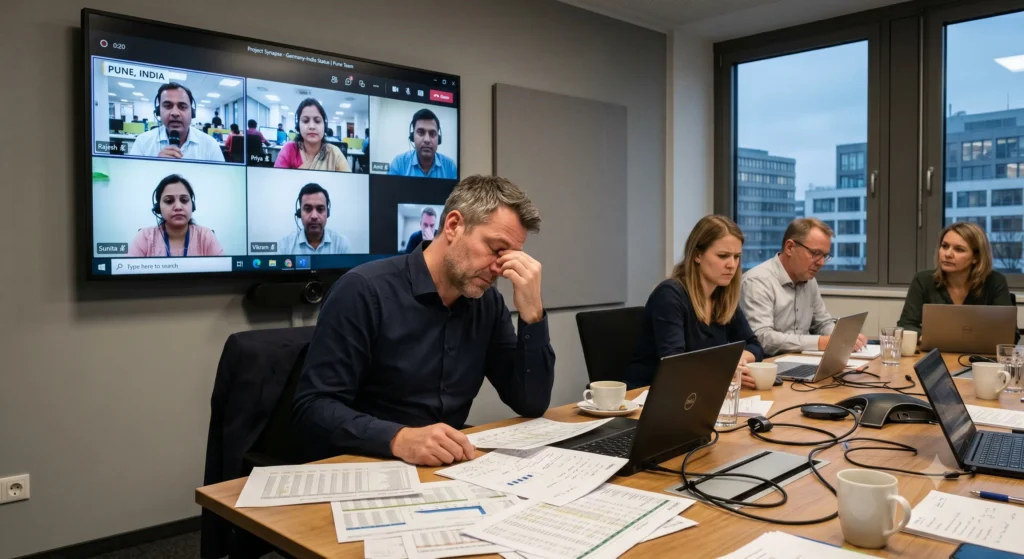
In Pune I encountered a situation I had not read about in any leadership book: my team was not delivering. Escalated twice, twice received “Yes, we are working on it.” Then I flew to India for four weeks.
What I discovered in two days on the ground: the plant manager had been giving my team hidden parallel tasks to support the plant. My team was caught between two chairs: the German manager on one side, the plant manager with local authority on the other. They had no way to do it right.
The solution was not a coaching exercise. It was a direct conversation with the plant manager about accountabilities: the RACI for the team, on paper, bilaterally agreed. After that, my team relaxed, deliveries came back on track, and we were even able to expand the scope of our collaboration.
What I learned: Behind every “Yes, we are working on it” can be a situation where the team had no structural choice. Ask instead of accuse. Go there instead of calling. The Radical Reality is often not found on a video call.
Measurable Value: The Hard ROI for Every Stakeholder
This is not a seminar about soft skills. It is a clinical intervention to protect your EBIT, your talent pipeline, and your SOP schedule.
GROW in the SDV Transformation: Why 2026 Is the Wrong Year to Skip Structure
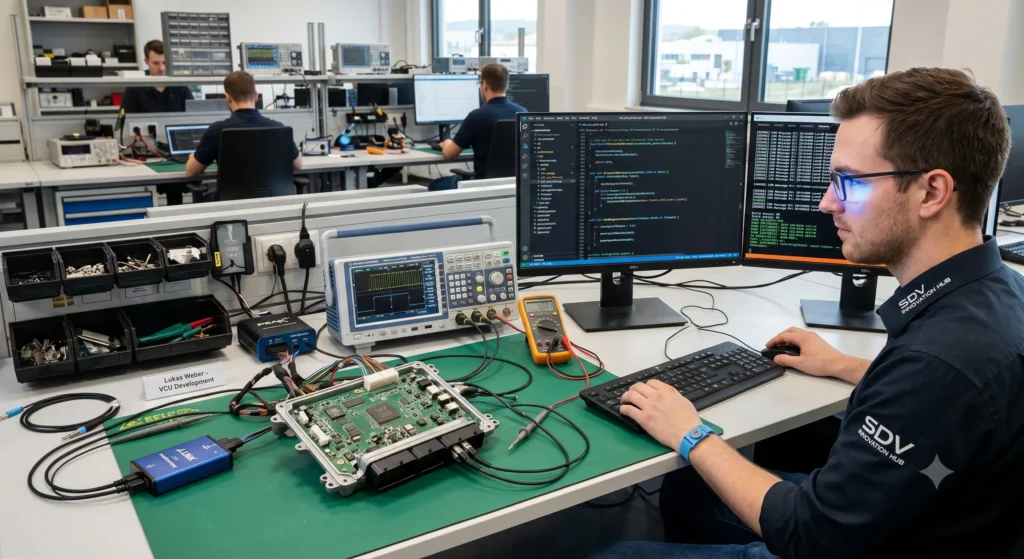
The transformation to software-defined vehicle (SDV) architecture fundamentally changes the requirement dynamics in R&D departments. Feature-freeze dates shift. OEM platform decisions change mid-project. Release cycles shorten. That sounds like an argument against structure. It is the exact opposite.
- Grounded Goals in SDV: Grounded Goals in SDV projects do not mean rigid adherence to original specs. They mean clear binary gate criteria for the current sprint, so that every requirement change runs as a formal goal update through the monitoring cycle, not as an informal scope shift that nobody can trace.
- Radical Reality in SDV: Radical Reality is particularly critical in SDV projects. When requirements change at weekly pace, the temptation for Green-Melon reporting is highest. Teams obscure uncertainty as “on track” to avoid political pressure, exactly when you need the real information most urgently.
- Weaponized Will in SDV: Weaponized Will in SDV environments means explicit commitment protocols for every requirement change. Whoever says yes to a new specification commits to a binary deliverable, not a best effort. That is how you prevent the Translation Tax.
Executive FAQ: Tactical Sparring & Industrial Implementation
Q1: What makes the BYG GROW version industry-ready, compared to standard GROW?
Standard GROW was designed for personal development conversations in stable environments. The automotive matrix is a different operating system: cross-cultural friction, OEM penalties, SDV transformation, 50-person task forces. I bring 25+ years of Industrial DNA to every session. A missed milestone has seven-figure consequences here.
Q2: How does the method solve the Indian Yes problem in my Pune hub?
A yes in India signals respect for the hierarchy, not commitment to delivery. The BYG GROW Method uses exclusively open questions, never closed ones: not Are you on track, but What is your concrete plan for the next two weeks. The result is a binary, measurable commitment in the words of the accountable person, not in mine.
Q3: Can GROW stop the Green-Melon Effect in my project reports?
Yes, but only if the Radical Reality phase is implemented correctly. That means building psychological safety before asking for the truth. In Prievidza, my team leads polished their reports not because they wanted to deceive, but because honest escalation felt dangerous. I show you how to build this safety structurally, so that escalation is seen as strength, not failure.
Q4: What is the Dopamine Paradox, and why is it more dangerous than loss of motivation?
Loss of motivation is a feeling. The Dopamine Paradox is neurochemistry: the brainstorming step triggers the same reward signal as actual delivery, the difference being that nothing was delivered. The team leaves the workshop energized and empty-handed. Structure, not motivational speeches, is the only answer.
Q5: We are in a high-stress transition. Is GROW not too slow for this?
The BYG version was built for exactly this situation. In my Task Force work I applied it under maximum OEM pressure. The first step is always the same: cut through the Alignment Tax immediately, identify the critical bottleneck with the EKS method, establish a SMART cycle. This gives you measurably more time within the first two weeks.
Q6: How does the method handle the Expert Paradox in R&D leadership teams?
Brilliant engineers struggle to delegate because they can do the work better than anyone else. That is not a weakness, that is a trap. The GROW framework provides a structured path from doing to steering: RACI structures and binary goals make delegation technically safe. The expert does not give up control, they transfer clarity.
Q7: Can I engage independently of my company HR department?
Yes. Many leaders, board members, senior managers, managing directors, finance their executive sparring privately. The reason is complete independence for boardroom conflicts, exit strategies, and sensitive succession questions. Strict NDA and absolute discretion are my standard. No content ever returns to the company.
Q8: What is the measurable ROI of this method?
Simple calculation: one week of SOP delay generates OEM penalties worth millions. My sparring secures your SOP schedule. In parallel, every senior expert you retain through better leadership saves up to 150 % of their annual salary in replacement costs. We calculate your specific number in the free Reality Check.
Q9: Which mentoring tier fits me after the GROW Method?
It depends on where you stand. Stepping from specialist into your first leadership role fits Expert to Leader. Scaling as a team lead fits the Team Lead tier. Moving to director level is about strategic influence. Leading without disciplinary authority in the matrix is the Lead Without Authority tier. The GROW Method is identical across all four, the context is not.
Q10: Does the method work across the DE-SK-IN matrix at the same time?
Yes, and that is exactly what it is calibrated for. Four years in Prievidza and two years in Pune sit inside the Radical Reality phase. Binary goals work the same everywhere, the path to the Ground Truth is culturally different. In Germany you ask more directly, in India you need on-site presence and the right open format. The method delivers both, without losing pace.
Q11: How is the BYG GROW Method different from a project-management tool?
A tool tracks tasks. The GROW Method changes behavior. Jira shows you that a ticket is red, but not why your team lead reported it green for two weeks. The method works exactly there: at the commitment architecture and the psychological safety a tool never creates. One complements the other, it does not replace it.
Q12: I am a consultant or coach. Can I learn the method for my own practice?
The sparring is about your concrete leadership situation, not a certification. What you take away is the logic behind binary goals, Radical Reality and Weaponized Will, applied to your case. How you use it in your own work afterwards is up to you. We clarify the scope in the Reality Check.

Results or Excuses? There Is No Middle Ground.
In R&D and production, you either hit the SOP or you do not. If you are ready for Radical Agency: the science is proven, the Industrial DNA is here. The only variable in this equation is your commitment.
Or reach out directly: founder_andybalbus@boost-your-growth.com | WhatsApp: +49 151 4495 7099
Worldwide Impact for Complex Global Operations
Navigating high-stakes market dynamics demands robust methodologies that deliver consistency across international operations. Supporting executive teams throughout China and India, as well as remote worldwide, our practice ensures that strategic principles translate directly into operational reality. We regularly work on site with clients in Pune, Mumbai, and Shanghai, providing structured guidance wherever your hubs sit.

Do Not Rely on Theory, Trust in Results.
- Academic Foundation: Graduate Industrial Engineer (Dipl.-Wirt.-Ing. FH), HFH Hamburg.
- Coaching Excellence: ICF Professional Certified Coach (PCC), Coacharya Advanced Program (160 hours, Level 2 and 3). Over 1,000 documented coaching hours.
- Slovakia Reference (Brose Prievidza): Built the complete electronics department from 0 to 40+ engineers. EUR 2M technical laboratory. Full product responsibility for IFE and POT lines. Department still runs today under my successor.
- India Reference (Brose India Pune): Coached 12 executives at Brose India Pune (2023 to 2024). Established the Brose Training Academy Pune. Confirmed by Vasanth Suratkal Kamath, President Brose India.
- Task Force Reference: Led a 50-person Task Force in a high-value automotive crisis under maximum OEM pressure. Real-time application of the BYG GROW Method.
The Next Step: Mentoring Matched to Your Leadership Reality
The GROW Method is the tool. Which guidance fits you depends on where you stand. Four tiers, one method.
Explore all 28 methods in the BYG Leadership Toolkit ›
Systemic leadership does not end after one call.
Follow for unfiltered automotive leadership insights, real-world case studies, and straight-talk execution strategies:


