
You Know What Needs to Change. The People Around You Cannot Tell You How.
Industrial Mentoring for automotive leaders is intercultural mentoring across the DE-SK-IN matrix: direct leadership experience transfer from someone who navigated your exact transition, not generic coaching questions.
The meeting ends. The right words were said. Three days later, nothing has moved. You have replayed the conversation and you cannot identify the specific error. The problem is not the conversation: it is the gap between what your organization rewards and what this next level of leadership actually requires.
No one inside the system can see the gap clearly enough to help you close it. Your manager navigated a different transition in a different decade. Peers are inside the same pressure. Your team is waiting for you to solve it.
Direct Experience Transfer Instead of Generic Coaching
Industrial Mentoring is direct transfer, not awareness built through questions. Operational experience transferred from someone who navigated the same transition, in the same kind of organization, under the same kind of pressure, and who tells you precisely what worked, what failed, and what to do next.

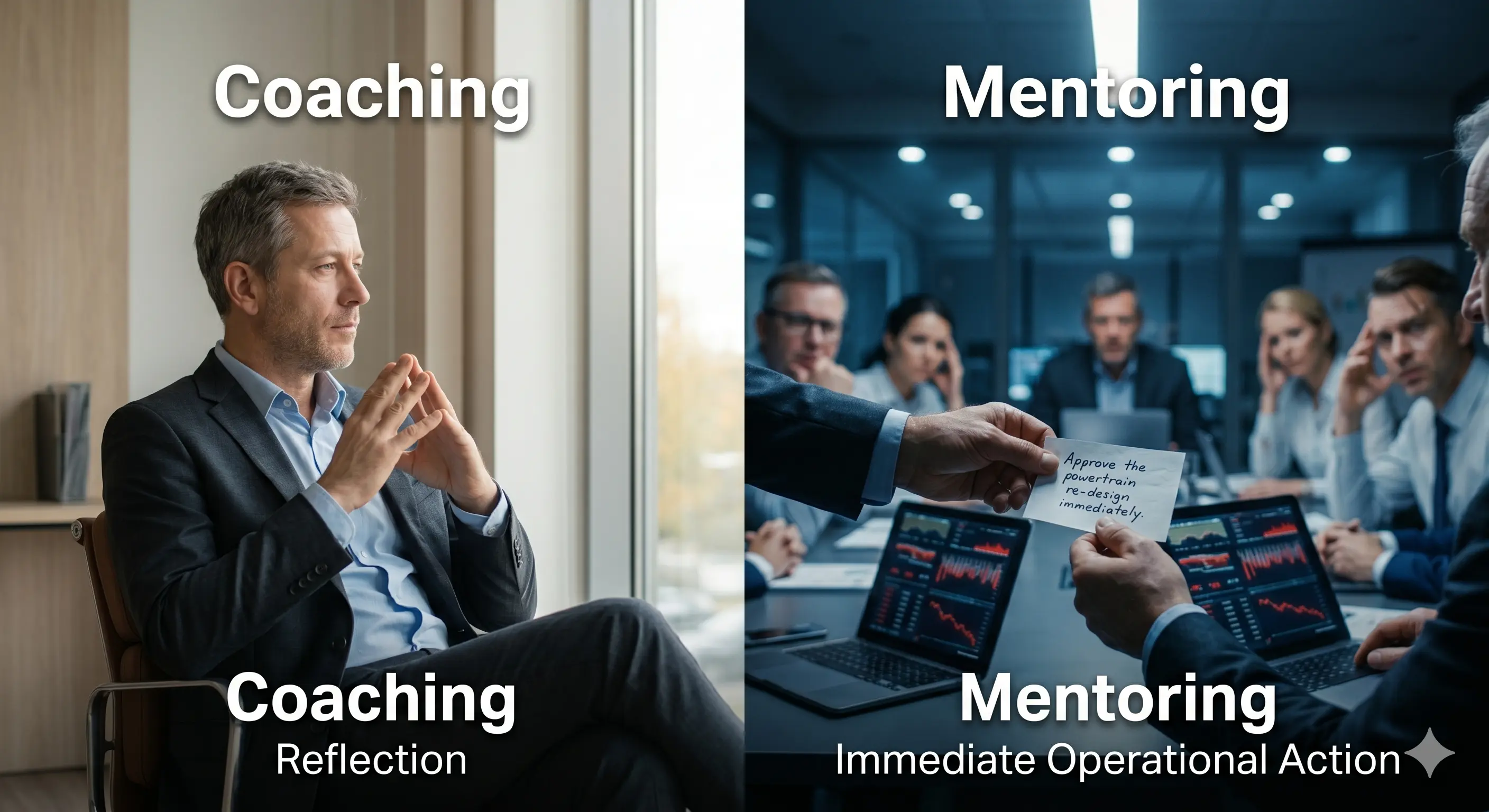
Mentoring Is Not Coaching. One of These Closes Your Gap Faster.
Coaching: Building Durable Self-Awareness
Coaching is a rigorous discipline. It builds durable self-awareness by surfacing what you already know but have not yet articulated. A skilled coach will not tell you what to do: the protocol prevents it. That is the strength of the format, and in the right moment, it is the only format worth choosing.
Industrial Mentoring: Immediate Operational Transfer
There are moments when you do not need to find the answer: you need the answer. The budget review is in four days. The headcount conversation has been avoided for six weeks. The team in Pune is delivering reports that look green and feel wrong.
In these moments, coaching builds awareness that the situation is serious, but mentoring transfers the specific operational move that closes the gap.
Industrial Mentoring starts with your current situation and ends with a concrete next step. Not a reflection question: a specific action, calibrated to your team, your matrix, and the cultural context of your exact organizational reality.
Which Mentoring Situation Is Yours?
Five questions. Two minutes. The widget routes you directly to the track description that matches your situation. Read it. If it describes your reality precisely, the link takes you to the full page.
Which Situation Is Yours?
Five questions, two minutes. The navigator routes you directly to the track that describes your situation most precisely.
1 of 5: What describes your situation most closely right now?
2 of 5: Where is your energy leaking?
3 of 5: What would change the most for you?
4 of 5: Which sentence hits home?
5 of 5: What is most urgent right now?
Four Mentoring Transitions. Read the One That Is Yours.
Expert to Leader: Monday, 7:42. The Phone Rings. There Is No One Else.
Your key engineer's child is sick. The project review is at ten. The system you built has exactly one backup plan: you. That moment is not a crisis: it is the structural reality of a leader who has not yet made the transition from solving every problem personally to building a team that solves them.
The reflex to go deep, to solve it yourself, to be the one who gets it right, is the exact behavior that produced your career. It is also the behavior that is now blocking the team's development and consuming the calendar space that belongs to leadership work.
The identity shift is harder than the skill shift. You were hired, promoted, and recognized for technical excellence. Letting go of the problem feels like a reduction. It is not: it is the transition that separates good technicians from lasting leaders.
The mentoring makes the transition explicit and structured: the decision between technical and leadership roles, the delegation architecture that transfers real ownership, and the GROW framework that converts escalations into development opportunities.

Lead Without Authority: You Run the Project. You Do Not Own the People.
The meeting ends. Everyone nods. Three days later, the engineer you depend on is deep inside a priority set by a line manager who has never heard your project name. You have no disciplinary role, no performance lever, no formal mandate. What you have is a delivery commitment and a team that technically belongs to someone else.
The response most coordinators develop is to absorb everything. Every gap, every missed commitment, you close yourself. At 23:00 on a Sunday. The system rewards this behavior because the project stays on track. What it does not see is the slow erosion of capacity.
Influence without authority is not a personality trait: it is a learnable architecture. The people who navigate this role sustainably build credibility that precedes the ask and accountability structures that hold without the disciplinary lever.
The mentoring builds genuine influence: the credibility sequence that earns respect, the accountability conversation framework that holds commitments, and the capacity protection system that makes the role viable over years.

Team Lead: Someone Falls Out and the Load Lands on You.
Friday afternoon. Your strongest engineer just called in sick. The customer review is on Wednesday. There is no deputy, no backup structure, no distributed ownership. The load transfers directly and entirely to you.
That moment is the diagnosis. The team you built has one critical dependency: you. Every escalation routes through you because you have always had the answer. Every absence exposes the same gap because no one else has been developed to carry the thread.
The instinct that made you excellent as a small-team leader (knowing every detail, being the person everyone turns to) has become the structural bottleneck. The team is not failing: the architecture is.
The mentoring builds strategic redundancy: the 90-day plan that identifies and develops deputies, the peer network beyond your silo, and the delegation architecture that transfers real accountability without removing your oversight.

Director: Your Team Is Strong. And Someone Else Just Decided Its Future.
The message arrives on a Tuesday: headcount restructuring. Your department is on the list. The engineers who carry the institutional knowledge of three product generations are now line items in a cost optimization model built by people who have never attended a technical review.
You were not in the room when the decision was made. Not because you were excluded, but because you were not yet part of the network where decisions like this are shaped before they reach a formal vote. You built a technically excellent department, but not the political architecture that protects it.
This is the director's blind spot. Technical performance is visible; strategic positioning is not. Budget conversations happen six months before the budget meeting.
The mentoring builds the pre-decision architecture: the internal network before you need it, the resource-framing language that repositions your department from cost center to capability asset, and the stakeholder map that turns resistance into partnership.

What Industrial Mentoring Actually Looks Like.
The lesson I did not expect to learn from a software developer who bred dogs.
When I was building the R&D department in Prievidza, one of my software developers, Eric, had an unusual arrangement from the start. He bred dogs professionally: competition-level breeding that required structured outdoor time every day. A normal 9-to-5 office schedule was physically impossible for him.
I said yes anyway. Not as a favor. As a calculated bet on a person I had read carefully.
High-Performance Results Beyond Standard HR Models
What happened was not what the standard model predicted. Eric became one of the most reliable people on the team. Bamberg, the German headquarters, praised his work directly and repeatedly. His ideas were sharper than colleagues who sat in the office eight hours a day. His team found a flexible schedule together: dog care and work, without conflict.
Trust as a Precise Operational Retention Mechanism
The lesson was not about home office policy. It was about what happens when a leader genuinely invests in understanding the real circumstances of each person on their team. Trust, real trust, is not a management concept: it is the precise operational mechanism that produces loyalty, performance, and team stability that survives a competitor offering 30% more salary.
You already know this instinctively. What the mentoring gives you is the architecture to apply it under pressure, across cultures, and at the speed your organization requires. Not as a philosophy. As a repeatable practice.

Executive FAQ: Industrial Mentoring & Matrix Leadership
Q1: What is the difference between mentoring and coaching?
Coaching builds awareness through structured questions. The coach does not tell you what to do. That is the discipline. Mentoring transfers operational experience directly. In a mentoring session, if you are navigating a specific organizational challenge, you receive the move that experience has already tested. Both are rigorous. They serve different moments. If you are uncertain which fits, the Reality Check gives you a direct answer in 30 minutes.
Q2: How do I know which track is right for me?
The widget on this page routes you in five questions. The direct read: a team lead carrying every escalation is Track 1. A director losing budget battles they should win is Track 2. A technical expert entering a leadership role is Track 3. A coordinator without formal authority absorbing every gap is Track 4. If your situation spans more than one track, the Reality Check is the right first step.
Q3: Is this only for automotive leaders?
No. The transitions are universal across technical industries. The DE-SK-IN intercultural dimension is specific to the BYG toolkit, but the structural challenges of scaling a team, navigating resource politics, making the expert-to-leader identity shift, and leading without authority appear in aerospace, pharma, energy, software engineering, and industrial automation.
Q4: How long does an engagement typically run?
Six to twelve months. The initial sessions establish baseline and identify the highest-leverage intervention points. From there, the work alternates between new operational input and structured application to real situations from your projects. The pace is set by your organizational calendar, not a fixed module sequence.
Q5: Is every session directly with Andy Balbus?
Yes. A maximum of ten active mentoring clients at any time. No delegation, no junior consultants. Every session is senior, direct, and fully confidential. The capacity ceiling is structural: above ten clients, the quality of individual attention cannot be maintained.
Q6: Can I combine mentoring with coaching?
Yes, and some leaders do. Mentoring transfers operational intelligence for the immediate leadership challenge. Coaching builds the deeper personal development layer alongside it. Both can run in parallel with clear boundaries between them. The Reality Check helps identify which is the right starting point for your current situation.
Q7: What happens in the 30-minute Reality Check?
Thirty minutes. You describe your current situation, the patterns you are navigating, and the outcomes that matter most. At the end of the conversation, you receive a direct answer: which track fits, what the engagement would look like, and whether mentoring is the right format at all. No obligation, no sales sequence. A direct assessment.
Q8: Why do my Indian developers agree in the meeting but the work does not arrive on time?
The Indian Yes is often a sign of respect for hierarchy, not a confirmation of feasibility. A direct no to a senior leader can feel disrespectful, so agreement is given in the room and the real constraint surfaces weeks later. The fix is not more pressure. It is a question structure that makes the honest answer the safe answer. Intercultural mentoring transfers the specific open-question patterns that surface the real timeline before it costs an SOP week.
Q9: How do I ask open questions that get honest answers from an offshore team in Pune?
Closed questions invite the answer the team thinks you want. Open questions, phrased to remove the hierarchy penalty, invite the answer you actually need. The move is to ask about the obstacle rather than the status: not whether you are on track, but what would put this at risk. The mentoring gives you the calibrated phrasing for each cultural context, tested across years of leading teams in the DE-SK-IN triangle.
Q10: My matrix splits functional and disciplinary responsibility. How do I lead someone I cannot evaluate?
This is the structural core of leading without authority. Real authority in a matrix rarely comes from the org chart. It comes from credibility and trust built before you need them. The mentoring transfers the credibility sequence and the accountability framework that hold commitments without the disciplinary lever, the exact situation the Lead Without Authority track is built for.
Q11: How do I build trust with a new engineering team in Slovakia that escalates everything upward?
Teams led by highly directive managers for years develop deep upward-escalation habits. Changing that is structural work, not a motivational speech. It starts with how you receive the first honest escalation, because that single response teaches the team whether candor is safe or expensive. The mentoring gives you the sequence that rebuilds distributed ownership in a greenfield or post-directive context.
Q12: We have a hiring freeze. How do I justify mentoring to the board?
A hiring freeze makes this intervention more rational, not less. If you cannot buy capacity, you have to extract more value from the talent you already have. The mentoring stops the expensive brain drain of senior experts and scales the output of your existing team. It protects EBIT when headcount is frozen.

The Gap Does Not Close by Itself.
Every transition that goes unnavigated costs more than the time it takes to close it. Team stability erodes. Political capital you should have built three quarters ago does not exist when you need it. The calendar fills with firefighting and the strategic work stays on the list.
Industrial Mentoring does not produce awareness of the problem: you already have that. It transfers the operational intelligence that closes the gap, calibrated to your exact situation, applied in the sessions where it becomes real.
The Reality Check is 30 minutes. You describe your situation. I tell you directly which track fits and what the engagement would look like. That is the entire first step.
Or Directly: founder_andybalbus@boost-your-growth.com | WhatsApp: +49 151 4495 7099

Systemic leadership does not end after one call.
Follow for unfiltered automotive leadership insights, real-world case studies, and straight-talk execution strategies:


