
Three Principles. Zero Compromises.
Not a manifesto.
Not a values poster on a wall.
The exact operational foundation Andy has used for 25+ years inside the automotive matrix, and applies in every engagement.

Before You Read the Three Principles, Ask Yourself These Questions.
These are not abstract leadership questions. They are the three operational root causes behind most SOP delays, attrition spikes, and cross-border alignment failures Andy has seen in 25+ years inside the automotive matrix. All of them maps exactly onto the three principles that define every BYG engagement.
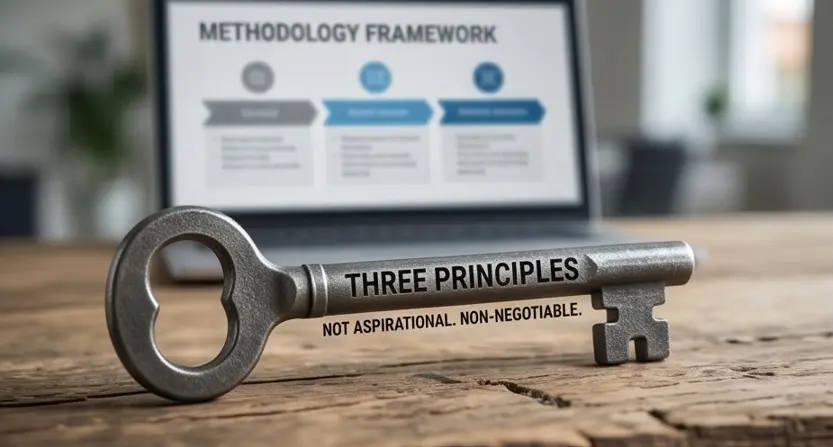
Why Three Principles, and Not a Methodology.
Every consultant has a methodology: a framework, a model, a branded process with phases and deliverables. Methodologies are useful. They do not tell you how a person decides when the situation is ambiguous, the pressure is high, and there is no slide in the deck for what just happened. Principles do, and that is the difference. A principle is not a rule you follow when it is convenient. It is the ground you stand on when everything else is uncertain.
The BYG Code has three. They are not aspirational. They are non-negotiable. Andy holds them for himself, and he holds them for every person he works with. They do not make leadership more comfortable. Often they make it harder. Without them, the work would be indistinguishable from advice in any book, and the problems you are managing are too real for that.
Why These Three. Not Because Andy Read Them in a Book.
Andy did not derive the BYG Code from a leadership framework. He extracted it from 25+ years of decisions made under real OEM pressure, and from the moments when he broke one of the three and paid for it.
There is one more reason the Code is not negotiable for him. On 15 January 2024, Andy nearly died. A blood clot. After an experience like that, a person stops tolerating the comfortable lie, the soft deadline, the excuse everyone in the room silently agrees to accept. The runway is too short to lead any other way. That is not sentiment. It is the most practical filter Andy owns, and it sits underneath all three principles.

Principle 1: Honesty Is Not Negotiable.
This is the one that makes people uncomfortable. Not because they disagree with it in theory, but because they have built entire organizational systems designed to avoid it.
The Green-Melon Effect is not a cultural problem. It is a psychological safety problem. Your Slovak team is not sending green reports because they are lazy or dishonest. They are sending green reports because at some point a red report cost someone something, so they calculated the safer version and sent that. The same pattern runs in every direction. German HQ sends directives and calls them suggestions, because a direct command is politically inconvenient. The Indian hub confirms deadlines, because saying no to authority is culturally dangerous. The result is a system where nobody is lying and the truth is nowhere in sight.
From the field: the day Andy learned his own emotions were visible.
On his last day in Prievidza, his assistant Livia told him something he had never expected. She had run a secret team chat for years. Its purpose: to warn colleagues when Andy arrived in a difficult mood, so they could prepare. He had believed he was managing his emotions. He was wrong. The people who knew him well had been reading him accurately and protecting themselves, quietly and efficiently. The lesson he took from that day: you cannot enforce honesty in others if you are not first honest about yourself. Leadership starts with knowing that your inner state is not as private as you think.
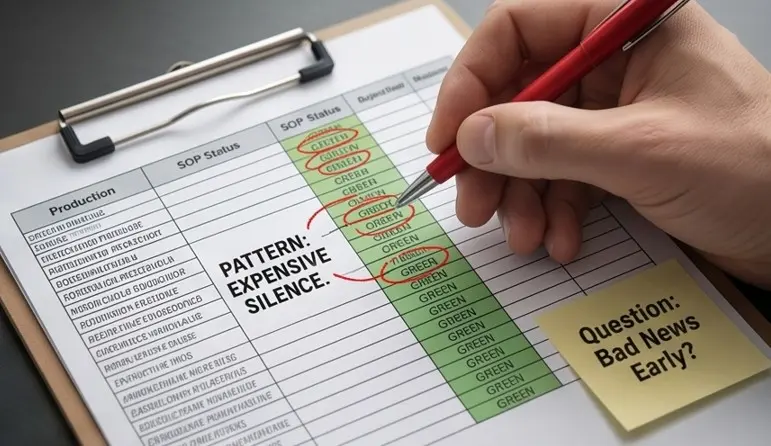
What Honesty Is Not Negotiable means in practice:
Principle 2: A Deal Is a Deal.
This sounds obvious. It is the least obvious principle in practice.
In most international matrix organizations, a commitment is the beginning of a negotiation, not the end of one. A deadline is a suggestion with built-in buffer. And a yes from Pune is a sign of respect, not a promise of delivery. A status report that says green means the person sending it has decided green is the version you needed to see.
The cost of that ambiguity compounds. Every unclear commitment generates three follow-up calls. Every missed milestone generates a week of replanning. Consequently, every yes that turns out to mean I will try costs someone a sleepless night before the next quarterly review.
From the field: the taskforce and the missed milestone.
Andy spent half a year in Würzburg, leading a global taskforce of 50 people and learning to hold his own among the most senior players in the company. The project had gone off course, and his job was to bring it back. A senior developer missed a critical milestone. When Andy asked why, the answer was: I forgot. In that room, at that moment, Andy made a choice. He did not shout. A scene would have not helped. He calmly asked the group what the missing piece meant for the project, and they documented it. After the meeting, he found the person privately and made one thing unambiguous: this would not happen twice. Within days, everyone in that taskforce understood that a commitment was not the start of a conversation. It was the end of one. The project came back on track, and the culture shifted in a single exchange.

What A Deal Is a Deal means in practice:
Principle 3: No Excuses, Go for Results.
This is the most misunderstood of the three. It does not mean be harsh, ignore context, or demand the impossible. It means own your part completely, and move your energy from explaining the problem to solving it.
The excuse culture in international matrix organizations has an elegant structure. There is always someone else to blame. German HQ sent unclear requirements. The Slovak team misunderstood the brief. The Indian hub confirmed something it could not deliver. Everyone is technically correct. The SOP is still failing.
No Excuses does not mean context does not matter. It means context is your starting point, not your destination. You name the constraint, you own your response to it, and you solve from there.
From the field: the 22-minute problem.
One of Andy’s clients had carried a problem for months. It was draining his team, his calendar, and his confidence. He arrived with a full list of reasons the situation was as hard as it was: structural, political, interpersonal. All of them real. None of them useful. Andy asked one question: what would you do right now if none of those constraints existed? He answered immediately. The session lasted 22 minutes. The problem he had managed for months had a solution he already knew, and had been protecting himself from acting on by keeping the conversation in the excuses.
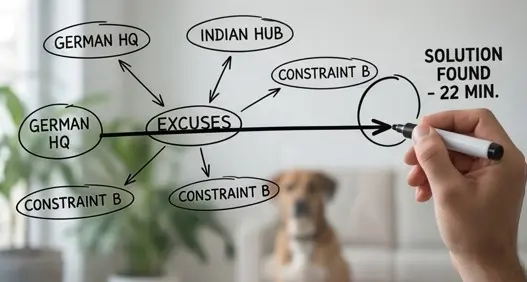
What No Excuses means in practice:
What Happens When One of the Three Breaks.
Not as a philosophical question. As an operational reality.
When Honesty is negotiated:
Problems arrive late. By the time you hear about the SOP deviation, the delay is already in the timeline. The green report has been green for three weeks while the floor was managing red. Trust repair takes longer than the project itself.
When a Deal is not a Deal:
Micromanagement becomes structurally necessary. You cannot delegate because you cannot trust delivery. Every milestone needs a follow-up call. Your calendar fills with status meetings, and your strategic thinking disappears into them.
When Excuses are accepted:
The standard moves. Once one excuse passes without consequence, the next is easier to give. Within six months, your team has learned that the real deliverable is not the outcome. It is a plausible explanation for why the outcome did not happen.
Each of these patterns is self-reinforcing. Each is reversible, but only if someone names it directly, holds the line consistently, and models the alternative.

Why the Code Pays for Itself.
The three principles are not a moral position. They are a margin position. A team that escalates honestly catches the SOP deviation while it is still cheap to fix. Ultimately, a team where a deal is a deal lets a leader delegate, which frees the strategic capacity the role was hired for. A team that goes for results instead of excuses keeps its best engineers, because good people stay where the work is honest and the standard is real.
That is the win for the leader, the win for the employee, and the win for the customer who receives the better product. Underneath all three sits the win the company can put in a spreadsheet: lower attrition, lower cost of replacing lost knowledge, lower sick leave from prevented bore-out and burn-out. Soft skills, hard margins. The Code is simply where that math begins.
Why These Three. The Proof Behind the Code.
Andy extracted these principles from 25+ years at Brose Automotive as Director of Electronics: 40+ engineers built from zero in Prievidza, 150 million euro in annual revenue responsibility as Head of Electronics, six countries, real pressure, real consequences. He coached 12 executives inside the Brose India hub in Pune (2023-2024) and built the Brose Training Academy from the ground up, where the three principles were not taught as concepts but practiced in real escalation calls and real cross-cultural friction. Across coaching, mentoring, and training, 1,000+ coaching hours and ICF PCC certification, the principles hold across industries, cultures, and seniority levels, from a first-year student to the President of a hub.
The department he built still runs today, under his successor Maik. That is not a credential added to a slide. It is the proof that what was built was built to last beyond him, which is the only version of success that counts.
FAQ: Direct Answers on the Three Principles.
Q1: How do you build a culture of honest escalation in a team that has learned silence is safer?
You make the first red report safe, visibly and repeatedly. People stayed silent because at some point a red report cost someone something. The repair is to reward the early warning, never punish the messenger, and model it yourself by naming your own mistakes first. Honesty becomes safe only when the leader proves it is, more than once.
Q2: How do you handle team members who demand salary increases when you do not have final budget authority?
With honesty about what you control and a real commitment on what you do. You do not pretend to hold authority you lack, and you do not hide behind that either. You name the constraint, you own the part of the outcome that is yours, the advocacy, the documentation, the timeline, and you deliver on exactly that. A deal you can keep beats a promise you cannot.
Q3: Does honesty include showing your own stress or frustration as a leader?
Your state is already visible, whether you show it or not. The honest move is not to perform a calm you do not feel, but to name your state accurately so the team does not have to guess and protect itself from you. There is a difference between dumping emotion and acknowledging it. The first erodes safety. The second builds it.
Q4: Why do standard meeting protocols often fail to secure real commitments?
Because a protocol records what the leader paraphrased, not what the responsible person actually committed to. The gap between I noted that you will deliver Friday and the person saying, in their own words, I will deliver Friday is where commitments quietly dissolve. Real commitment is spoken by the owner, not transcribed by the leader.
Q5: How do you handle a senior expert who misses a critical milestone and says they forgot?
Two moves, in order. In the room, you protect the project and the person: name the impact, document it, keep the meeting about the work, not the blame. After the meeting, in private, you make it unambiguous that this does not happen twice. The standard is held without a public scene, which is exactly what makes it credible.
Q6: My Indian team confirms every deadline but deliveries often fail. How do I change that without damaging the relationship?
Stop treating the confirmation as the commitment, and never punish the first honest this is at risk. The deliveries fail because saying no to authority felt unsafe, so the gap stayed hidden until the deadline. Build a structured escalation path where surfacing a risk early is rewarded, and where the person is never trapped between two authorities. The relationship improves, because you have removed the trap.
Q7: Is it fair to demand results when someone is missing deadlines because of genuine overload?
No Excuses does not mean ignore overload. Overload is a real constraint, and naming it is honest. The principle says the constraint is the starting point, not the destination: you name it once, then you solve from there, together. If the overload is structural, the result you go for is fixing the structure, not pretending the person can do the impossible.
Q8: Is the BYG Code compatible with coaching-based leadership?
Yes, and it sharpens it. Coaching is how you help a person find their own answer. The Code is the standard the conversation is held to: honesty, kept commitments, ownership of results. Coaching without a standard becomes comfortable and goes nowhere. A standard without coaching becomes command and control. The two together are the point.
Q9: These three principles sound more like rules than coaching. Isn’t that a contradiction?
A principle is not a rule. A rule tells you what to do in a known situation. A principle tells you how to decide when the situation is new and the deck has no slide for it. The Code does not script your behavior. It gives you stable ground to stand on while you work out the specifics, which is exactly what high-pressure leadership needs.
Q10: How long does it take to shift a team that has run on green-melon reporting for years?
The first shift can happen in a single honest exchange, the way a taskforce can change in one conversation. Making it durable takes longer, usually months, because the team needs repeated proof that honesty is safe now. The variable is not time. It is consistency. One accepted excuse, one punished red report, and the old pattern returns.
Q11: Which of the three patterns is the most expensive when it breaks?
Accepted excuses, because the damage compounds quietest. A late escalation is visible once the delay lands. A broken deal forces a follow-up call. An accepted excuse moves the standard itself, and within six months the real deliverable becomes a plausible explanation instead of a result. By then the cost is cultural, and cultural cost is the hardest to reverse.

If You Want Someone Who Accepts Excuses, You and Andy Are Not a Fit. If You Do Not, Let’s Talk.
The BYG Code is not a promise Andy makes to you. It is a standard he holds for himself first. Every session he delivers, every commitment he makes, every piece of honest feedback he gives runs through these three filters. Not because they are easy. Because without them, the work would not be worth doing.
If these three principles describe the leadership culture you want to build, or the leader you are trying to become, the 30-minute Reality Check is the right first step. No commitment. No pitch. A direct conversation about what is actually in the way.
Or reach out directly: founder_andybalbus@boost-your-growth.com | WhatsApp: +49 151 4495 7099

Systemic leadership does not end after one call.
Follow for unfiltered insights and straight-talk strategies:


