
Thirteen Decisions. Not Thirteen Success Stories.
Real leadership moments, with the pressure, the uncertainty, and the outcomes that took months to become visible.
These automotive leadership case studies are not polished stories written for a brochure. They are situations where a decision had to be made before the outcome was known. Every leader who works with me brings a situation that looks unique to them, and it is. Yet after 25+ years inside the automotive matrix across Germany, Slovakia, India, China, Mexico, and the United Kingdom, the patterns underneath are recognizable: the names change, the pressures differ, the root causes stay the same.
Every story on this page is anonymized. That is by design, not by caution. Anyone who works with me should know this: what you share with me stays with me. That safety is the foundation of any honest sparring relationship. What I share is the situation and the lesson, never the identity of the person.

Spotting and Keeping Talent
The most expensive role is the one you have to fill twice. In automotive, specialist attrition sits in a documented band of 20 to 25 percent. Keeping talent does not start with salary. It starts with whether someone finds the right thing with you. Three stories on that.
The Key Engineer Who Left, and Came Back to Lead
When someone takes a detour and returns, that is the clearest proof the culture was real.
One of my strongest young engineers received a much better salary offer from Western Europe. I knew at once that I could not match it, and honestly I would not have tried. He was talented, ambitious, and looking for more experience than our structure could give him at that moment. What mattered was how he raised it: openly, respectfully, directly. So I kept the door explicitly open for him, not as a tactic, but as an expression of trust.
About a year later he came back, and his priorities had shifted: team cohesion and a dependable environment now meant more to him than salary alone. He became team lead for one of my groups, and in many ways a stronger leader than he would have been without that detour.
The Outcome
He did not return because the salary was higher. He returned because the culture was real. A team charter is not a poster on the wall. It is how a team actually works when no one is watching.
The Lesson
Team culture is not built through rules. It is built through consistent behavior over time, led from the top. The charter gives the team a language for it. The leader’s daily example makes it credible.

Situation: Talent retention, key engineer resigns despite a strong offer, team culture · Service: Team Charter Workshop, Industrial Mentoring · Anchor: Team Charter, Psychological Safety, Servant Leadership · Location: Electronics R&D, Slovakia
The Engineer Who Would Only Work From Home, and Impressed Headquarters
He had no nine-to-five day. He had ownership. And he carried it more reliably than many on fixed schedules.
He was clear from the first conversation: if he joined, it would be exclusively from home. No negotiation. His reason was not convenience but a genuine passion. He breeds dogs for competitions, and that does not fit a rigid office day. I could have insisted on the standard model. Instead I accepted his condition, and together we built a rhythm that allowed both: dog care and dependable delivery.
What happened next surprised even me. He became a bridge between Slovakia and our German site, delivering performance and ideas that earned real recognition. Not polite acknowledgment, but unsolicited praise that reached me repeatedly from Germany.
The Outcome
Trust creates responsibility. Control creates only compliance. A leader who sees the person behind the employee earns a loyalty no control system in the world can force.
The Lesson
Remote leadership is not the same for everyone. That is the most uncomfortable truth about leading at a distance, because it demands individual solutions rather than a uniform rule. Know people’s circumstances and respect them, and performance comes willingly.

Situation: Remote leadership, trust over control, individual work models · Service: Industrial Mentoring, Executive Coaching · Anchor: Servant Leadership, Psychological Safety · Location: Electronics R&D, Slovakia
The Hotel Receptionist I Recruited on a Gut Feeling
Three languages, one solution, no hesitation. Sometimes talent shows itself not in a resume, but in how someone solves a problem.
My parents were on their way to visit me in Slovakia and got stuck in traffic near Brno. They asked me to go to the hotel and sort out how they could still check in late at night. I drove there straight after my meetings, opened in Slovak, then switched to English, and the receptionist smiled: she heard my German accent. We moved to German, she listened to the situation briefly, gave me the solution, and arranged everything in the house.
What impressed me was three languages, focus, and a solution-oriented, customer-first instinct in a single moment. I asked whether she could imagine joining us. What I did not consider then, and know now, is that you do not simply recruit someone away from another company. She felt genuinely at home with us and grew strongly. She became the mother of the department, strict and empathetic at once. With my HR team I had to find a clean solution afterward, because I had skipped every process. We managed that too.
The Outcome
A hire made against every formal process became one of the defining personalities of the department. The instinct was right, the path to it had to be put in order afterward.
The Lesson
Trust your instinct when you spot talent, and respect the structures that protect others at the same time. Both belong together. A good gut feeling does not release you from the responsibility to make the process right afterward.

Situation: Spotting talent, potential over resume, lateral hire · Service: Industrial Mentoring · Anchor: Active Listening, Servant Leadership · Location: Slovakia
The Intercultural Matrix: Germany, Slovakia, India
The most expensive misunderstanding in a global engineering matrix appears in no status report. It happens when a team reports harmony out of structural caution while the problem grows quietly. Three stories about what happens beneath the surface.
Three Escalations From a Distance, Solved in Two Days on Site
The team had not failed. The system had failed the team.
I led a growing team of engineers in India from Germany, voice calls only, no video. We worked closely, and I was responsible for their outcomes. One delivery stopped arriving, even though my local contact confirmed progress on every call. Two formal escalations later, nothing had changed. During my annual four-week visit, the situation became clear within two days: the plant manager on site had been assigning hidden work to my team, tasks that never appeared in the project tracker.
My contact was caught between two authorities, me in Germany and the plant manager on site, with no safe way to say no to either without risking the other. I had a direct conversation with the plant manager. We clarified responsibility. From that day, all work for my team came through me, and support for the plant continued, now coordinated and transparent. Deliveries returned to schedule.
The Outcome
Three months of remote escalation, solved in two days on site. Not because the problem was simple, but because it was invisible from a distance and obvious in person. The Indian Yes was never dishonesty. It was a team in an impossible structural position with no safe path to escalate.
The Lesson
Before diagnosing a performance problem, understand the structure the person performs inside. Accountability conversations only work when accountability is genuinely possible.

Situation: Intercultural matrix conflict, the team that confirms but does not deliver, hidden accountability gap · Service: Executive Sparring, Industrial Mentoring · Anchor: Clarity in Responsibility, GROW, Active Listening · Location: R&D hub India, remote leadership from Germany
The Helmet That Was Not One: What India Taught Me About Safety Culture
Understand the system first, then change the behavior. Never confuse compliance with genuine commitment.
On one of my first days in India, my driver explained why he did not need a helmet. Calmly and with complete conviction he said: as long as he did nothing bad, God would protect him. No defiance, no indifference, deep-rooted belief. My first reaction, honestly, was frustration. Then I stopped, and understood something that changed how I lead there.
When someone grows up believing that harm only reaches those who do wrong, a helmet is not a safety device but a statement of doubt about one’s own character. No poster and no process manual from Germany changes that. What changes it is a leader who invests time in understanding a belief before trying to change behavior.
The Outcome
Safety culture grew not through instruction but through example and patience with the roots of a behavior. That is the principle behind every engagement I run in intercultural teams: understand the system before you try to change it.
The Lesson
Ask rather than tell. And never mistake obedience for commitment. To change a behavior, you first have to understand the belief that carries it.

Situation: Building safety culture, intercultural leadership in India, compliance versus commitment · Service: Industrial Mentoring · Anchor: Active Listening, Psychological Safety · Location: India
They Are Taking Our Work Away: Four Years to Reframe a Fear
Freed capacity did not become layoffs. It became new, innovative products.
As we built the department in Slovakia, the skepticism in the German home team was tangible: they are taking our work away. That fear is not irrational. It is the obvious reaction when knowledge transfer looks like a zero-sum game. You cannot dissolve it with rules, only with time, one-to-one conversations, and an honest explanation of what the freed capacity is for.
Over roughly four years the picture shifted. The capacity the Slovak team took on was not used at headquarters for cuts, but for new, innovative products. A perceived threat turned into a shared engine of growth.
The Outcome
Two sites that first saw each other as rivals ended up working on different parts of the same future. A company that does not drive innovation falls behind over time. That narrative is exactly what made the transfer durable.
The Lesson
Knowledge transfer has to be framed as a strategic goal, not a threat. People carry a change when they understand what the freed energy will be used for.

Situation: Team fear of knowledge transfer, HQ integration, resistance to a new site · Service: Industrial Mentoring, Executive Sparring · Anchor: SMART goals, one-to-one conversations, storytelling · Location: Slovakia and German headquarters
Accountability and Performance
Culture is not declared. It becomes visible the moment a standard is either held or abandoned. In automotive, the financial risk of a missed milestone is not theoretical: a production line stoppage costs, on average, around 2.3 million US dollars per hour, according to Siemens (True Cost of Downtime 2024). Three stories about how accountability is built.
I Forgot: How a Protocol Became an Agreement
A deal is a deal. The standard is demonstrated in the moment it is held.
I was put into a taskforce leadership role with no preparation, accountable for the decisions of 50 people I had no direct authority over. My approach was simple: every commitment went into the protocol in the exact words of the person who made it. I asked each person in the round: how should I note this? When will you deliver? Does the group agree? The protocol became a binding agreement, not a meeting summary.
Three months in, a delivery was missing. A senior developer said in a full-round session: I forgot. I stayed calm and asked the group to document the consequences of that gap. After the meeting, I made one thing clear to him in private: a deal is a deal. This would not happen a second time.
The Outcome
The culture shifted at once. Participants began declining unrealistic deadlines in advance instead of explaining them later. The standard was held, and the project came back on track. The Project Management Institute notes that 56 percent of at-risk project budgets are jeopardized by communication failures. That is precisely the gap closed here.
The Lesson
Commitments are not flexible. If a deadline cannot hold, it has to be renegotiated in advance. Explanations after the fact do not count. Accountability is built in the one moment a standard is visibly held.

Situation: Taskforce without direct authority, accountability culture, senior stakeholders · Service: Executive Coaching, Core Principles · Anchor: A Deal is a Deal, Conflict Moderation, Harvard Negotiation Concept · Location: International taskforce, 50+ stakeholders
Three Missed Deadlines and a Whiteboard: The Problem Was Never the Work
The question what is wrong gives you explanations. The question walk me through your week gives you the truth.
One of my young hardware engineers missed three deadlines in a row. The workload was high, and I got a call from a partner site asking what was wrong. Late in the afternoon I sat down with him in a meeting room, not with a list of complaints, but with a whiteboard and questions. I asked him to walk through everything on his desk: what it was, when it was due, how long each part would take.
After an hour it was clear: this was not a capability failure. It was time management. The work was right, but sequencing and prioritization broke down under the increased load. I gave him no ready-made framework, but asked what support would help. We agreed I would find a suitable course, and within weeks he completed a two-day training.
The Outcome
Over the following two years the development became measurable. A person in chaos became one with structure that helped his internal customers enormously. He became one of the most reliable contributors on the team. The root cause was never work ethic or competence, but an invisible skill gap under a new level of load.
The Lesson
Coaching is the discipline of asking until the real problem becomes visible. The leader who listens, understands, and solves, rather than shouting, finds the cause. Every time.

Situation: Employee repeatedly misses deadlines, root-cause analysis, leading through questions · Service: Executive Coaching, Accelerate Now · Anchor: GROW, Active Listening, WHY-based leadership · Location: Electronics R&D, Slovakia
The 50 Circles: The Moment an Expert Became a Leader
Can you be the expert for all 50? That one question brought the breakthrough.
I sat with my mentee and asked how many people he leads today. Five, he said, and I asked him to draw that in his notebook. Then I asked what he does all day. He was the technical expert, leading the five both technically and as their disciplinary manager. When I asked how many people he wanted to lead as a director, he said 50. That is how the 50 circles came about, because I asked him to draw those too.
The circles alone did not create the click. The last two questions did. First I asked him to explain what all these people do technically, and he named very specific roles from hardware to software development, from test to validation. Then I asked him to look at his 50 circles again, knowing those roles and their challenges, and asked: can you be the expert for all 50?
The Outcome
That is when it landed. For the director role, he has to focus on leadership skills, not on whether he writes the best Python code. The step up is not a step into more technical depth, but into a different discipline.
The Lesson
Whoever leads can no longer be the expert for everything. The real job is to enable other experts. A good question at the right time moves more than any advice.

Situation: From expert to leader, the step to director, learning to let go · Service: Industrial Mentoring, Executive Coaching · Anchor: GROW, Delegation, Servant Leadership · Location: Slovakia
Building and Handing Over
True legacy does not mean being irreplaceable. It means creating conditions under which a team stays successful even after you leave. Two stories about building a structure and handing it over responsibly.
This Role Will Fail: The Department Still Runs Today
From zero to 40+ engineers. And a team that said at my departure: you are leaving a family we built.
When I was offered the role of Director of Electronics, my former team manager took me aside and was direct: this role will fail. Conditions too uncertain, technical demands too high. He believed in me, but not in the assignment. I accepted within seconds anyway. There was no detailed plan yet. I trusted the instinct that this was my moment and that the plan would be built on the ground.
Four years later the department had grown from zero to 40+ engineers, with a 2-million-euro technical lab, full product responsibility for two core lines, and 150 million euros of annual revenue responsibility. When I moved on, it was about a responsible handover. The combined leadership of engines and electronics was consolidated by headquarters to create synergies. I invested a great deal of time handing over each team member and each responsibility, person by person. That combined responsibility runs to this day.
The Outcome
The department that was meant to fail still runs almost a decade later. I did not hand my successor a folder. Over the final months I spoke with every individual and documented what was agreed, which development plans were running, which commitments were open. No one should lose their agreed future just because I moved on.
The Lesson
Trust your instinct, but prepare your exit from day one. The leader who builds a successor earns the right to move forward.

Situation: Greenfield build of an R&D department abroad, talent development, succession · Service: Industrial Mentoring, Legacy Program · Anchor: Consistent Delegation, Tuckman, GROW · Location: Electronics R&D, Slovakia
The Successor I Built Myself Over a Year
Succession is not an event at the end. It is a process that begins long before.
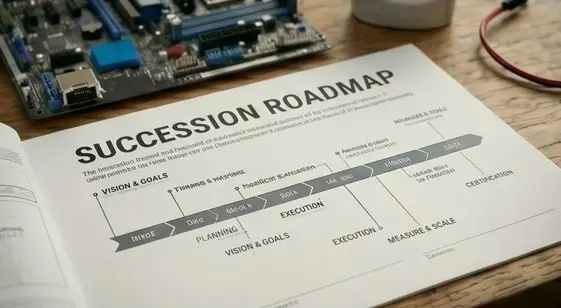
In India I built a genuine successor over roughly a year, not centrally appointed, but developed myself. She took on responsibility step by step in the training academy until she could carry its leadership. This was not a handover day with a binder and a handshake, but a long path of tasks, feedback, and growing trust.
The difference from a centrally mandated succession is large. Whoever builds a successor themselves hands over not just a function, but a posture and a network. That is what makes a handover stable, even when the leader leaves the site.
The Outcome
A successor who was grown rather than installed carries the responsibility forward with confidence. That is the clearest proof that development worked: when someone continues what you built, without you.
The Lesson
Distribute responsibility early, across several shoulders. Whoever plans succession only when it becomes urgent has few options left. Whoever builds early gives the team a future.
Situation: Building a successor yourself, knowledge handover, developing a successor · Service: Legacy Program, Industrial Mentoring · Anchor: Delegation, GROW, Mentoring Method · Location: India
The Person Behind the Employee
Leadership is not decided in the quiet moments, but where life reality and work reality meet. Two stories about the fact that you can only lead people if you see them as people.
The Fight for Office Access: Why There Is Never a One-Size-Fits-All
Some could not work remotely. I did not want to leave my team alone, so I went in myself.
Even before the lockdown I had proactively organized laptops, not as a pandemic plan, but out of caution. When it came, it quickly showed: for hardware and lab staff, remote work was barely possible. Their work cannot be done from the kitchen table. I fought, under strict conditions, for office access for exactly those colleagues.
And I went in myself, despite the risk, because I did not want to leave my team alone in the plant while others sat safely at home. That decision was not a gesture. It was the consequence of seeing that a blanket rule does not do justice to reality.
The Outcome
The team experienced that caution and presence are not opposites. Whoever had to work in the lab was not alone. Whoever could work from home was allowed to. Trust grew because the decision was built around the person, not around the most convenient policy.
The Lesson
Never blanket home office or office. Always respect the individual life and work situation. Leadership shows in who stands next to the team in the difficult moment.

Situation: Leading in a crisis, home office or office, individual work reality · Service: Industrial Mentoring, Executive Coaching · Anchor: Servant Leadership, Psychological Safety · Location: Electronics R&D, Slovakia
The Secret Group Chat: Why a Leader’s Mood Is Never Private
The team had a group chat to warn each other when I was in a bad mood. On my last day, I found out.
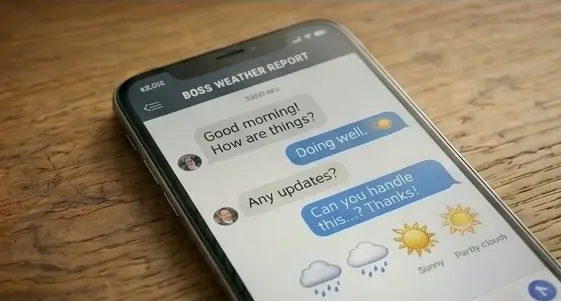
On my last day, one of my assistants let me in on a secret. The team had a private group chat with a single purpose: to warn each other when I arrived at the plant in a bad mood. First I smiled, then I understood how much was in it. What I considered my private matter had long been a weather report for the team.
On that same day everyone came in person, even though many worked remotely. They formed a line and said something personal to each of us. I could not hold back the tears. The secret group chat and that farewell belong together: both show how precisely a team reads its leader.
The Outcome
The realization changed how I handle my own state. Whoever openly says a day is hard takes the ground from silent observation. Honesty about your own mood is not weakness, it is leadership.
The Lesson
A leader’s emotional state is always visible. Be honest about it, or the team will be honest about it for you. Self-leadership starts with acknowledging your own impact.
Situation: Role modeling, emotional self-leadership, the leader’s effect on the team · Service: Executive Coaching · Anchor: Active Listening, Psychological Safety · Location: Slovakia
Client Voices
No theory, just concrete shifts in your operational reality.In their own words, distributed across the themes on this page.
No theory, just concrete shifts in your operational reality.

FAQ: Frequently Asked Questions
Q1: My key employee is resigning for a better offer. What can I do?
Do not assume you must outbid the salary. Check whether the person finds what they truly seek with you, such as development, responsibility, or an environment that carries them. Keep the door open. People who leave with respect often return with stronger values.
Q2: My team in India confirms every step but does not deliver. Why?
Treat a quick yes as a signal, not a commitment. In hierarchical high-context cultures, a no toward a superior is structurally risky. Very often there is no dishonesty behind it, only a missing safe way to escalate. Look at the structure first, then the performance.
Q3: When performance drops, do I look at the person or the structure first?
Start with the structure. Unclear priorities or hidden extra tasks often make performance problems look like people problems. Only when the structure is clean can you talk about the person.
Q4: An employee keeps missing deadlines. Is that a lack of discipline?
Rarely. More often it is an invisible skill gap under increased load, usually in time management. Map the real week together, task by task. The question walk me through your week reveals the cause faster than any reproach.
Q5: How does a protocol become real accountability?
Capture commitments in the exact words of the responsible person, with a date and the group’s agreement. The protocol then becomes an agreement rather than a summary. A deal is a deal, and that holds visibly for everyone.
Q6: I am the best technician on the team. Why should I let that go when I step up to director?
Because you cannot be the expert for every role you then own. The job shifts from solving yourself to enabling others. Whoever cannot let that go becomes the bottleneck of their own area.
Q7: Does remote leadership really work, or do I lose control?
It works when it sees the person behind the employee. Trust creates responsibility, control creates only compliance. A blanket home-office rule fails, while individual arrangements that respect circumstances hold.
Q8: My German team fears the foreign site is taking its work away. How do I handle that?
Frame the knowledge transfer as a strategic goal, not a threat. Explain what the freed capacity is for, ideally innovation. This reframing takes time and many one-to-one conversations, yet it is the only durable path.
Q9: Why plan succession while everything is still running?
Because the options shrink once it becomes urgent. Strong leaders distribute responsibility early and build their successor over months. A self-developed succession is more stable than a mandated one.
Q10: Does a leader’s mood really matter?
More than most believe. Your team reads your state daily, whether you want it to or not. Honesty about a hard day takes the ground from silent observation and creates psychological safety.
Q11: How does coaching help when the problem is hidden?
It begins with the right questions, not with advice. We create clarity until the real bottleneck becomes visible. Change then usually follows quickly, because it addresses the true cause.
Q12: Is my case confidential if I work with you?
Completely. Every story on this page is anonymized, and that is deliberate. What you share with me stays with me. That safety is the foundation of any honest collaboration.

Direct answers to the situations behind these stories.
Practice Insights
Your Situation Is Different. The Patterns May Not Be.
Every story here began with a leader who sensed a problem they could not yet fully name. The Reality Check takes 30 minutes and is built to do exactly one thing: identify your real bottleneck and tell you honestly whether BYG is the right partner for it.
Or reach out directly: founder_andybalbus@boost-your-growth.com | WhatsApp: +49 151 4495 7099
Where My Services Run: Global Reach
I built the foundation of this work along the Germany, Slovakia, and India axis, in Prievidza and Bratislava, in Pune and Mumbai, and across the German industrial belt around Bamberg, Nuremberg, and Zapfendorf, where I made this shift myself. From there, the reach extends on purpose: across Europe into Austria, Spain with Barcelona, the Czech Republic, and Poland, and beyond the continent into China with Shanghai, Mexico with Querétaro, and the USA with Pittsburgh.
Because my services run live online and worldwide, I can support you wherever your matrix sits. And for on-site delivery, I come directly to you, including the Bangalore on-site with Ruchikka Kar.

Systemic leadership does not end after one call.
Follow for unfiltered insights and straight-talk strategies:


