Summary
Hidden Factory: The hidden factory is an invisible second plant that produces nothing but rework, scrap, and costs, eating up to 20 percent of your revenue. Low wages only mask this margin killer. Learn how a structured Gemba Walk helps you spot cluttered aisles, identify the true cost of poor quality, and attack errors directly at their source.
Your plant makes parts. Next to it runs a second one nobody planned, and it produces only one thing: cost.

This post is written for plant managers, production leaders, and quality leaders whose metrics look right on paper while the margin still disappears. For the leader who senses that more happens between the lines than the reporting shows. For anyone who has ever walked through a hall and thought something is wrong here, without being able to name it. What you saw has a name: the hidden factory.
What the hidden factory really is
The hidden factory is the sum of every activity that produces scrap, rework, and error correction without creating a single additional sellable part. It appears in no org chart and in no capacity plan, and yet it ties up people, machine time, and floor space. It is not an accident but a quiet, permanent state accepted as normal. And precisely because it counts as normal, almost nobody sees it, even though it stands right between the production lines.
What I saw in a factory hall in China
The walk to the canteen
My name is Andy Balbus. It was a visit to the test lab in China, still in my test-engineering role at the time, when I walked through the plant to the canteen. Production there was heavily manual, quite unlike the largely automated lines I knew from Germany. I was simply walking through, no task, no checklist, and still that walk has stayed with me to this day.

The cluttered aisles and the people in them
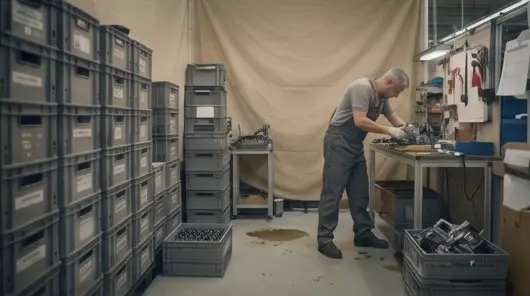
What struck me were the aisles between the production lines, which were relatively cluttered. And in those cluttered aisles stood many people doing rework on the products. Because I had the German production lines immediately in mind, the contrast was clearly visible. This was not only production, this was repair on a large scale of what the line had failed to make correctly the first time, right in the middle of the walkway, visible to anyone who looked.
Why low wages do not solve the problem
I was well aware that hourly wages in China were at a different level than in Germany at the time. So one could afford to rework and put more people on the lines. But that was exactly my conclusion, and it holds to this day: better onboarding, more thought-through production flows, quality controls at the correct points, each after a value-adding process step so as to strike where the error happens, short correction loops, and low scrap, all of it would have made sense even at low labor cost. Low wages only hide the hidden factory, they do not remove it.

What the eye sees before the metric shows it
I later saw similar behavior in India, rarely in Germany, but it happened there too. What I want to say is this: anyone who walks through a production hall with open eyes and sees cluttered corners, with people working on parts around them, should prick up their ears. Something unplanned is happening there that is worth exploring more closely. The eye often sees the hidden factory long before any metric quantifies it, provided someone actually goes there and looks.
The hidden factory does not reveal itself in the reporting but in the cluttered aisle. Whoever goes and looks finds the margin the numbers overlook.
Andy Balbus, 25+ years automotive, DE-SK-IN
You suspect such a second plant in your own operation? Then let us look together at where unplanned rework eats your margin. The Reality Check is a 30-minute diagnostic conversation, no slides, no sales pitch.
Book your Reality Check: 30 minutes, only your situation
What the hidden factory costs in numbers
The Hidden Margin Killer: The True Cost of Poor Quality
The hidden factory is no anecdote from a Chinese hall, it is quantified. The American Society for Quality and the work of Joseph Juran place the cost of poor quality at typical manufacturers between 15 and 20 percent of revenue. At operations with a weak quality system it climbs to as much as 40 percent, while world-class plants keep it below 5 percent. Between an average and an excellent plant lie double-digit percentage points of pure margin that nobody books as a revenue drop, because they pass through as normal cost.
Below the Surface: Why Scrap is Only the Tip of the Iceberg
The real trick of the hidden factory is how small its visible part looks. Benchmark data from the quality specialist EASE shows that scrap and rework alone run, depending on maturity, between 0.6 percent at the top performers and 2.2 percent at the weakest performers of revenue.
That is the tip that becomes visible in the scrap bin. The far larger remainder that fills up the 15 to 20 percent hides in re-inspections, expedited shipping, overtime, buffer stock, and lost capacity, exactly in the cluttered aisles I saw in China.
The 1-10-100 Rule: Striking the Error at Its Source
Why the focus on the error source pays off is shown by a principle Joseph Juran and Philip Crosby described as early as the 1960s in the prevention-appraisal-failure model. The order of magnitude follows the rule of thumb one to ten to a hundred: one euro spent on prevention saves about ten euros in internal error correction and about a hundred euros once the error first shows up at the customer. That is exactly why it is decisive to strike where the error arises, rather than laboriously working it out again at the end of the line.
Three Honest Questions Before You Read On
When did you last simply walk through your own production hall, with no task and no checklist?
Do you know how high your cost of poor quality really is, or only the visible scrap in the bin?
And at which point of your line is the check done, right after the value-adding step or only at the very end?
If you hesitate on one of these questions, the next section is for you.
Making the hidden factory visible: the Gemba Walk in three steps
1. Go there and see with open eyes
Step one is the one I took unconsciously in China: go there and look. Gemba is the Japanese word for the place where value is created, and a Gemba Walk is the structured walk to that place, not to control but to understand. You watch for cluttered aisles, waiting parts, people repairing instead of producing, and paths that make no sense. What separates Gemba from an ordinary tour, and why watching alone is not enough, is explained in the post on active listening, and the precise terms around the hidden factory are in the glossary.
2. Check at the value-adding step and attack the error at its source
Step two moves the check to where it works. Quality controls belong right after the value-adding process step, so that an error surfaces where it arises rather than at the end of the line. Short correction loops and clear priorities on which error source to tackle first you sort with the Eisenhower prioritization and translate into measurable goals with the SMART method. To make sure the root cause is fixed and not just the symptom reworked, the structured approach of the GROW method helps, and where errors grow out of unresolved friction between interfaces, industrial conflict architecture is the lever. How a single undetected error endangers the production start is shown in the post on SOP delay.
3. Make it visible and reduce it for good
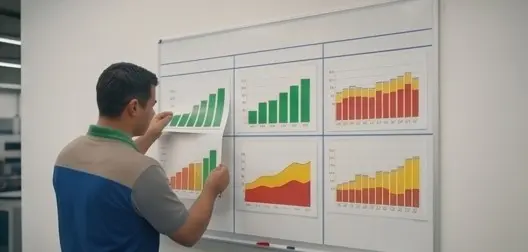
Step three lifts the hidden factory out of the shadows and into the reporting. Make scrap, rework, and their causes so visible that they sit on the table week after week, instead of passing through as normal cost. Binding rules on who maintains and discloses which metric you anchor in the Team Charter Workshop. Anyone who does not want to work the points off alone but hands over real responsibility will find the craft in uncompromising delegation, and how a team learns to name problems openly rather than cover them up is shown in the post on psychological safety. How hidden costs are lifted in real starting situations is shown in the case studies.
You want to finally see and quantify your own hidden factory?
Go to the Gemba Walk method page: from ritual to result
Or book your Reality Check directly: 30 minutes, only your situation
Voices from the Field
Why these two voices on a page about the hidden factory? Valentine Nelaev has worked for more than 18 years in technically complex industrial environments and judges clarity and depth from exactly the world where hidden quality costs arise. Manuel Prando has known me for many years and describes what makes a view that recognizes what matters now while keeping the future in sight, precisely the mindset that makes a hidden factory visible.
Every question I posed received a clear, direct, and well-considered response, and each matter was discussed in meticulous detail. What particularly impressed me was that even the most unexpected questions were met with thoughtful, insightful solutions.
Valentine Nelaev, Project Execution Expert, 18+ years oil and gas
He focuses on the currently important topics while keeping the future in view. Thanks to his broad experience and deep understanding, he has probably already mastered challenges similar to those of many others.
Manuel Prando, Google review (translated from the German)
FAQ: Straight Answers to Skeptical Questions

Q1: What exactly is the hidden factory?
The hidden factory is the sum of every activity that produces scrap, rework, and error correction without creating a single additional sellable part. It appears in no org chart, yet it ties up real people, machine time, and floor space. It becomes visible in cluttered aisles, waiting parts, and repair stations in the middle of production. Because it counts as normal, it is rarely quantified, even though it often costs 15 to 20 percent of revenue.
Q2: What does cost of poor quality mean?
Cost of poor quality is the sum of every cost that arises because products or processes are not right the first time. It includes internal failure costs such as scrap and rework and external ones such as complaints, warranty claims, and recalls. According to ASQ and Juran it runs at typical manufacturers between 15 and 20 percent of revenue. More terms around production and quality are explained in the glossary.
Q3: Is the hidden factory not simply a quality problem for the specialist department?
No, it is a margin problem for leadership. Scrap and rework tie up capacity that would otherwise make sellable parts, and this lost capacity appears in no profit-and-loss line as such. Anyone who delegates the hidden factory to the quality department treats a leadership issue as a specialist one. The responsibility to know the place of value creation yourself cannot be delegated away.
Q4: We have low labor costs, is the effort even worth it for us?
Yes, and for the very reason I recognized in China. Low wages make rework cheaper, they do not make it free, and they hide the real problem: processes that create the error in the first place. Better onboarding, sensible check points, and short correction loops pay off even at low wages, because they improve capacity, throughput time, and quality at once. The wage advantage evaporates the moment a competitor switches off its hidden factory.
Q5: Why check at the error source and not at the end?
Because an error grows more expensive with every process step it survives undetected. The principle from Juran and Crosby describes the order of magnitude one to ten to a hundred: prevention is ten times cheaper than internal correction and a hundred times cheaper than when the customer finds the error. A check right after the value-adding step catches the error where it arises, instead of dragging it through half the factory.
Q6: What separates a Gemba Walk from a normal plant inspection?
The intent. An inspection checks whether rules are followed, a Gemba Walk wants to understand why reality looks the way it does. On a Gemba Walk you go to the place of value creation, observe without a premature verdict, ask the people on the spot, and look for the cause rather than a culprit. How this questioning stance works in conversation is shown in the post on open-ended questions.
Q7: How do I start without disrupting ongoing production?
With a single walk through the hall, with open eyes and no checklist. Note where parts pile up, where people repair, and where paths make no sense, and start with the most striking spot. The structured method behind it is provided by the Gemba Walk method page, and the order in which to tackle each error source you arrange with the Eisenhower prioritization.
Q8: Who should do the Gemba Walk, the leader or the specialists?
Both, but the leader must not stay out of it. If only the specialist department goes, the hidden factory stays a specialist topic that never gets the priority and budget it needs. When leadership goes itself, it sees with its own eyes what the reporting smooths over, a pattern described in the post on the green melon effect, and can steer resources to where they work. The combination of both turns an observation into a decision.
Q9: How often should a Gemba Walk take place?
Regularly enough to become a habit, and irregularly enough not to harden into a ritual. A fixed rhythm creates reliability, yet the real value comes from the stance of being able to go and look at any time. A Gemba Walk that is merely ticked off loses exactly the open eyes that make it effective. The hidden factory changes, so the view must stay awake too.
Q10: Does this apply to sites I only lead from a distance?
There above all, because from a distance you cannot see the cluttered aisles at all. Anyone leading sites remotely needs deliberately designed formats to grasp the place of value creation anyway, whether through structured video walks or regular on-site visits. How to lead across distance without losing touch with reality is shown on the remote leadership method page.
Q11: How does BYG concretely help lift the hidden factory?
The methodical core is the Gemba Walk method page, embedded in the wider methods toolkit. For the individual development of leaders who need to sharpen their eye for the hidden factory there is engineering leadership coaching, and for acute relief of overloaded teams there is Accelerate Now.
The next step out of the hidden factory

If this post describes your meetings, start where the gap opens: with a binding operating agreement in the Team Charter Workshop or with the individual work on your own leadership in engineering leadership coaching. The mindset behind accountable leadership is laid out in the BYG core principles, and anyone who wants to develop team leads toward exactly this accountability will find the frame in team lead mentoring.
About the author: three worlds in one walk through the hall
You do not learn to recognize the hidden factory from a textbook, but from your own walk through the hall. Andy Balbus brings together three worlds that rarely meet in one person: 25+ years of operational automotive responsibility with 150M € revenue accountability and an R&D hub of 40+ engineers built greenfield, the methodology of an ICF PCC certified coach with more than 1,000 hours, and the intercultural perspective of four years as the accountable executive in Slovakia plus two years in Pune, with experience across DE, SK, IN, CN, MX, and UK. He has seen the cluttered aisles in China with his own eyes and knows which structure turns an observation into recovered margin.
Results or Excuses: The Reality Check
Your hidden factory keeps running, whether you look or not, and every week it burns margin nobody books as a loss. The Reality Check is a 30-minute diagnostic conversation: you bring your production reality, and together we find the point where unplanned rework costs the most, with the combined view from leadership, coaching, and culture change. No slides, no sales pitch, only your hall and its hidden costs.
Book your Reality Check: 30 minutes, only your situation
Systematic Leadership does not end with a phone Call.
Follow Andy for more Perspectives and Insights.
Leave a Reply