Summary
The Green Melon Effect describes the exact pattern where engineering teams deliver green status reports while critical problems compound invisibly inside your DE-SK-IN matrix. It emerges because challenging headquarters carries a heavy political cost in hierarchical cultures. This post exposes the three structural causes of automotive matrix reporting friction and reveals the only intervention that breaks the pattern before it destroys your SOP.
When Silence is Cheaper Than Honesty: The Hidden Cost of Your Alignment Calls
Your status dashboard is green. Every alignment call ends with agreement. And three weeks before your SOP date, a problem surfaces that your team has known about for a month.
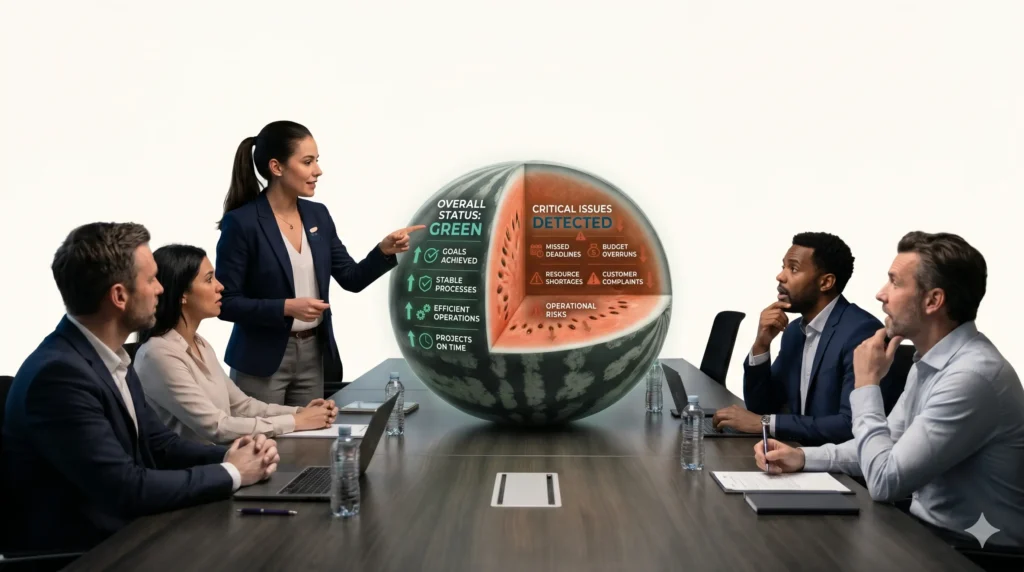
Nobody lied to you. Nobody made a mistake. Your engineering team gave you exactly what the system trained them to give: a safe answer. The real answer was too politically expensive to deliver. We define this automotive matrix reporting friction as the Green Melon Effect. Everything looks bright green on the outside. Inside, the operational reality is deep red.

The Financial Reality: What Invisible Friction Actually Costs
The Green Melon Effect is not a soft cultural problem. It is a severe financial risk with a direct line to your EBIT. Before we examine why it happens, the scale of the damage requires a clear baseline:
- Siemens, “True Cost of Downtime 2024”: Automotive production downtime averages $2.3 million USD per hour.
- McKinsey: 65% of matrix organizations report longer decision-making cycles due to alignment gaps.
- PMI, “Pulse of the Profession”: 56% of at-risk project budgets fail due to poor communication, not technical failure.
These are not abstract statistics. Every line represents a scenario that plays out in the DE-SK-IN matrix every week. A Slovak engineer knows the process directive will fail on the line but executes it anyway. An Indian project manager says yes to signal respect, not commitment. A German operations director looks at a green dashboard while the actual situation deteriorates.

Four Years in Prievidza: What I Learned About Silence
Slovakia, 2019. A new team. A new silence.
When I arrived in Prievidza to build the Electronics R&D department from zero, I ran alignment meetings the way I had always run them. Clear agenda. Structured updates. Confirmation at the end. Everything looked professional. Everything looked green.
What I did not understand yet was the silence. This was not the silence of people who had nothing to say. It was the silence of people who had learned that saying the wrong thing carried a cost. In a culture where challenging hierarchy felt politically unsafe, the safest move was to confirm, nod, and manage the problem quietly at the working level.
The turning point came when I stopped asking how things were going and started asking my team to walk me through the last step that did not go as planned. The pause after that question told me more than six months of status reports had. What I heard was not incompetence. It was self-protection from a system that had never made honesty safe enough to deliver.
Building psychological safety in Prievidza took longer than building the technical infrastructure. The lab equipment arrived in weeks. Trust took two years. The department we built grew to 40+ engineers managing 150 million Euro in annual revenue. It only became genuinely high-performing when the Green Melon Effect was broken structurally, not patched with better reporting tools.

Three Structural Causes of the Green Melon Effect
Dishonesty, incompetence, or cultural weakness do not create this dynamic. Three structural features in the interaction between the Bamberg headquarters and international teams produce this reporting friction. Understanding these features is the first step toward breaking the pattern.
What Changes When You Break the Pattern
Better dashboards, more frequent check-ins, or cultural awareness training cannot solve the Green Melon Effect. These interventions address the symptom while the structural cause remains intact. The only effective intervention is Industrial DNA Transfer: leaders stop broadcasting checklists and start building genuine two-way communication channels. When the Indian team understands the strategic background behind a deadline, not just the what, but the why, they make judgment calls in your direction even when you are unreachable. When the Slovak engineer knows that headquarters views early problem-raising as competence, not as failure, they raise it early.
Mentoring across 8,000 kilometers builds the binding operating system that protects your margins. Not through a single training, but through a sustained structural shift in how hierarchy and honesty interact across cultural boundaries.
FAQ: Frequently Asked Questions
Q1: What exactly is the Green Melon Effect and where does the term come from?
The Green Melon Effect describes the organizational pattern where status reports and alignment calls consistently show green, while the actual project or operational situation is deteriorating invisibly inside. The term comes from the visual of a watermelon. It is green on the outside and deep red on the inside. It emerges specifically in hierarchical cultures where challenging a superior or delivering bad news to headquarters carries heavy political cost.
Q2: How is the Green Melon Effect different from normal project delays?
Normal project delays are visible and escalated. The Green Melon Effect is specifically invisible. The problem is known at the working level but filtered out before it reaches decision-makers. In the DE-SK-IN matrix, this filtering is amplified by power distance in hierarchical cultures where challenging a superior from Germany is particularly costly.
Q3: How do I know if my team in Slovakia or India is showing me this effect?
Your status reports are consistently green and problems only surface at or after critical milestones. In alignment calls, your team confirms deadlines without pushback, even for complex deliverables. When you ask directly whether something is achievable, the answer is always yes, even in situations where you privately doubt it. The simplest diagnostic is to ask your team to walk you through the last step that did not go as planned instead of asking how things are going.
Q4: What is Malicious Obedience and how does it relate to the Green Melon Effect?
Malicious Obedience describes the specific behavior that produces the Green Melon Effect on the execution side. It is technically compliant behavior in which a team follows instructions exactly as written, even knowing the instructions will fail, because challenging them carries political cost. The system has trained initiative out of existence. Malicious Obedience and the Green Melon Effect are the same dynamic from two perspectives.
Q5: Why does cross-cultural leadership training not fix this problem?
Generic cross-cultural training addresses awareness, not structure. A Slovak engineer who understands intellectually that Germans prefer direct communication does not become more likely to push back against a directive because the political cost of doing so has not changed. The Green Melon Effect is a structural problem produced by an incentive system that rewards green status and penalizes honest escalation.
Q6: How does cross-border industrial mentoring break the Green Melon Effect?
Industrial mentoring breaks the Green Melon Effect by changing what honesty costs. When a Slovak or Indian engineer has a genuine personal relationship with a senior leader who has demonstrated over time that honest escalation is received as competence, the political calculus changes. It happens through sustained interaction where the mentor actively transfers context and the strategic why behind directives.
Q7: Does this apply to mid-sized automotive suppliers or only large OEMs?
Mid-sized suppliers are frequently more severely affected than large OEM groups. Explicit ownership structures and escalation protocols are less formalized in mid-sized companies. The direct SOP pressure from the OEM hits the tier supplier with immense force, making the hiding of problems even more dangerous and prevalent.
Q8: Why does the German headquarters struggle to see the reporting friction?
Headquarters often operates within its own echo chamber, relying on rigid Excel templates and digital dashboards. They assume their direct communication style is universally understood as objective. They miss the nuance that their suggestions are received as non-negotiable commands, masking the growing friction on the actual factory floor.
Q9: Can better dashboard software fix the visibility issue?
No software can fix a psychological barrier. If a team feels unsafe reporting a delay, they will simply enter green metrics into the new software just as they did in the old spreadsheet. You have to fix the cultural architecture and the escalation pathways before any digital tool can provide accurate data.
Q10: What is the true cost of ignoring silent resistance in the DE-SK-IN matrix?
Ignoring this friction leads directly to the Hidden Factory. Teams spend countless hours executing workarounds and hidden rework to fix flawed directives they were too afraid to challenge. This burns engineering capacity, destroys EBIT margins, and ultimately risks severe OEM penalties for delayed launches.
Q11: How quickly can the BYG Reality Check identify these structural gaps?
The diagnostic is immediate. By analyzing how your team responds to specific escalation triggers and observing the communication flow between the German HQ and your international hubs, we can pinpoint the exact origin of the reporting friction within the first 30-minute session.

The Question That Ends Every Alignment Call
How do you ensure a yes in your global alignment calls is an actual commitment rather than pure courtesy? It is the most important question any leader managing a DE-SK-IN matrix can ask themselves. The answer is not in the dashboard. It is in how you have structured the cost of honesty inside your organization.
If that question has no clear answer for you right now, a 30-minute Reality Check is the starting point. We will identify the specific pattern costing your organization the most, and define one structural lever you can implement this week.
Or directly: founder_andybalbus@boost-your-growth.com | WhatsApp: +49 151 4495 7099

This post is based on one of my most-read LinkedIn articles.
If you are interested in more operational insights from 25+ years of frontline automotive leadership, follow Andy Balbus on LinkedIn for regular perspectives from the DE-SK-IN matrix.
Systematic Leadership does not end with a phone Call.
Follow Andy for more Perspectives and Insights.


Leave a Reply