
Summary
Internal or External: Coach Choosing between an internal and external coach is a structural question, not a test of trust. Internal coaches excel at skills, processes, and fast context. However, when dealing with company politics, conflicts with superiors, or career decisions, internal reporting lines create natural filters. An external sparring partner provides the true independence needed to address sensitive subjects without career risks.
The difference is not a question of qualification or trust. It is structural, and the person opposite you is counting on it.
Your company has an internal coaching offer. It is good, it costs you nothing extra, and the colleague behind it is trained and easy to talk to. And yet the one subject you have been carrying around for months has never come up there.

That is not because you distrust them. It is because you know who they report to.
This article is for leaders choosing between an internal offer and external sparring, and for HR professionals who buy both. Anyone looking for a takedown of internal coaches will be disappointed. For a considerable share of all subjects the internal offer is the better choice, and this article says which ones.
I Was the Internal Coach Myself, and I Hit the Same Wall
In Pune I coached twelve leaders, as an employee
Between 2023 and early 2025 I was responsible for developing the leadership levels in India. In 2024 I worked with twelve clients there. I was certified, I was experienced, and with many of them I had built a genuinely good connection.

And still there was always a point where it stalled
As soon as real company politics came up, there were reservations. Not with everyone, not on every subject, but reliably whenever things got uncomfortable. For a long time I put that down to the relationship and was convinced more time and more trust would resolve it. That was a mistake.
The reason did not sit with the people but in my role
I was not neutral in that position, I was there to help stabilise the site.
Reporting went to the President locally and to the Senior Vice President at headquarters. My channels were known, and my coachees knew I had them.

That made the arithmetic simple for them
Anyone telling me about a conflict with their manager was telling somebody who sat in meetings with that very manager. I would never have passed on a word, and that was never the point. It is enough that the possibility exists. You do not have to suspect anyone of bad intent in order to be careful.
What that taught me about my own profession
Confidentiality is not a promise you can make. It is a property of the position. In Pune I could give any assurance I liked, and it changed nothing about what the person opposite knew: this man has a reporting line, and he will still have one for years after our conversation.
What is different for me today

Today the coachee has me exclusively in sparring. There is no reporting and no site stabilisation. That leader booked the sparring with me, which makes their arithmetic a different one: I have no stake in their appraisal, nothing to do with their salary or their promotion, and no career of my own inside their company.
And what I still grant internal coaching
Proximity and access are real advantages and they are not small. An internal coach knows your processes, knows the history and is available tomorrow, with no procurement process and no budget approval. For a whole range of subjects that makes them the better choice. The boundary does not run along quality but along depth: once it becomes genuine personality work directed at the boss’s boss, they structurally cannot deliver it, however good they are.

No sales conversation. If I am not the right person for you, you will hear that in the first five minutes.
What the Research Shows, Including Where It Is Uncomfortable
Coaching effectiveness is documented, and it is sober
Jones, Woods and Guillaume meta-analysed 17 studies covering 2,267 people in the Journal of Occupational and Organizational Psychology in 2016, exclusively coaching delivered by internal or external coaches. The overall effect on organisational outcomes sits at 0.36, broken down into skill-based 0.28, affective 0.51 and individual-level results 1.24.

Only the comparison makes that figure usable, and the authors supply it themselves. Training effectiveness in general runs at 0.60 to 0.63 per Arthur and colleagues, managerial training at 0.24 per Powell and Yalcin, and multi-source feedback at 0.05 to 0.15 per Smither, London and Reilly. Coaching therefore sits well above managerial training and far above feedback instruments, though below general training. That is a statement a finance function can work with, unlike the return promises customary in this industry.

(Source: Jones, R. J., Woods, S. A. & Guillaume, Y. R. F. (2016), The effectiveness of workplace coaching, Journal of Occupational and Organizational Psychology, 89(2), 249-277.)
And now the finding that argues against me
The same meta-analysis examined moderators, meaning conditions under which the effect comes out stronger or weaker. The result: stronger effects for internal coaches than for external ones. I am an external coach, and I am putting that here anyway, because otherwise you will find it elsewhere and then trust none of this article.
My response to it is not a rebuttal but a matter of scope. The outcomes studied are skill-based, affective and individually measurable. Those are precisely the subjects where context knowledge and fast access pay off, meaning the internal coach’s strengths. Politics at the top does not belong to that set, and it barely appears in such studies at all, because research access to CEO-level coaching is effectively closed. The finding therefore says that internal coaching is strong for what was measured. It says nothing about what was not measured.
(Source: Jones, Woods & Guillaume (2016), moderator analysis.)
The finding that carries my observation from Pune
Wasylyshyn found something in a 2003 outcome study of executive coaching that looks contradictory at first glance. Seventy percent of respondents expressed strong positive interest in using internal coaches. At the same time, 79 percent raised concerns about conflict of interest, trust issues and the potential inability of internal coaches to maintain confidentiality.
The same people therefore want the internal offer and mistrust it simultaneously. That is exactly what I experienced in Pune. And the decisive addition comes from a more recent study of trust and confidentiality in internal coaching: it found no actual breaches. Earlier work had named conflicts of interest and workplace politics as barriers, but the barrier sits in perception rather than in behaviour.
(Sources: Wasylyshyn (2003), outcome study on executive coaching; study of trust and confidentiality in internal coaching, citing Frisch (2001) and St. John-Brooks (2014).)
That is the core of this article. Nobody has to do anything wrong for the limitation to bite. It bites because the person opposite can do the arithmetic.
Voices From Practice
Priyanka Maturi took part in several of my programmes. Her feedback sits here because it names what sparring is supposed to deliver: not comfort but clarity on questions that have been open for a long time.
Who Can You Say Your Current Subject To?
The question is not whether internal coaches are good. The question is which subject belongs where. Pick the subject you are carrying around at the moment. You get an assessment, the reasoning behind it, and a test you can run yourself. For several of these subjects the answer is internal, and that is what you will read.
Which subject are you carrying around at the moment?
No points, no grade, and no result that always says external. For several of these subjects the internal route is the better one, and that is exactly what you will read.
The difference is not a question of trust or qualification. It is structural: somebody who has a reporting line has it even when they never use it. And the person opposite knows.
The Four Questions That Make Your Choice
You do not need a blanket decision between internal and external. You need four questions asked per subject. Three concern the other side, one concerns you.
Question one: who does this person report to?
Not whether they are trustworthy, but where their reporting line ends. Somebody who reports to a person who also talks about you carries a dual role, even if they never exercise it. In Pune my reporting line was known, and that was enough.
Question two: what is this person measured on?

An internal coach is measured on retention, on development numbers or on the stability of a site. That is entirely legitimate and it is a conflict of interest the moment your subject points the other way. Do not ask about attitude, ask about targets.
Question three: what happens to this person if your position prevails?
This is the hardest of the four and the most revealing. Anyone helping you prepare a position against the line is positioning themselves in the process. An internal coach would have to risk their own standing for it. Do not expect that of them, and do not think less of them if they step aside.
Question four: what are you holding back?
This one is for you. If you notice yourself rephrasing sentences before you say them in the internal conversation, you are already working on a filtered version of your problem. That does not cost time, it costs the outcome. There is more on why openness depends on structure rather than goodwill in the article on psychological safety.
And the honest recommendation
Use both, just not for the same thing. Capability subjects, method questions, settling into a new role: internal, gladly, because it is faster and the context fits. Conflicts with your own reporting line, doubts about the role, the question of leaving the company, and anything touching politics: external, because the structure there is different. Anyone trying to unload both on the same person gets a polite version of the second category.

You leave with a phrasing you can use, not with a proposal.
Where an External Sparring Partner Achieves Nothing Either
Independence is no cure-all. If you have no mandate, clarity about your position will not help you, and what you need is leading without authority. If your calendar leaves no room to think, that is not a coaching subject but a prioritisation one. And if you are only fighting fires, work on the chief firefighter syndrome first. Sparring accelerates what you are already doing. It does not replace the decision to do it.
Jimena Aguilar Aued is a founder and worked with me in the Your Power Within programme. Her feedback sits here because it names what independence is actually for: a space in which honest reflection becomes possible at all.
What sparring looks like in practice sits in executive coaching, in coaching for CEOs and senior leaders, in coaching for automotive leaders and in female executive coaching. Terms from this article are defined in the leadership glossary, and the full toolkit sits in the methods overview.
FAQ: Frequently Asked Questions About Internal and External Coaching
Q1: Is external coaching fundamentally better than internal?
No. The meta-analysis by Jones, Woods and Guillaume across 17 studies actually found stronger effects for internal coaches on the outcomes examined. The difference does not show up in quality but in reach: on subjects that touch politics or your own reporting line.
Q2: What can an internal coach structurally not deliver?
Open-ended work on subjects where their own standing, their reporting line or their targets are implicated. Conflicts with your manager, doubts about your role and the question of leaving the company belong there. That is not a weakness of the person but of the position.
Q3: My internal coach promised confidentiality. Is that not enough?
The promise is sincere and it changes little. Wasylyshyn found that 70 percent of respondents are interested in internal coaches while 79 percent simultaneously raise concerns about conflict of interest and confidentiality. A more recent study found no actual breaches. The barrier therefore sits in perception, and it works regardless.
Q4: How do I know I am holding back internally?
By noticing that you rephrase sentences before saying them. Or that what you actually wanted to say occurs to you after the conversation. Both are reliable signs that you are working on a filtered version of your problem.
Q5: How independent is an external coach really, given they live off the engagement?
A fair question. The independence is structural rather than financial: no stake in your appraisal, nothing to do with salary or promotion, no career of their own inside your company. You can check it with one question: who placed the engagement, you or your HR function? And who receives a report?
Q6: Does my employer receive a report on our sparring?
Not with me. Where a company pays for the sparring, it is agreed in writing beforehand that there is no substantive feedback, at most a confirmation that sessions took place. Ask any provider about this before you start rather than afterwards.
Q7: What is the difference between coaching and sparring?
Coaching works with questions and deliberately brings in no content of its own. Sparring means your counterpart also disagrees, brings their own experience and attacks your position before somebody else does. Both have their place. At senior level the second is usually what is needed.
Q8: Is external sparring worth it at middle management level?
Rarely for capability subjects, where internal is faster and cheaper. It becomes worthwhile as soon as you are preparing a decision that affects your own line, or when you doubt your role. The subject decides more than the level does.
Q9: How do I measure the effect?
Agree two or three observations beforehand that would show you something has changed, and check them after three months. Stay away from return promises, including the pleasant-sounding ones. What holds up are effect sizes from meta-analyses, and for coaching those sit around 0.36 across the outcomes examined.
Q10: Can the same person be both, internal and external?
Sequentially yes, simultaneously no. I was both, first internal in Pune and external today, and that contrast is what made the difference clear to me. Somebody employed in the company and coaching there cannot switch position merely because the subject switches.
Q11: What if my company only offers internal coaching?
Then use it for everything it is good for, and that is more than half. For the rest you need a different address, and it does not always have to be a paid one. A person outside your company who understands your industry and gains nothing from your career meets the same structural condition.
Q12: How do I find out whether somebody is the right external partner?
In a first conversation, by checking whether you get disagreed with. If your counterpart agrees with everything for thirty minutes, you have had a pleasant appointment and nothing else. And ask what they would tell you if they considered you the wrong client for them.

About the Author: The Intersection of Three Worlds
Most providers have always been either external or internal. I have been both, which is why I know the boundary from my own role in Pune rather than from theory.
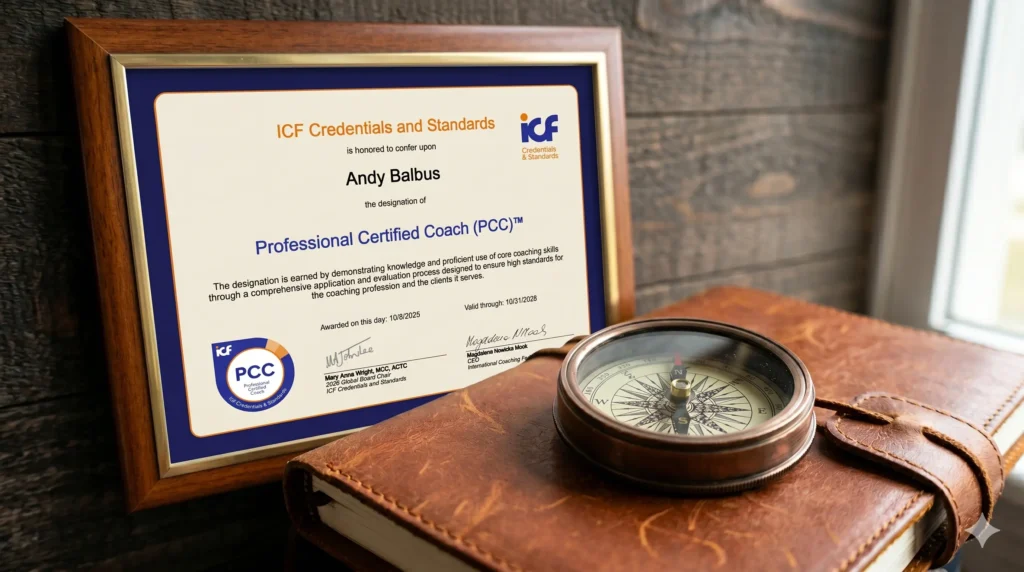
Executive leadership: 25+ years of operational automotive DNA, 150 million euro of revenue accountability, an engineering site with 40 engineers built from a greenfield. Executive coaching: ICF PCC certified, more than 1,000 coaching hours.

Intercultural transformation: four years as the accountable leader in Slovakia, two years in Pune, alongside experience in Germany, China, Mexico and the United Kingdom.
If you work with me today, there is no reporting and no site stabilisation. There is you, your subject, and somebody who gains nothing from how your next appraisal turns out. More about the path is on the page about Andy Balbus and in the case studies.
Results or Excuses?
The subject you have been carrying around for months does not get smaller. It only gets more expensive, because every week without a decision is a week in which the situation sorts itself out without you. And it will not become discussable internally by waiting another three months, because waiting does not change the structure.
In 30 minutes you say the one thing you do not say internally, and we look together at what follows from it. There is no reporting, no note and no feedback to anybody. I bring the view from leadership, coaching and cultural change at the same time.
One calendar link, no preparation required.

You can also reach me through the contact page. How the formats connect is visible in Accelerate Now, in the legacy programme for owners and in Your Power Within. For the role change there is mentoring from expert to leader, for growing spans mentoring for team leads and for strategic influence mentoring at director level.
To work structurally, use the team charter workshop, the mentoring method, intercultural mentoring, the GROW structure, active listening, the SMART method, prioritisation, uncompromising delegation, the conflict architecture, the Gemba Walk and remote leadership. To dig into root causes, start with micromanagement, goal setting and breaking down silos.
Systematic Leadership does not end with a phone Call.
Follow Andy for more Perspectives and Insights.


Leave a Reply