
Summary
Leading Hybrid Teams: A rigid return to office mandate replaces true leadership with administration. If you can only evaluate performance when people sit at their desks, you have a measurement problem. Neither blanket presence nor full remote work fits every role. Leading hybrid teams effectively requires evaluating specific tasks and individual needs. Focus on outcome signals rather than physical presence to boost retention and keep top talent.
The opposite rule is equally wrong. Every exclusive mandate replaces leadership with administration.
The announcement arrives from headquarters and sounds decisive. From the first quarter, three days in the office again, for everybody, no exceptions. It is justified with collaboration, with culture, and with the feeling that some things have been slipping lately.

Look behind that feeling and you almost always find the same sentence: I can see in the office who is working.
That settles the matter, though differently than intended. Anyone saying it is also saying that outside the office they see nothing.
This article is for leaders who have to make that decision or live with it. Anyone looking for a defence of home working is in the wrong place. Blanket remote work is just as much a mistake as blanket presence, and for the same reason.
How I Led an Electronics Department Through a Lockdown
Weeks beforehand the management meetings multiplied
In Prievidza the directors and everybody above met at ever shorter intervals. The subject was information from the Slovak government and what it might mean for us as a company. All of it was declared strictly confidential.

My team was nervous, and they asked me directly
People were reading the news and were worried. Andy, what did you discuss, what do you know, what happens now. I brought the whole team together and told them everything I was allowed to communicate. On the remaining topics I said openly that there had been further conversations, that the management team was trying to learn more from the government, and that I would pass on anything settled the moment it was.
In the background I was preparing something else
With IT I had laptops made ready.
With two senior colleagues I worked out how we could support customers remotely if we were no longer allowed to travel to them. Whether a lockdown would come I did not know at that point, and above all I had no experience at all of what it would mean in practice.

Then it came, and daily life was different from what I expected
What occupied me during that period was not the question of whether somebody was working at home. In Slovakia the testing requirement arrived: get tested or no route to work. Not everybody wanted to be tested, and I was fully engaged in resolving that. Matters like this filled the days.
What I did not do during that time
I simply did not have the time to review project reports in detail. So anyone assuming I got through that phase with close monitoring is mistaken. I did not exercise control, because I could not.
And how I knew it was working anyway

Our electronics development carried on. Not a single customer raised criticism with us. And I knew one thing for certain: had there been a customer escalation, I would have been the first to get a call. That call never came, and that was my information. Many years later I still take the view that we handled it well.
That is the point this article turns on
During those months I could see nobody. I could read no reports. And I still knew where we stood, because the signals I relied on needed no physical presence. Anyone who lost the overview in the same period did not lose performance, they lost their familiar instruments.
Afterwards I learned the second half of the answer
Namely that the right place of work is not a question for the company but for the person and their work. Two colleagues on my team taught me that, and they could not have been more different.
The developer who bred dogs
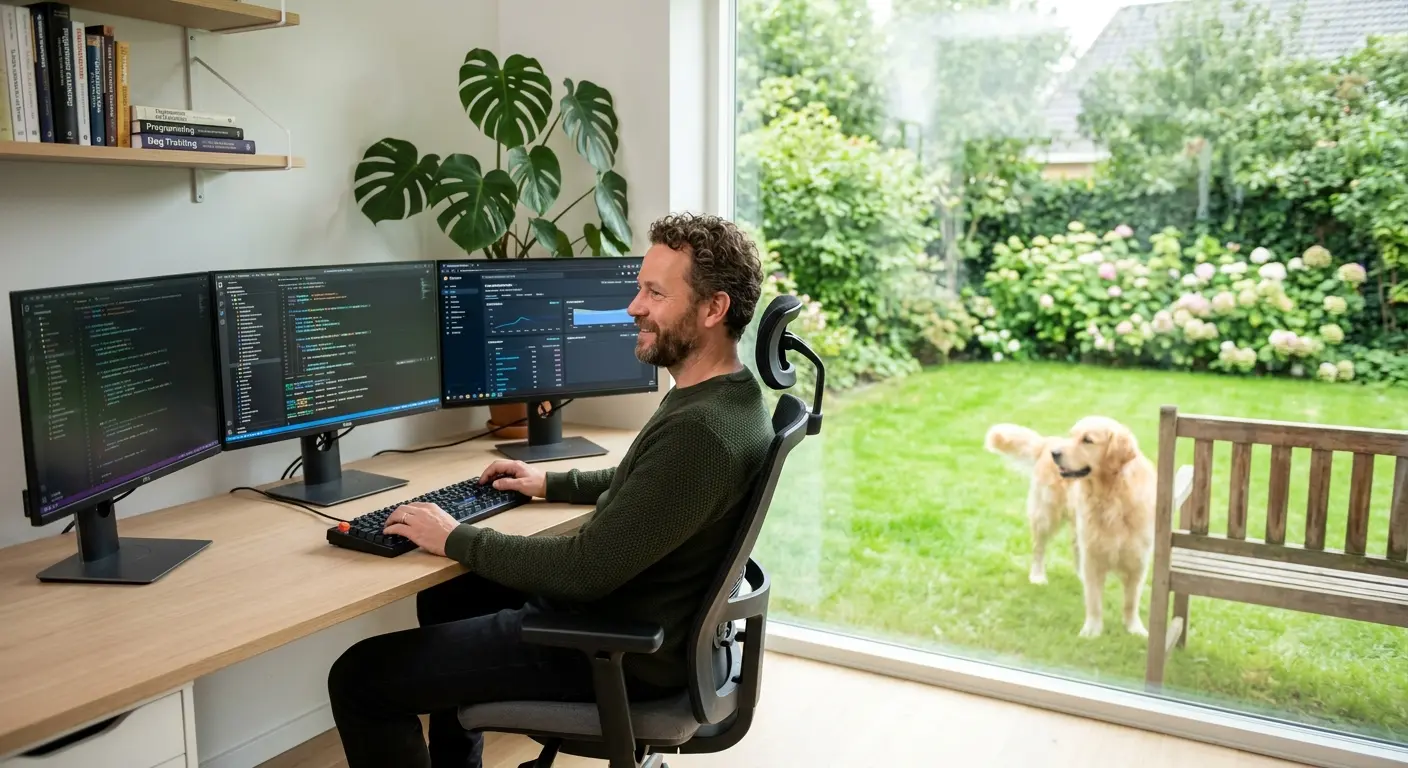
He joined my team on one condition only: fully remote. His life was tied to a fixed place, and that was not negotiable. He was outstandingly good. He had a great way of working with the team in Germany, and his results were top class. Under a presence rule I would never have got him.
And the colleague who normally sat in the office

He needed home working whenever family situations arose that he could handle better that way. I know he often caught up at night what had to wait during the day, because his children mattered. And that is as it should be. Anyone who does not support family when it is needed will not stay happy in a company for long. Who genuinely chooses for or against a family?
What three countries showed me about family
Over my years in Slovakia, the long collaboration with India and the two years in Pune, what struck me was the standing family holds there. If there is one truly large difference between countries, in my view this is it. It stands out the moment you live there, how strongly family influences everything.
And that leads to my position

I am neither for a presence mandate nor for fully remote work. The optimal location depends on the person and their work. The question of office or home must never be asked exclusively. It has to be connected with what this person actually does, which activities have to happen on site, what kind of person they are, and why they should be restricted by an exclusive rule at all.
No sales conversation. If I am not the right person for you, you will hear that in the first five minutes.
What the Research on Hybrid Work Actually Shows
The most robust study is a genuine controlled trial
Nicholas Bloom, Ruobing Han and James Liang published a six-month randomised experiment in Nature in 2024. Some 1,612 graduate employees from two divisions of a large Chinese travel technology group were assigned by even or odd birthday to one of two groups: five days in the office, or three days in the office with Wednesday and Friday at home.

The result is unambiguous. Quit rates fell by one third, from 7.20 to 4.80. Work satisfaction rose from 7.84 to 8.19. And null equivalence tests showed no effect on performance grades over the following two years and no effect on promotion rates. The drop in quitting was most pronounced among non-managers, among female employees, and among people with long commutes.

(Source: Bloom, N., Han, R. & Liang, J. (2024), Hybrid working from home improves retention without damaging performance, Nature.)
The secondary finding that explains the presence debate
The study also recorded what the managers themselves expected. Before the experiment they were sceptical and anticipated a negative productivity effect. Afterwards they rated the effect considerably more positively and moved closer to the expectations of non-managers.
That is the real core of many presence decisions. They rest on an expectation that did not survive observation. Anyone issuing a rule for everybody because they have an uneasy feeling should first examine what that feeling is built on.
(Source: Bloom, Han & Liang (2024), Nature, survey of productivity expectations before and after the experiment.)
And now the counterweight, so that nothing here becomes one-sided
The same researcher published a different experiment in 2015, that time on fully remote call-centre work at the same group. Result: a 13 percent productivity gain, higher satisfaction, lower attrition. And one finding that advocates of remote work rarely quote: promotion rates declined.
Taken together, both studies say exactly what I experienced in my own department. Hybrid work functions and costs nothing in performance. Fully remote work carries a price, and it shows up not in productivity but in visibility for the next step. Anyone who knows that can compensate for it. Anyone who does not will be puzzled in three years.
(Source: Bloom et al. (2015), randomised study of home working in the CTrip call centre.)
Why a location means more to one person than to another
The GLOBE study measured 62 societies. The Southern Asia cluster, which includes India, scores 5.87 out of 7 on in-group collectivism and ranks first across the clusters. That construct measures precisely what struck me in three countries: how strongly pride, loyalty and cohesiveness towards family and immediate group are expressed.

That does not mean family matters less in Germany. It means the degree to which family obligations are treated as self-evident differs, and that a rule ignoring this difference will inevitably feel unjust in distributed teams. There is more on what that means for collaboration in intercultural mentoring.
(Source: GLOBE study, cluster analysis in Gupta, Surie, Javidan & Chhokar (2002), Journal of World Business, 37, 16-27.)
Voices From Practice
Prashant Chaudhari worked at Brose in test automation and later became a client. His feedback sits here because it names exactly the capability distributed work turns on: coordination across time zones, without anybody sharing a room.
Which of Your Signals Survive Distance?
Before you decide about attendance, examine what you actually rely on today. Think of one specific person and mark which of the six signals you genuinely use. You will then see which of them work without physical presence and what can replace the rest. No points, no grade.
How do you currently tell that somebody is doing good work?
Four Questions Instead of a Rule
A rule for everybody is convenient because it requires no argument. That is precisely why it replaces leadership with administration. These four questions cost you ten minutes per person and spare you the discussion that otherwise returns every quarter.
Question one: what does this person actually do?
Not which role appears on the org chart, but what the week genuinely consists of. Focused individual work, close coordination in the team, work on equipment or rigs, customer contact. The mix decides, not the job title.
Question two: which activities must happen on site?

That list is usually shorter than everybody assumes, and in electronics development it is not empty. A setup on the test rig, a measurement, a fault you have to hear and smell. Write those activities down specifically and you have justified the attendance rather than decreed it.
Question three: what kind of person is this?
Some people need a room with others to get going at all. Others lose their best hours there. Both are legitimate and both are observable, if you ask. The developer with the dogs would never have joined my team under any presence rule, and he was among the best people I had.
Question four: why should this person be restricted?
This question reverses the burden of proof, and that is what matters. It is not the employee who justifies working from home, it is you who justifies why they may not. If all you can come up with is that it has to be the same for everybody, you do not have a justification, you have an administrative instruction.
And what you must not forget in the process
Anyone permanently off site is seen less often, and visibility drives promotion. That is exactly what Bloom's earlier study measured. If you grant somebody fully remote work, you take on the job of creating their visibility actively. Otherwise you give them freedom today and take away their development in three years. How to raise this in the one-to-one sits in the article on the GROW structure.
You leave with a list, not with a proposal.
Where Location Is Not the Real Problem
If your team delivers less when working from home, check first whether it really delivered more before or whether you could simply see it better. Where nobody reports delays to you, what is missing is not attendance but psychological safety. If you feel the need to chase constantly, you are working on micromanagement. And when your calendar consists only of coordination, that is not a location problem but a prioritisation one.
Vasanth Suratkal Kamath was President of Brose India Automotive Systems. His assessment sits here because it names the standard distributed collaboration is judged by, and it has nothing to do with attendance.
How distributed leadership is built methodically sits on the remote leadership page. Terms from this article are defined in the leadership glossary, and the full toolkit sits in the methods overview.
FAQ: Frequently Asked Questions About Leading Hybrid Teams
Q1: Does a presence mandate solve the problem of declining performance?
No, it conceals it. If performance is only visible when people are present, it was never measured, only observed. The randomised trial by Bloom, Han and Liang found no effect of hybrid work on performance grades over two years, but a quit rate one third lower.
Q2: Is home working therefore always the better choice?
No, and the same research shows why. In Bloom's earlier study of fully remote work, productivity rose by 13 percent but promotion rates declined. Anyone permanently off site is seen less often. That can be compensated for, but only deliberately.
Q3: How do I recognise performance when I see nobody?
Through signals that need no presence. Are commitments kept, and do you hear about delays beforehand? Do colleagues come to this person for advice? Do the results hold up under technical review? If you cannot answer those three questions, what you lack is a measurement system, not an attendance rule.
Q4: How do I handle employees who want to be fully remote?
Examine the work, not the wish. An outstanding developer joined my team only on that condition, and the collaboration with the German team worked excellently. What you additionally take on is his visibility, otherwise he pays later with stalled development.
Q5: What if headquarters mandates a rule for everybody?
Then negotiate exceptions against specific activities rather than against people. A list of tasks that must run on site can be argued. A list of names who should get exceptions cannot, and it additionally breeds resentment in the team.
Q6: How many office days are right?
The evidence supports two days at home per week as a workable model, because that is what was studied. What matters more than the number is what the office days are used for. Anyone mandating three days of attendance so that people sit silently at screens has bought commuting time and nothing else.
Q7: Does culture not suffer when everybody works distributed?
Culture does not come from attendance, it comes from repetition. What you lose are the chance encounters, and that is a genuine loss. It cannot be replaced, only rebuilt, through fixed occasions that produce the same information without relying on chance. The team charter workshop is one such format.
Q8: How do I lead across time zones?
By sharing the load rather than shifting it. If a recurring meeting sits permanently in one side's evening, the same people always carry it. And ask which times of day are difficult on site rather than assuming. More in the remote leadership method.
Q9: What about employees who become isolated at home?
That happens, and it is an argument for differentiation rather than for a rule. Some people need a room with others. Ask about it instead of decreeing it, because attendance experienced as an obligation does not feel like community.
Q10: How do I account for family obligations fairly?
By not treating them as an exception but as part of the plan. A colleague on my team caught up at night what had to wait during the day, because his children mattered. That was his solution rather than my instruction, and it worked because he chose it himself.
Q11: Do these considerations apply in India or Slovakia too?
Yes, with one extra caution. The standing of family obligations differs, which the GLOBE study captures through in-group collectivism. A rule applied identically across sites therefore feels self-evident at one location and like an imposition at another.
Q12: How do I know the presence debate in my team is a symptom?
By the fact that it keeps coming back regardless of which rule applies. When every decision is followed by a new discussion, the subject is not location but trust, or clarity about goals. How to establish the latter sits in the article on goal setting.

About the Author: The Intersection of Three Worlds
Most providers encountered hybrid leadership as a concept. I led a department of 40 engineers through a lockdown in which I could neither see people nor read reports.

Executive leadership: 25+ years of operational automotive DNA, 150 million euro of revenue accountability, an engineering site built from a greenfield. Executive coaching: ICF PCC certified, more than 1,000 coaching hours.
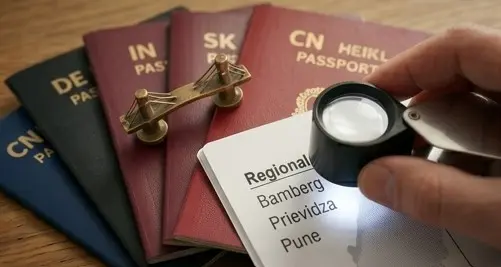
Intercultural transformation: four years as the accountable leader in Slovakia, two years in Pune, alongside experience in Germany, China, Mexico and the United Kingdom.
What stands in this article I did not read, I tried it under pressure, including the parts where I had no choice. More about the path is on the page about Andy Balbus and in the case studies.
Results or Excuses?
A rule for everybody costs you nothing until it costs you the people who cannot work under it. The developer you would only get on fully remote terms applies elsewhere. The colleague with a parent needing care resigns quietly. And replacing them costs you 150 to 200 percent of an annual salary, while the rule continues to help nobody, because it never solved a leadership problem.
In 30 minutes we go through your signals, name the activities that genuinely require presence, and you leave with a justification you can defend at headquarters. I bring the view from leadership, coaching and cultural change at the same time.
One calendar link, no preparation required.

You can also reach me through the contact page. How the formats connect is visible in Accelerate Now, in executive coaching, in coaching for automotive leaders, in coaching for CEOs and senior leaders, in female executive coaching, in the legacy programme for owners and in Your Power Within. For the role change there is mentoring from expert to leader, for growing spans mentoring for team leads, for leadership without formal authority mentoring without authority and for strategic influence mentoring at director level.
To work structurally, use the mentoring method, active listening, the SMART method, prioritisation, uncompromising delegation, the conflict architecture and the Gemba Walk. To dig into root causes, start with breaking down silos and the chief firefighter syndrome.
Systematic Leadership does not end with a phone Call.
Follow Andy for more Perspectives and Insights.


Leave a Reply