
Summary
Decision-Making Under Pressure: When a line stops, the most expensive decision in the first minute is setting the pace. Not every technical fault is a supply crisis. Three questions clarify the true buffer: How many finished parts are in stock? When is the next call-off? How much is in transit? Only leaders have the standing to ask these questions, back their team, and turn expensive panic into a scheduled repair job.
And why your team cannot ask these questions, only you can.
The phone rings and the first sentence contains the word stoppage. From that second something starts that you recognise: people get pulled together, calendars get cleared, somebody drives out there. Within twenty minutes eight people are working on a problem whose urgency nobody has verified.

The most expensive decision of that day is made in the first minute, and it is not about the repair. It is about the pace.
This article is for engineering and manufacturing leaders who receive those calls. Anyone looking for the choreography of the first 72 hours will find it in the article on leading a task force. This is about the question before that one: is this a crisis at all?
How I Turned Crises Into Scheduled Jobs in Prievidza
My team was the third level
During my four years as Director Electronics in Prievidza, my test engineering team was the third and final level of fault resolution for the end-of-line test systems on the lines that assembled motors and electronics into finished products. When such a line stopped it was treated as a crisis, and the call came quickly to me or to my team.

Two other levels sat ahead of us, and they had their own job
The first level was the operators on the line. Through checklists and methods they had their own options for getting the line running again, and their focus was on the simple things: restarting the line back into automatic mode, cleaning contacts and transfer points, removing contamination that was disturbing sensors.
The second level was local plant maintenance
Their checklists were already more extensive.

It covered relay replacement, component replacement in control cabinets, a great deal that can be described as electrician and mechanic work. Only after that did we come in: software and highly complex measurement technology, the actual job of test engineering. My people did however also find lines where a relay upstream of the equipment had caused the whole problem.
What I did not ask first when the call came

I did not ask what was broken. That question answers itself as soon as somebody looks, and it says nothing about how fast this has to go.
The first question: have the stock levels been checked?
How many finished parts have we produced and how many are sitting there? That number is obtainable within minutes and it changes everything that follows. If there was not much, we moved straight to the next question.
The second question: when is the next call-off and for what quantity?
The call-off sets the real deadline. Without it you work to an invented deadline, and invented deadlines are almost always too short. Only with the call-off does a feeling become a number.
The third question: how much is in transit?
Which is to say, how long is the customer still supplied? Goods already on the road are almost always forgotten when a stoppage is reported, and the decisive days often sit precisely there.
And sure enough, many of these crises were no longer crises
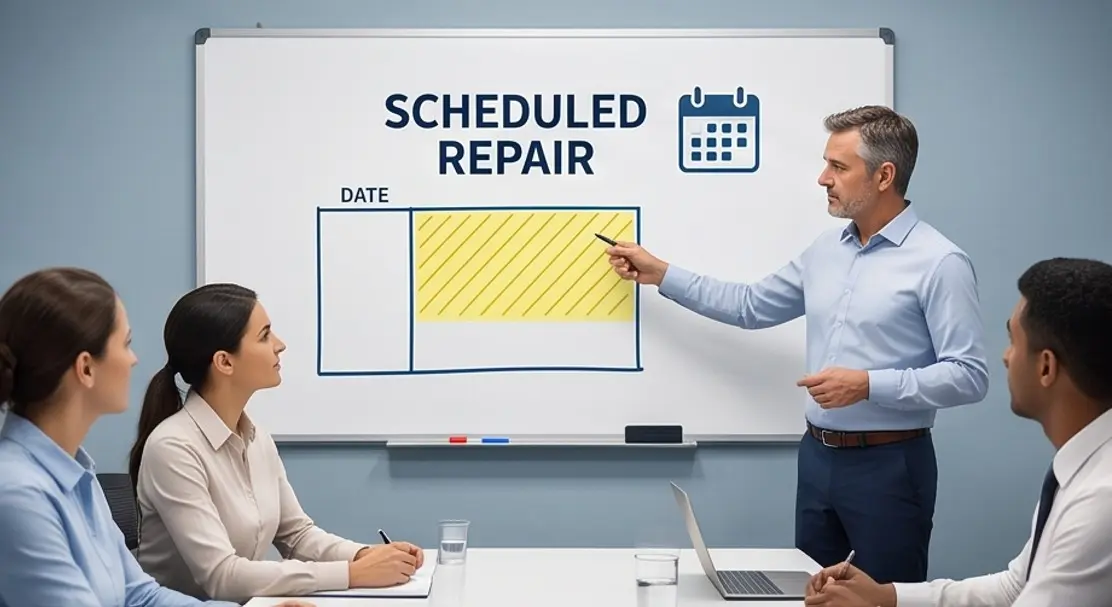
They were a schedulable repair job. Suddenly nothing was burning, and instead we knew that we had, for instance, five days of buffer and that new parts had to be produced by then at the latest. That creates room to think.
The buffer was not only calm, it was money

With five known days we could involve the right suppliers with the right response times. Our agreements often specified 48 hours.
Anything faster was available too and would have carried immense cost. Anyone who does not know their buffer buys the expensive option in case of doubt, and does so every single time.
My engineers could not ask these questions
That is the point this article actually turns on. They knew the questions perfectly well. What they lacked was the standing my director title gave me. An engineer who calls about a faulty test system and then asks about stock levels and call-off quantities gets told it is none of their business. Not because the question is wrong, but because the role does not fit it.
So I asked them
Not because I could do it better, but because I was allowed to. Backing your people does not mean keeping their back clear while they work. It means asking the questions they cannot reach by virtue of their position, and making sure your team knows that before they call.
And one rule I insisted on consistently

Where the first and second level had not done their work properly, it was raised. After the crisis. During the crisis it was the wrong time, for a very unsentimental reason: the customer does not care where the problem sits or who failed to do what. The customer wants their parts.
No sales conversation. If I am not the right person for you, you will hear that in the first five minutes.
What the Research Says About Decisions Under Pressure
When you may trust your gut, and when you may not
Daniel Kahneman and Gary Klein published an unusual piece in American Psychologist in 2009. The two researchers represented opposing schools, Kahneman the study of thinking errors, Klein the study of expert judgment in the field. They wrestled with each other for around six years and eventually recorded what they agreed on.

Their answer to the question of when professionals’ intuition is trustworthy has two conditions. First, the environment has to be sufficiently regular, meaning it must contain valid cues. Second, the person must have had adequate opportunity to learn those cues, through practice with high-quality feedback. Where one condition is missing, the judgment is not expertise but an impression.

(Source: Kahneman, D. & Klein, G. (2009), Conditions for Intuitive Expertise: A Failure to Disagree, American Psychologist, 64(6), 515-526.)
Why that explains my three questions exactly
My engineers met both conditions, though only for one question. In fault-finding on a test system they moved in a highly regular environment with immediate feedback, practised thousands of times. When one of them said this smells like a sensor problem, they were usually right, even without a justification.
On the question of how long the customer was still supplied, neither condition was met, and that applied to everybody in the room. There were no valid cues on the line, and nobody ever received feedback on whether their estimate of the buffer had been correct. That is precisely why you must not guess there but ask. It is not a question of experience but of access to information.
And the finding that stings most in a crisis room
Kahneman and Klein state explicitly that subjective experience is not a reliable indicator of the accuracy of a judgment. Translated: how certain somebody feels tells you nothing about whether they are right. And in a room full of tense people, the person who sounds most certain almost always prevails.
The leader’s first job in that moment is therefore not to hold an opinion but to ask the question that forces the room onto numbers. Anyone deciding without numbers is not deciding about the repair but about the pace, and the pace is the expensive part.
(Source: Kahneman & Klein (2009), American Psychologist, 64(6), 515-526.)
What a stoppage actually costs
Siemens puts the true cost of unplanned downtime at around 2.3 million US dollars per hour in its study, an increase of 113 percent on the previous survey. That figure gets quoted to establish urgency, and it works just as well for the opposite.

Because it applies to a stoppage that actually interrupts supply. As long as your customer is served from stock and goods in transit, those costs do not arise. Anyone who does not know their buffer confuses a technical stoppage with a supply stoppage and buys whatever the market offers against it. How that compounds over weeks into a delayed start of production sits in the article on SOP delay.
(Source: Siemens, True Cost of Downtime 2024.)
Voices From Practice
Valentine Nelaev has run projects in oil and gas for more than 18 years, an environment where stoppages are similarly expensive. His feedback sits here because it names what counts in such moments: not reassuring answers but considered ones.
Was Your Last Stoppage a Crisis or a Scheduled Job?
Think of the last call where somebody used the word stoppage. Five questions, no points, no grade. You will then see whether you were genuinely dealing with a crisis or with a scheduled job, and what was missing that would have settled it in ten minutes.
Think of the last stoppage where your phone rang.
Five questions, no points, no grade. At the end you see whether you were dealing with a crisis or with a scheduled job, and how to tell the difference in ten minutes next time.
These five questions replace no repair. They only decide whether you approach the repair in panic or with a calendar, and that is the most expensive difference in the whole process.
The Procedure for Your Next Call
Five steps, of which the first three together take under ten minutes. They replace no repair. They decide the pace at which you approach it, and that is the most expensive lever in the whole process.
Step one: get the three numbers before you send anybody anywhere
Stock of finished parts, next call-off with quantity, goods in transit. Those give you your real deadline in days. Everything you decide before that number is a guess, even when it is correct.
Step two: hold the deadline against the agreed response time

If your supplier is contractually on 48 hours and you have five days of buffer, you do not need an immediate response. That calculation takes thirty seconds and regularly saves five-figure sums. So put the response times of your critical suppliers where the call comes in, not in a contract folder.
Step three: ask the questions yourself when your team cannot
Check honestly whether your people can reach those answers. If they cannot, that is not a question of their competence but of their position. Then you ask, and you tell your team beforehand that you will. Roles cannot be lent, answers can.
Step four: live the escalation plan rather than merely having one
An agreed plan that gets skipped when it matters is not a plan, it is a document. Insist that first and second level walk their steps, even when it feels slower. Anyone calling the third level for a relay has not only solved that one case wrongly, they have failed to develop their own capability. There is more in the article on escalation management.
Step five: put the blame question at the end, and mean it
Where upstream levels have not done their work properly, raise it once the customer is supplied. During the crisis it costs twice: it holds things up, and it ensures you are told later next time. Google identified psychological safety as the most important factor in effective teams in Project Aristotle, and nothing destroys it more reliably than a blame question at the moment of maximum tension.
And the rule that holds it all together
Your job on the first call is not to know the solution. It is to establish the difference between urgency and feeling. Everything else your team can do better than you, and it should. How to hold that separation day to day sits in the article on uncompromising delegation.

You leave with three questions, not with a proposal.
Where Three Questions Are Not Enough
Some calls are genuine crises, and then something else applies. How to structure the first 72 hours sits in the article on leading a task force. If your calendar consists of nothing but stoppages, work on the chief firefighter syndrome rather than on your reaction speed. Where your units do not inform each other, silo thinking is the cause. And if nobody reports a problem to you before it escalates, what is missing is not a question but psychological safety.
How the capacity to decide under pressure can be built systematically sits in the Accelerate Now programme and in coaching for CEOs and senior leaders. Terms from this article are defined in the leadership glossary, and the full toolkit sits in the methods overview.
FAQ: Frequently Asked Questions About Deciding Under Pressure
Q1: What is the first question when a line stops?
Not what is broken, but how long the customer is still supplied. For that you need three numbers: finished parts in stock, next call-off with quantity, goods in transit. Only then do you decide the pace, and the pace is the expensive part.
Q2: Is that not a waste of time while the line is down?
The three questions take a few minutes and run in parallel with somebody driving out there. What they save is the reflex to buy an immediate response from the supplier. If your agreement provides 48 hours and you have five days of buffer, any faster option is purchased reassurance.
Q3: Where do I get those numbers at eleven at night?
You settle that beforehand, not during the call. Decide who is reachable for stock levels and the call-off schedule, and by what route. If that question is first asked in an emergency, the answer is always the same: nobody knows, so we treat it as a crisis.
Q4: Why can my people not ask these questions themselves?
Because their role does not fit them. An engineer calling about a test system who then asks about call-off quantities is often told it is none of their business. That is not a competence problem but a standing problem, and solving it is your job rather than theirs.
Q5: When may I trust my own experience?
When two conditions hold, according to Kahneman and Klein: the environment must be regular enough to provide valid cues, and you must have had adequate opportunity to learn those cues with real feedback. For technical fault patterns that is usually the case. For supply questions where you never receive feedback, it is not.
Q6: So the most confident person in the room is not automatically right?
No, and that is one of the clearest findings on the subject. Kahneman and Klein state that subjective experience is not a reliable indicator of judgment accuracy. How certain somebody sounds says nothing about whether they are right. In tense rooms that person usually prevails regardless.
Q7: What do I do when upstream levels have not done their work?
You raise it, but after the crisis. During it the cost is double, because it holds things up and because next time you will be told later. The customer does not care where the problem sits or who missed what. They want their parts.
Q8: How do I stop every small thing landing on my desk?
By making sure the agreed escalation plan is actually lived, even when it feels slower. Anyone calling the third level for a relay solves that case and fails to develop their own capability. After the crisis, that is exactly what belongs on the table.
Q9: Does this apply outside manufacturing?
Yes, with different numbers. The underlying question is always: by when must this be done so that nobody suffers a loss, and how do I know? Whether the answer rests on a stock level, an approval date or a statutory deadline changes nothing about the logic.
Q10: What is the difference between this and running a task force?
This comes first and takes minutes. It establishes whether a task force is needed at all. If it is, you continue with the structure of the first 72 hours, which I described in a separate article.
Q11: How do I prepare my team for this?
Tell them the three questions and tell them you will be asking them. Then everybody knows on the next call what happens first, and nobody feels held back. The team charter workshop is a good frame for agreeing something like this bindingly.
Q12: What if I decide too quickly under pressure myself?
Then you need a fixed intermediate step that takes the first minutes off your hands. For me it was these three questions. They also work because they give you something to do while you are not yet able to decide.

About the Author: The Intersection of Three Worlds
Most providers know decisions under pressure from accompanying them. I know the call where a line is down and eight people are waiting for somebody to set the pace.

Executive leadership: 25+ years of operational automotive DNA, 150 million euro of revenue accountability, an engineering site with 40 engineers built from a greenfield. Executive coaching: ICF PCC certified, more than 1,000 coaching hours.
Intercultural transformation: four years as the accountable leader in Slovakia, two years in Pune, alongside experience in Germany, China, Mexico and the United Kingdom.
The three questions in this article were not learned in a seminar. They came from four years of lines that stopped. More about the path is on the page about Andy Balbus and in the case studies.
Results or Excuses?
On the next call you will again decide the pace in the first minute. If you do not have the three numbers then, you will decide for panic, because panic is the safe choice when you know nothing. You pay for it in expedite charges, in your people's weekends, and in the calm your team will be missing the time after next.
In 30 minutes we fix your three questions, settle who supplies the answers and when, and you leave with a procedure you can tell your team in the same week. I bring the view from leadership, coaching and cultural change at the same time.
One calendar link, no preparation required.

You can also reach me through the contact page. How the formats connect is visible in executive coaching, in coaching for automotive leaders, in female executive coaching, in the legacy programme for owners and in Your Power Within. For the role change there is mentoring from expert to leader, for growing spans mentoring for team leads, for leadership without formal authority mentoring without authority and for strategic influence mentoring at director level.
To work structurally, use the mentoring method, intercultural mentoring, the GROW structure, active listening, the SMART method, prioritisation, the conflict architecture, the Gemba Walk and remote leadership. To dig into root causes, start with micromanagement, no time for strategy and the Executive Sparring India page.
Systematic Leadership does not end with a phone Call.
Follow Andy for more Perspectives and Insights.


Leave a Reply