
Summary
The ‘Indian Yes’ is a signal of respect, not an operational commitment. Learn why misinterpreting this response derails deadlines and how mastering automotive offshore R&D alignment permanently secures your SOP timelines.
The Friday Panic: When “Yes” Doesn’t Mean “Delivered”
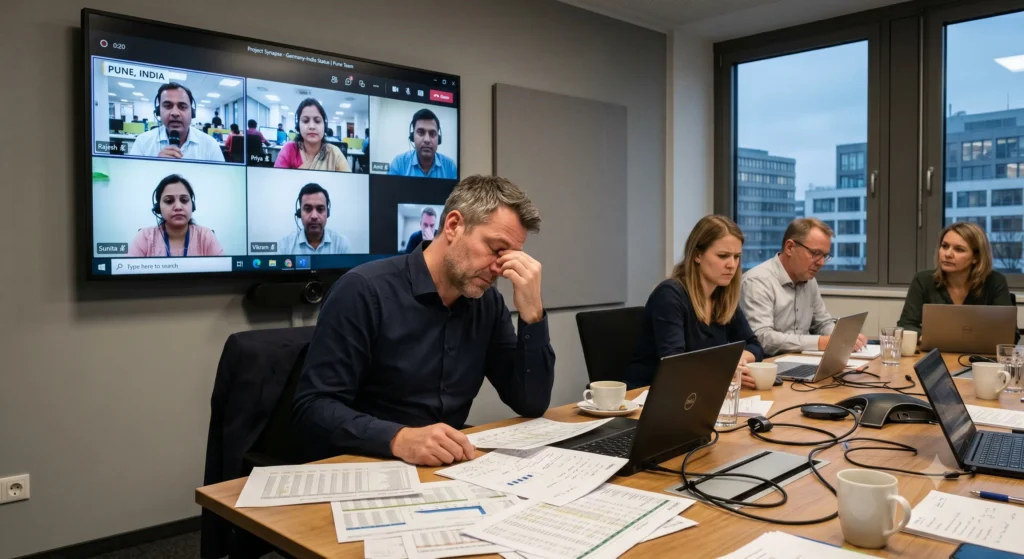
You ask your lead engineer in Pune if the critical documentation will be ready by Friday. He looks you in the eye, nods respectfully, and says, “Yes.” Friday arrives, and the server remains empty.
This is the most expensive cultural misread in the DE-IN automotive axis. When a deadline slips after a clear verbal agreement, German headquarters often assume a performance issue. Nobody lied to you. The engineer did not lack competence. Your automotive offshore R&D alignment failed because you interpreted a signal of profound respect as a binding operational commitment.

The Real Meaning of the Indian Yes
In a high-context culture, directly contradicting a superior carries a heavy social cost. When you issue a directive from Germany to your hub in Pune or Bangalore, the local team hears the instruction. Saying “yes” translates to acknowledging your authority, receiving the message, and valuing the relationship.
It does not mean the task has been evaluated against current capacities. It does not mean the deadline is feasible. Accepting a simple nod as a delivery contract creates an invisible gap between the dashboard and reality. We call this the Translation Tax.
The Financial Cost of Alignment Gaps
The Translation Tax is not a soft HR metric. It drains your project budget long before a line stops.
- Siemens, “True Cost of Downtime 2024”: Automotive production downtime averages $2.3 million USD per hour.
- McKinsey: 65% of matrix organizations report longer decision-making cycles due to alignment gaps.
- PMI, “Pulse of the Profession”: 56% of at-risk project budgets fail due to poor communication, not technical errors.
Missing a documentation deadline in R&D eventually forces a rushed validation phase. A rushed validation phase creates unmitigated risks at the Start of Production (SOP). The cost of fixing a misunderstanding is minimal on a Wednesday afternoon. The cost of fixing it three weeks before SOP destroys your EBIT margin.

The Story of Sandesh: Ground Truth in Pune
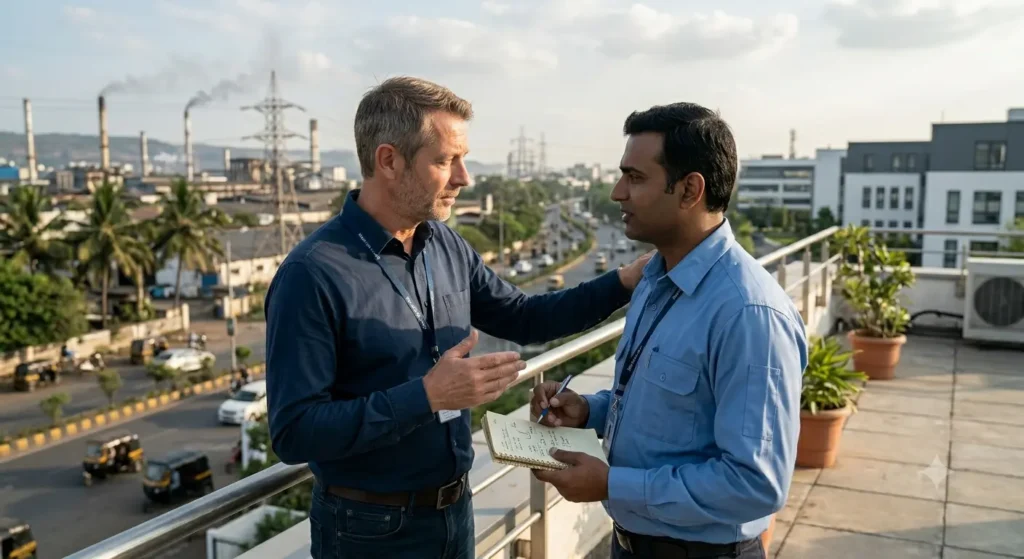
During my time leading on the ground in Pune, I worked closely with a brilliant engineer named Sandesh. Our team faced three major escalations. Critical deliverables were missing. Colleagues back in Bamberg categorized this as a typical offshore performance problem. I refused to accept that premise.
I sat down with Sandesh to analyze the bottleneck. The truth emerged quickly. The local Plant Manager was assigning hidden extra work to the team outside the official matrix structure. Sandesh wanted to remain respectful to all leaders. He said “yes” to the Plant Manager, and he said “yes” to me.
Escalating from Germany via email would never have uncovered this structural conflict. The local team followed flawed prioritization because the environment lacked the psychological safety required to say “no” to a superior. I intervened, clarified the accountability with local management, and protected the team’s capacity. Sandesh immediately returned to being one of our most reliable engineers.

How to Build Reliable Offshore Architecture
You cannot manage an Indian R&D hub using German operational logic. Directives that sound perfectly objective in Bamberg sound like uncompromising commands in Pune. Building a high-performing offshore hub requires three distinct leadership shifts.
1. Shift from Broadcasting to Active Listening
You must stop listening to the words and start reading the silence. When an Indian engineer hesitates before saying yes, that hesitation is your data point. Ask questions that cannot be answered with a simple binary response. Ask them to walk you through the implementation steps. If the steps are unclear, the yes was purely respectful.

2. Establish a Team Charter
Psychological safety does not happen by accident. You must build a binding operational contract. A Team Charter Workshop defines exactly how disagreements are voiced across borders. It outlines how a junior engineer in Pune can escalate a risk to a Director in Germany without losing face or fearing retribution.

3. Transfer Industrial DNA
Your overseas teams do not just need task lists. They need context. They need to understand the strategic why behind a deadline. When you transfer your industrial DNA through structured mentoring, you empower local leaders to make autonomous decisions that align with headquarters expectations.

Stop Surviving Your Projects
Hard profits require cultural competence. You can continue sending rigid Excel sheets to Pune and wondering why the deliverables fail. Or you can build a structural bridge that turns an extended workbench into a fully integrated global engineering powerhouse.
FAQ: Frequently Asked Questions
Q1: What exactly is the Translation Tax in automotive R&D?
The Translation Tax is the invisible waste of engineering hours caused by cross-cultural misinterpretation. It happens when a German suggestion is executed as a rigid command in India, or when an Indian signal of respect is falsely tracked as a confirmed delivery date in Germany.
Q2: Why do Indian engineers agree to deadlines they cannot meet?
It is not about deception. In hierarchical, high-context cultures, preserving harmony and showing respect to a senior leader is paramount. Saying no directly is often considered rude or insubordinate. They agree to protect the relationship, hoping to figure out the execution later.
Q3: How do I get a truthful status update without causing offense?
Change the structure of your questions. Never ask, “Will this be done by Friday?” Ask, “What roadblocks do you anticipate between now and Friday?” or “Walk me through the sequence of steps required to finish this.” This forces a factual discussion about the process rather than a binary answer about a commitment.
Q4: Can we solve this by implementing stricter tracking software?
Software tracks data. Software cannot track fear or respect. If your team feels it is politically unsafe to report a delay, they will simply enter optimistic data into your new Jira board. You must fix the communication architecture before any tracking tool can reflect reality.
Q5: What is a Team Charter and why is it necessary for offshore hubs?
A Team Charter is a binding, co-created document that dictates how a global team interacts. It explicitly defines rules for escalation, conflict resolution, and feedback. It overrides default cultural behaviors by creating a newly agreed-upon “team culture” where raising problems early is rewarded.
Q6: How does this differ from standard intercultural training?
Standard training teaches you that Indians eat differently or greet differently. That is superficial. Automotive Offshore R&D Alignment deals with hard operational friction. It teaches you how to structure an escalation path so a critical software bug is reported weeks before it stops the OEM assembly line.
Q7: My Indian hub performs well on routine tasks but fails on complex R&D. Why?
Routine tasks rely on process execution. Complex R&D requires autonomous problem-solving and the ability to challenge assumptions. If your matrix penalizes pushback, your offshore engineers will revert to executing exactly what was asked, even if the request is technically flawed.
Q8: How long does it take to change this dynamic in a team?
Establishing the structural levers, such as a Team Charter and clear escalation triggers, takes weeks. Changing the actual behavior takes a few months of consistent leadership. The fastest ROI happens when a leader actively rewards the first engineer who dares to report a red status.
Q9: Is it better to send a German expat to manage the hub in Pune?
An expat can bridge the gap temporarily, but it is not a scalable long-term solution. The goal is to develop local leaders like Priti Shahane who understand the German industrial DNA but possess the cultural intuition to lead the Indian team effectively.
Q10: We are a mid-sized supplier. Is this only a problem for large OEMs?
Mid-sized suppliers feel this friction even harder. You lack the massive buffer budgets and redundant staff that large OEMs possess. When your offshore R&D alignment fails, the SOP delay hits your EBIT margin immediately and aggressively.
Q11: What happens during a BYG Reality Check?
We conduct a direct 30-minute diagnostic. We look at your current escalation protocols and identify exactly where the Translation Tax is draining your project budget. You leave with one actionable structural lever you can apply to your global matrix immediately.

IIs your dashboard green, but your project at risk?
In a DE-SK-IN matrix, an offshore “yes” is often a signal of profound respect, not a binding delivery promise. The solution isn’t stricter tracking software. It is lowering the cost of honesty inside your organization.
Discover where cultural misreads are draining your budget.

Reference to my Linkedin Article for the “Indian YES”
Systematic Leadership does not end with a phone Call.
Follow Andy for more Perspectives and Insights.


Leave a Reply