
Summary
High-performance teams need a shared finish line. A customized Team Charter replaces corporate posters with authentic, team-written rules that bind. The rule ‘Work hard, party hard’ proved to be a highly effective retention tool, drastically reducing turnover costs while fostering a cohesive ‘Kolektiv’ spirit.
Work hard, party hard. A professional electronics R&D department with that rule? That exact department delivered.
This article is written for leaders whose team delivers reliably and still grows quieter. For the R&D director who senses the extra mile is being run less often than two years ago. For the plant manager who gets attrition numbers explained but never the cause. And for every HR leader who has treated team charter rules as a poster in the hallway. In my experience, the answer rarely sits in the salary band. It sits in a question almost nobody asks: when was the last time your team truly got to celebrate a win?
Friday, 5:40 pm. The Milestone Is Hit. Then What?
The sample delivery is out, the customer has confirmed, the project shows green. Your team sacrificed three weeks of evenings for that. You post a short message in the channel: thanks everyone, on Monday we start the next work package. Then you close the laptop.
Three months later your best engineer resigns. In the exit interview, money never comes up. Instead, one sentence stays with you: it was never enough. No matter how much we delivered, it went straight on to the next thing. The problem was not the workload. The problem was that the finish line never actually happened.
Prievidza, One Workshop Day, and the Rule Nobody Took Seriously
Building from Scratch

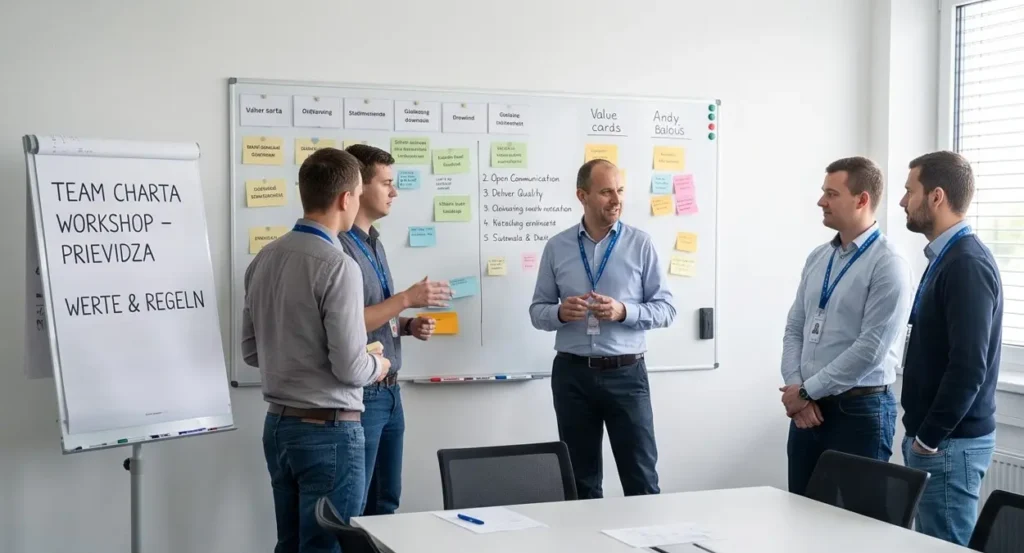
My name is Andy Balbus. When I built the electronics R&D department in Prievidza from zero, no processes, no lab, no network, we took a full day early on for something that appeared on no project plan: a team charter. With value cards, with thinking and laughing, with the questions of how we want to treat each other and what must never happen. At the end stood five rules. To be clear, they were not my rules. They were the team’s rules, sorted together, prioritized together. Every new member heard those five rules on day one and was asked whether they would carry them.
The “Work Hard, Party Hard” Contract
One of those rules read: Work hard, party hard. Whenever I mentioned it later, I saw the same disbelief. A rule like that? In a professional R&D organization? I understand the reaction, because on paper it sounds implausible. In reality it was the clearest contract this team ever made: we run the extra mile when it counts. And afterwards we gather the whole team and celebrate the win and the community that made it possible.
The True Meaning of “Kolektiv”
To avoid a wrong picture: I am not talking about excess. I am talking about evenings where I observed two things above all. First, the community. My team never called itself a team; it called itself Kolektiv. At first the word puzzled me, because it carries the imprint of the Soviet era, and Slovaks are proud people. Over time I understood what it meant in daily life: the win belongs to everyone, and nobody gets left behind. Second, I saw that wins were given a place. They were not ticked off in a status report; they were experienced together. The department grew to 40+ engineers and delivers to this day.
Your team delivers, but the spirit is eroding? Then let us look at it together. The Reality Check is a 30-minute diagnostic conversation, no slides, no sales pitch.
What Not Celebrating Costs: The Math Behind the Gut Feeling

Maybe this still sounds too soft for a management decision. So let us run the numbers. Gallup has shown two connections for years that land directly on this topic: the manager explains around 70 percent of the variance in team engagement, and highly engaged teams show up to 59 percent lower turnover. Engagement does not come from pressure. In other words, it comes from experienced appreciation, and celebrating together is its most visible form.
Now the cost side. Replacing a specialist typically costs 150 to 200 percent of their annual salary (PLOS ONE/Accenture). As a result, at a baseline attrition of 20 to 25 percent, a team of ten engineers spends the equivalent of three to five full salaries every year just to stay the same size. A team evening after a delivered milestone costs a fraction of that. The implausible-sounding rule is not a nicety. In short, it is one of the cheapest retention decisions a leader can make.

Three Honest Questions Before You Read On
If you hesitate on any of these, the next section is for you.
Team Charter Rules the BYG Way: Three Steps
1. The Team Writes, the Leader Co-Signs
One full day, value cards, and the questions: how do we treat each other, what must never happen, what do we stand for? The result is a maximum of five rules, phrased so they can be tested, prioritized together. Above all, authorship is the decisive factor: a team working agreement the team wrote itself gets defended. One that was handed down gets administered. And every rule applies to everyone in the room, explicitly including the leader.
2. Allow the Uncomfortable Rule
This is where the real process separates from compliance theater. When all five rules sound like they came off a corporate poster, the team did not work honestly; it delivered what it assumed was wanted. In my experience, the rule that makes you flinch as a leader is usually the most truthful one. Work hard, party hard passed that test. At the same time as it sounded unprofessional, it described precisely how this Kolektiv combined peak performance with cohesion. A team code of conduct does not have to sound elegant. It has to be true.
3. Translate Rules into Rituals

A rule that only exists in the workshop dies in daily business. That is why every rule needs a recurring place: new members hear the rules on day one and are asked whether they carry them. For instance, delivered milestones get a fixed celebration slot, planned like a work package instead of left to chance. Beyond that, the question of whether the rules are still being lived belongs on the team agenda at regular intervals. That is how a document becomes a culture.
This is exactly the process I facilitate as a Team Charter Workshop: one day, your people, and at the end a maximum of five rules that actually hold.
Explore the Team Charter Workshop
What Was Said About Leadership from Inside That Team
Marianna Kopásková was my first direct report after her studies, right in the middle of building this department. Her recommendation:
FAQ: Straight Answers to Skeptical Questions
Q1: Is a rule like Work hard, party hard not unprofessional for an R&D department?
On paper it looks that way; in practice the opposite was true. The rule spelled out a two-sided contract: full commitment when it counts, and real recognition afterwards. More importantly, professional is whatever demonstrably strengthens delivery and retention. That is exactly what this rule did for years, in a department that grew to 40+ engineers and delivers to this day.
Q2: We already have corporate values. Why write team charter rules on top?
Corporate values describe what the organization wants to stand for. Team rules describe how ten specific people at one specific site behave every day. The difference lies in authorship and testability: in other words, values get communicated, rules get agreed. In my experience, commitment only comes from the second.
Q3: Celebrating costs time and money. Where is the measurable return?
The math sits earlier in this article: replacement costs of 150 to 200 percent of an annual salary per lost specialist meet baseline attrition rates of 20 to 25 percent. Celebrating together is one of the cheapest documented forms of experienced appreciation, and appreciation is one of the strongest retention levers Gallup keeps confirming. In short, a team evening is not an expense. It is an insurance premium on your key competencies.
Q4: How many team rules make sense?
Five at most. A rule nobody can recite from memory is not a rule; it is a document. Five rules, truly believed and truly lived, change daily behavior. Twenty rules produce a shared folder nobody opens.
Q5: What do I do when the team proposes a rule I dislike?
First check why you dislike it. When a rule violates safety, law, or respect, you rephrase it together. When it merely sounds unusual, that is often a sign of honesty rather than a problem. My most implausible rule became my most effective one. A charter from which the leader deletes the uncomfortable rules is not an agreement. It is a directive with better branding.
Q6: Does this work in distributed or hybrid teams?
Yes, and there it matters most, because informal hallway recognition disappears. The creation process works remotely; the rituals need more deliberate planning: shared virtual moments for wins and, wherever possible, physical gatherings for major milestones. Authorship by the team stays the decisive factor, not the location.
Q7: How do I prevent the rules from being forgotten after three months?
Through rituals instead of reminders. New members hear the rules on day one and are asked whether they carry them. In addition, wins get a fixed, planned place. On top of that, the question of which rule was recently broken or especially lived belongs in regular team rounds. Rules only survive where they are spoken out loud regularly.
Q8: Do I have to attend every celebration as the leader?
You need to be there when the team celebrates what was achieved together, because your presence is the recognition. You do not need to stay until the end. In my experience there is a point in the evening when the Kolektiv deserves to be among itself. Respecting both is part of the rule.
Q9: My existing team is skeptical about workshop formats. How do I start?
With honesty instead of a motivational poster. Name what you observe, for example that delivery continues while the energy drops. Invite the team to write its own ground rules, and make clear that you will submit to the same rules. As a rule, skepticism about workshops is skepticism about workshops without consequences. The difference is made in step three: the rituals afterwards.
Q10: What is the difference between team rules and a team charter?
The team rules are the core; the charter is the full operating system around them: the facilitated creation day, the prioritization, the anchoring in onboarding, and the follow-up in daily business. You can find the complete process on the Team Charter Workshop page, and in addition the BYG Glossary covers the leadership concepts behind it.

The Next Step for Your Team

If this article describes your team, there are two fitting paths: the facilitated Team Charter Workshop for the shared rule work, or Executive Sparring Slovakia if your site build-up in Slovakia needs exactly this culture work.
Why trust is the foundation underneath all of it is covered in the previous article on psychological safety in teams (URL: insert live EN slug of post No. 7). The key leadership terms sit in the BYG Glossary.
Results or Excuses: The Reality Check
You do not need to book a workshop for the first step. The first step is a 30-minute diagnostic conversation: you bring your situation, and together we identify where your team is losing spirit right now and which lever works first. No slides, no sales pitch, only your reality.

Systematic Leadership does not end with a phone Call.
Follow Andy for more Perspectives and Insights.


Leave a Reply