
The dashboard is green. So why does your gut say otherwise?
You run a plant in Prievidza or a team in Pune from German headquarters. The reports add up, the calls run smoothly, everyone nods. Three weeks later the deadline slips, the quality fails at the OEM, or your best engineer hands in notice. You did not see it coming. And you are the one the board asks afterward.

It is not incompetence. It is a bridge that was never built.
You know the feeling that precedes that call. In the quarterly review everything looked clean: precise slides, confirmed numbers, alignment from every location. And still, something did not sit right. Rightly so.
Because underneath the green numbers, something else is running. Imagine, the Indian team says yes to every milestone and delivers silence. The Slovak hub reports green for two months while a problem is quietly managed on the shop floor. A part that passed inspection cleanly on the ground fails at the OEM in validation. And your best engineer hands in notice, with the real reason surfacing only in the exit interview.
The bitter part: you asked the right questions. You did the right reviews, the right metrics, all was ticked off. And it still happened. This is not a failure of your diligence. It is what happens when German precision leadership meets hierarchical high-context cultures without a deliberately built bridge in between.
The Green-Melon Effect is running in your organization right now. Green on the outside, deep red inside. And as longer it goes unnoticed, as more expensive the moment it bursts.
The gap between commitment and delivery is your exposure
Whether you sit on the board, lead an R&D team, or own a project: in the end you carry this gap. Not the Slovak plant manager, not the Indian R&D director. You. Because you approved the rollout, confirmed the timeline, and signed off on the strategy.
The good news: this gap is solvable. And the window to close it sits before the crisis, not in the middle of it.
If a crisis is already running, jump straight to Accelerate Now. Three sessions, stabilization within days.

I know the friction in Coburg and Bamberg. And I also know why Pune goes quiet.
I am Andy Balbus, a German industrial engineer, former Director Electronics at Brose, and the person who spent four years from 2019 building a department from zero in Prievidza.
Early on it was clear that I could not do it alone. Consequently, I needed the experts at headquarters. So I used my drives home to the sites in Coburg, Bamberg, Hallstadt, and Würzburg to connect with every relevant colleague.
What I saw came down to two reactions. Some offered support. Through their people I could let my team plug in, work together, let knowledge flow. Others said we had to manage this on our own.
Behind that second reaction sat almost always one of two things. Either the fear that my team would make the people at HQ redundant. Or the sense of being overloaded already and unwilling to commit capacity.
In both cases it took a lot of back and forth before headquarters understood what was really happening. My team took no one’s work away, and it cost no colleague at HQ their job. It freed up important capacity the center could use to bring genuinely new, innovative products into the company in the first place.
That is my message to every leader sitting in HQ today and wrestling with their foreign locations.
First, take the time to truly listen to the people on the ground. Then integrate the location so it acts autonomously and not as an extended workbench. Distribute capacity between the locations so the foreign team can also grow, innovate, and develop. And the capacity that frees up at the center goes deliberately into your own innovation.
Because in the end this is about more than deadlines and friction. A company that drives no innovation dies over the long run. Whoever stands still today is moving backward. A working bridge to your locations is not an HR topic, it is the precondition for your center to regain room for innovation.
Straight after Slovakia I spent two years in Pune at Brose India, coaching twelve leaders through exactly this dynamic, from the other side. I sat in the alignment calls where everyone nodded. And I knew what the nods meant, and why the status report would show something entirely different three weeks later.

Where this perspective comes from


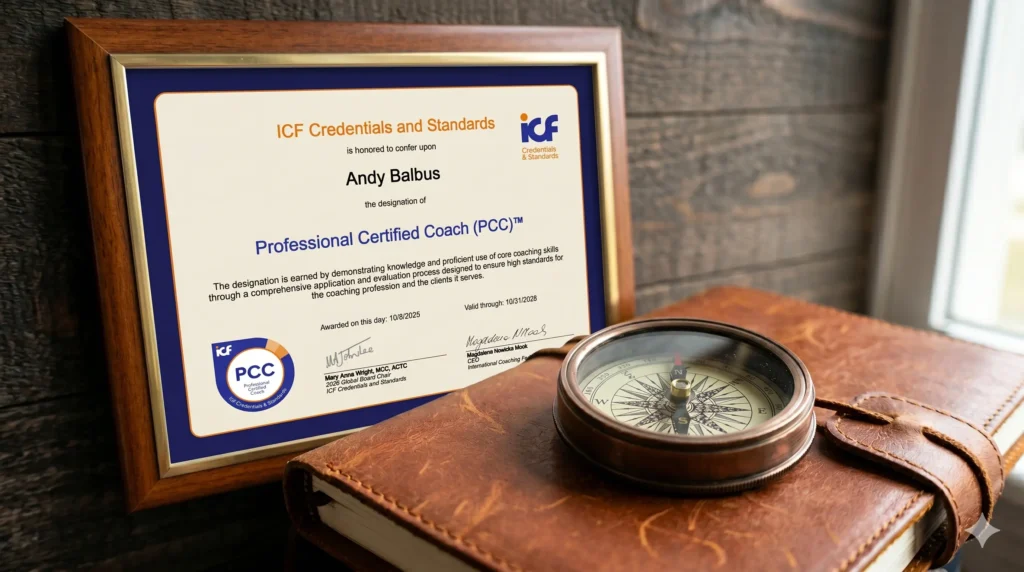
These are not brochure lines. They are the proof that I have stood on both sides of the gap you are managing right now. Meet Andy Balbus, the full story The BYG Code, three principles, zero compromise
The HQ bubble is not a culture problem. It is a financial risk.
Leadership in German headquarters reliably underestimates one thing: the cost of the gap between what gets decided in Munich and what gets executed in Pune or Prievidza.
What makes it so dangerous is its invisibility. The gap never produces a single large invoice that anyone notices. It spreads across hundreds of small frictions: a clarification call here, a quiet rework there, a milestone that slips three days without anyone logging the reason. Because no single line item stands out, it keeps running quarter after quarter and becomes visible only when it lands on your desk as an OEM penalty or the departure of a key engineer. By then you have long paid for it.
WHAT THE GAP COSTS
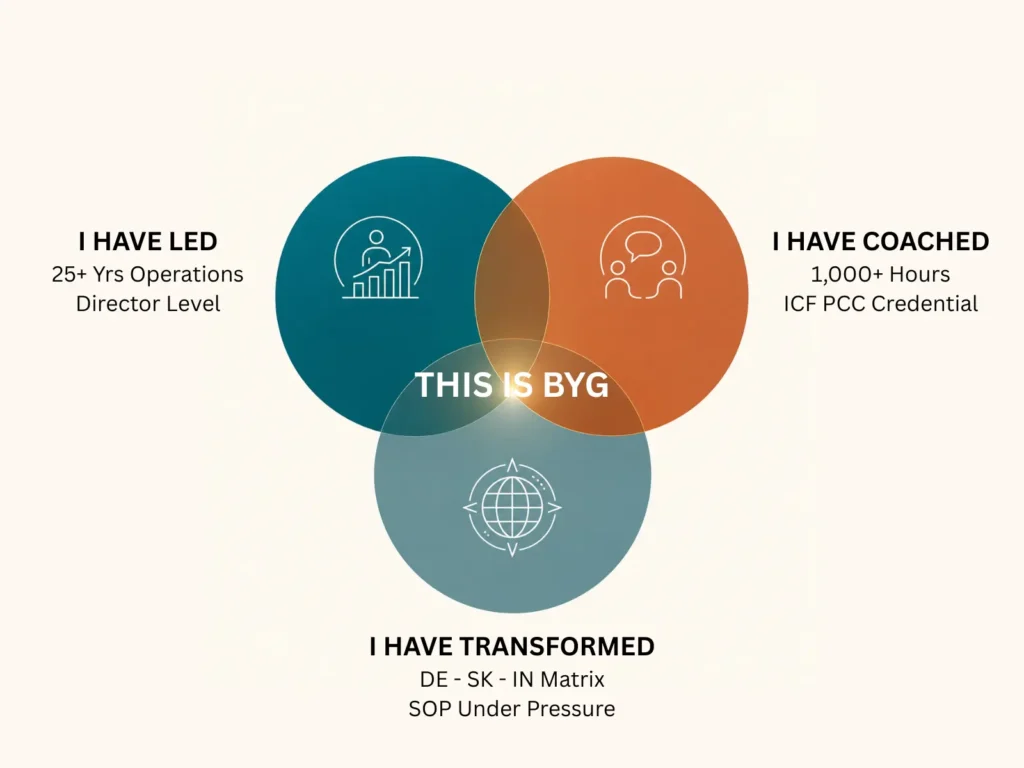
What does the gap really cost you?
Move the sliders. The figures rest on documented sources: an industry attrition band of 20 to 25 percent and Gallup’s replacement cost of one-half to two times annual salary.
Friction-driven attrition, per year
€ 1,177,600 to € 1,472,000
One avoidable line stoppage adds up to 2.3 million USD per hour (Siemens).
This is the annual exposure once friction drives even part of your engineering attrition, before a single line stoppage is added.
Estimate. Industry attrition band 20 to 25 percent; replacement at a conservative one times annual salary, where Gallup documents one-half to two times. Annual cost = hourly rate x 40 hours x 46 weeks. Sources: Gallup; SHRM; Siemens.
Close this gap in a Reality Check ›Three things your international teams do not tell you directly
Not because they are dishonest, but because the system you run makes honesty structurally unsafe. This is what really happens inside your Slovak and Indian hubs.
Blind spot 1: The yes that is not a commitment
When you ask your Indian counterpart whether something will be ready by Friday, the answer is almost always yes. Not because Friday is realistic, but because a yes to a superior in a high-context culture signals respect. Whether the commitment holds shows up three weeks later as a quietly managed problem that never appeared in the status report. This is the Indian Yes, the most expensive cultural misread on the DE-IN axis.
And there is a deeper layer that German headquarters almost always miss. The yes is not only politeness. It is often the rational survival response in an environment where an honest no gets punished. A practitioner in the powertrain quality field put it plainly after one of my articles: anyone who says no with experience and substance gets treated as an obstacle, hears that they have no ownership and only make excuses, and ends up branded a rebel who is pushed out of the organization.
The result is bitter logic. When a well-reasoned no becomes a career risk, the soft yes that fails later is safer than the honest no with real risk mitigation. And the one question that would change everything is almost never asked: what would it take in resources and support to turn this into a yes you can rely on? Skip that question, and you get exactly the system you built.

What does the yes really mean?
Tap a signal you know from your calls and reports. You will see what it often really means, and the one bridge question that creates clarity.
Blind spot 2: The green report that is not green
Your Slovak or Indian team is not lying to you. It is protecting itself, and you, from a conversation that feels politically dangerous. Four years in Slovakia taught me one thing: the escalation your HQ needs to hear is the very one your local team is most afraid to send. So the green version arrives. You see harmony, your team manages the red alone.

Blind spot 3: The directive that becomes a crisis
Every suggestion from a German HQ is received in Slovakia as a binding order. Every process rollout designed in Munich without the local engineering reality produces three weeks of silent workarounds and then an SOP deviation that surprises everyone at the center and no one on the shop floor.
What you can do differently as the center
Decoding the Indian Yes is not enough. As long as an honest no stays dangerous, you keep getting the soft yes. The lever is not at your locations, it is with you.
Four concrete shifts that work immediately:
None of these four levers needs a budget or a program. They need a board member or director willing to change their own questioning technique, and someone alongside who knows how that shift actually lands in a DE-SK-IN matrix instead of staying a well-meant note in the minutes. That is exactly where the sparring begins.

How exposed is your matrix right now?
Five questions, two minutes, an honest picture of how much of your offshore reality you are currently not seeing.
1 of 5: When your Indian or Slovak team agrees to a deadline in a call, how sure are you the commitment will hold?
2 of 5: How often does your offshore team flag a risk before it becomes an SOP crisis?
3 of 5: When an experienced engineer on the ground gives a reasoned no, what happens in your organization?
4 of 5: How reliably do your green reports reflect the real situation on the shop floor?
5 of 5: When a directive from HQ does not fit on the ground, how do you find out?
What changes, 90 days after we start
No theory, just concrete shifts in your operational reality.
- Slovak and Indian hubs escalate risks before they become SOP crises, because a new structure makes honesty professionally safe instead of dangerous.
- The alignment call with Pune produces real commitments. You have a protocol that distinguishes between "I understood" and "I will deliver by Friday".
- Green status reports begin to reflect the actual operational reality. Not because you demanded honesty, but because the system now makes it safe to deliver it.
- Top engineers in India stop planning their exits. They feel like strategic contributors, not an extended workbench.
- Your Slovak hub pushes back on HQ directives constructively, documented, with alternatives. And it lands.
- You stop guessing what is happening on the ground. You have a direct line to the operational truth, without flying to Prievidza or Pune.
- A well-reasoned no now reaches you early and with a path forward, instead of disguising itself as a soft yes that returns as a crisis three weeks later.
This does not happen through a method. It happens because someone who has stood on both sides of this gap builds the structure your matrix needs, with you. Go deeper: Active Listening, Uncompromising Delegation, Industrial Conflict Architecture.
The right format for your situation
Not every situation needs the same intervention. We match it to your pressure level.
Andy Balbus BYG Consulting operates remotely and works across every time zone you do. The firm accepts mandates and supports clients throughout Germany, Austria, Slovakia, the Czech Republic, Poland, Spain, and across Europe, as well as the USA, Mexico, China, and India. Wherever your headquarters, your plants, or your hubs sit, our consulting travels with you.
FAQ: Frequently Asked Questions
Q1: My international managers say everything is on track. Why should I be concerned?
Because that is the symptom, not the all-clear. The Green-Melon Effect means reports are green precisely because reporting red carries a personal career risk. The smoother the report, the more important the question of what is being quietly managed underneath. In the Reality Check we look directly at that gap.
Q2: We have done cross-cultural training before. Why did it not work?
Because classic training delivers knowledge but builds no structure. People learn that India is high-context, then sit in the same call on Monday with the same nods. We do not work on awareness, we work on protocols and agreements that hold under pressure, inside your specific HQ-hub matrix.
Q3: Can you help even if the problem is already a crisis?
Yes. That is what Accelerate Now is for, a stabilization protocol in three focused sessions with results within days. Once the acute situation is stable, we move to the structure so the same crisis does not repeat.
Q4: Is this relevant for a German Mittelstand company scaling internationally for the first time?
Especially then. On a first international build, the communication architecture forms organically, through calls and reviews, through whoever happens to be in the right roles. That unplanned growth is exactly what creates the expensive gaps later. Built early, the bridge costs a fraction of what it costs to repair later.
Q5: How much time does this require from me personally?
The entry point is a 30-minute Reality Check, not a budget decision, just 30 minutes and the willingness to look honestly at the gap. The ongoing sparring is 1:1 sessions across 6 to 12 weeks, fully remote, scheduled around your calendar.
Q6: I am the HR Director, not the CEO. Can I initiate this?
Yes. HR leaders often see the attrition, the escalation culture, and the silent departures earlier than the board does. You are frequently the right place to get the bridge moving before it becomes a board-level problem.
Q7: What happens if my German leadership team is part of the problem?
That is the rule more than the exception, and it is not an accusation. The HQ side sends directives in good faith and underestimates how they land. We work on both ends of the bridge, without blame, focused on how authority is sent and how it is received.
Q8: What does the first step cost?
Nothing but 30 minutes. We do not start with a long-term contract, we start with a direct conversation. By the end of the Reality Check you know exactly where the friction sits and what the first move looks like.
Q9: Does this run remotely or on site?
The sparring runs fully remote, scheduled around your HQ-hub reality. For Team Charter Workshops an on-site day is also an option. The diagnosis and the ongoing work need no travel.
Q10: What language do we work in?
German or English, depending on the constellation. In the DE-SK-IN matrix both are everyday, and I move in both worlds, linguistically and culturally.
Q11: How is this different from classic management consulting?
Consultants deliver frameworks and slides. I built for four years in Prievidza and coached for two years in Pune, standing on both sides of the gap. You get no theory, but structures from lived operational experience that hold in your matrix.
Q12: My Indian team says yes to everything and then fails. Is it culture or management?
Both, and above all a safety problem. The yes is often not politeness but the safer choice in an environment where an honest no gets punished. Someone who says no with experience quickly hears that they have no ownership. So they deliver a soft yes and fail later, because that feels less risky than a clear no. The lever is not to decode the yes, but to make the no professionally safe and to ask, after every no, what it would take to make it a reliable yes.
Q13: Is strict ownership not exactly right? We do not tolerate excuses.
Ownership yes, but beware the trap. If every well-reasoned no counts as an excuse, you train your organization into the soft yes that fails expensively later. Real ownership grows when a no is an invitation to solve together, not a career risk. Ask for conditions, not for someone to blame, and you get honest commitments instead of pretty ones.
Q14: How do I make an honest no professionally safe in my offshore team?
Three levers, usable immediately. First, after every no, ask the missing question: what would it take in resources and support for a yes? Second, separate the messenger from the message and reward an early risk signal visibly instead of punishing it. Third, ask for conditions rather than commitments: not "will you hit the deadline" but "under what conditions does it hold". That shifts the culture from self-protection to real delivery commitment.
Q15: Our problems are more about quality than deadlines. Does this still fit?
Very much so. Deadline and quality problems share the same root in the matrix: a team that sees a risk early but cannot escalate it safely. The deviation that surfaces later at the OEM or in validation was often known on the ground weeks earlier, but disappeared into the Hidden Factory of rework and silent workarounds. Make escalation safe and ask for conditions rather than commitments, and you catch the quality escape before it reaches the line.

Honest answers to real concerns. Read them. By the end you will know whether to act or to wait.
You cannot fix from Stuttgart what breaks in Pune and Prievidza. But you can build the bridge.
Your international hubs deliver, or fail to deliver, on the basis of a communication architecture that was never deliberately designed. Building that architecture on purpose is what offshore R&D leadership actually means. It grew organically and is showing its limits.
The 30-minute Reality Check needs no budget decision. It needs 30 minutes and the willingness to look honestly. By the end you know exactly where the friction sits and what the first move looks like.
Or reach out directly: founder_andybalbus@boost-your-growth.com | WhatsApp: +49 151 4495 7099

Regularly on site: Bamberg, Nuremberg, Zapfendorf, Bratislava, Prievidza, Barcelona, Pune, Mumbai, Shanghai, Querétaro, and Pittsburgh.
Systemic leadership does not end after one call.
Follow for unfiltered insights and straight-talk strategies:


