
It’s 11 PM. You’re Still Doing It Yourself.
This method is part of the BYG Leadership Toolkit: 28 validated instruments for automotive executives navigating the DE-SK-IN matrix.
Uncompromising delegation in automotive leadership is the discipline that decides whether your department depends on you or runs without you. This page is for leaders who carry the weight when an SOP date starts to wobble:
- Single Desk Dependency: Sitting two or three levels up and watching every critical decision route back to your single desk.
- R&D Bottlenecks: Leading an engineering group that has been “90% finished” for weeks without reaching closure.
- Green-Melon Reports: Running a plant and receiving green status reports while knowing the line will stall tomorrow.
- The Expert Trap: Stepping into leadership as a top engineer, only to find your technical excellence working against scalable delegation.

The Situation: What the Failure to Delegate Actually Costs
The deadline is tomorrow morning. Your team in Pune was supposed to own this milestone. Three weeks ago you said “I will take a quick look,” and you never gave it back. Now you are finishing it yourself, again. This is not a time problem. It is not a capability problem in your team. This is the Expert Paradox, and it quietly drains the strategic capacity your role exists to provide.
You were promoted because you were exceptional. For ten to fifteen years you solved every technical problem on your desk faster and cleaner than anyone around you. The board trusted you. Your OEM contacts trusted you. You were the person who made things happen.
That strength has become a structural trap. Your department runs, but only because you are the bottleneck of every critical decision. Escalations route through you. Technical risk assessments wait for your judgment. SOP milestones depend on your personal intervention. The accountability transfer to your technical leaders never truly happened, because deciding yourself was faster in the short term.
When you are unavailable, traveling, in a board meeting, or sick for a week, the system slows down. Not because your team is incompetent, but because you built a dependency instead of an organisation. That is the Chief Firefighter Syndrome, and in the automotive matrix it has a price: silent escalation gaps turn into OEM penalty events on SOP day.

Slovakia, 2021. 11 PM. In Front of a Laptop.
I was that manager. The deadline was the next morning. My team in Prievidza had held the task for days. I did not trust that the output standard would be met, so I sat down and rewrote the critical sections myself. Three hours. The delivery was clean and the OEM was satisfied.
The next day I spoke with my engineers. Most of them had never understood why this milestone was so critical. I had delegated the What and had never delegated the Why. I had also never defined, in measurable terms, what “good enough” actually looked like. So I had built a system that could only function with my personal involvement, and then wondered why it could only function with my personal involvement.
The question I had to ask myself that night was not how to learn to let go better. The real question was sharper: why had I built a system that needed me to survive?

Why the Bottleneck Is Expensive: Four Numbers
These figures come from public, checkable sources. They explain why the cost of being the bottleneck is not a feeling, but a measurable exposure.

The Expert Paradox: Why Your Greatest Strength Became Your Biggest Obstacle
There is a specific neurological reason why delegation feels so hard, and it has nothing to do with personality or discipline.
Every time you stepped in and solved a problem yourself, your brain released dopamine. You were the hero, the deadline held and the OEM was satisfied. Neurologically you were rewarded for exactly this behaviour, thousands of times across a career. The moment you try to delegate, you withhold that reward from yourself. You feel uncertain, so you intervene and take the task back. And in doing so you train your team in what organisational psychology calls malicious obedience: they stop proposing solutions, because they have learned you will solve it anyway.
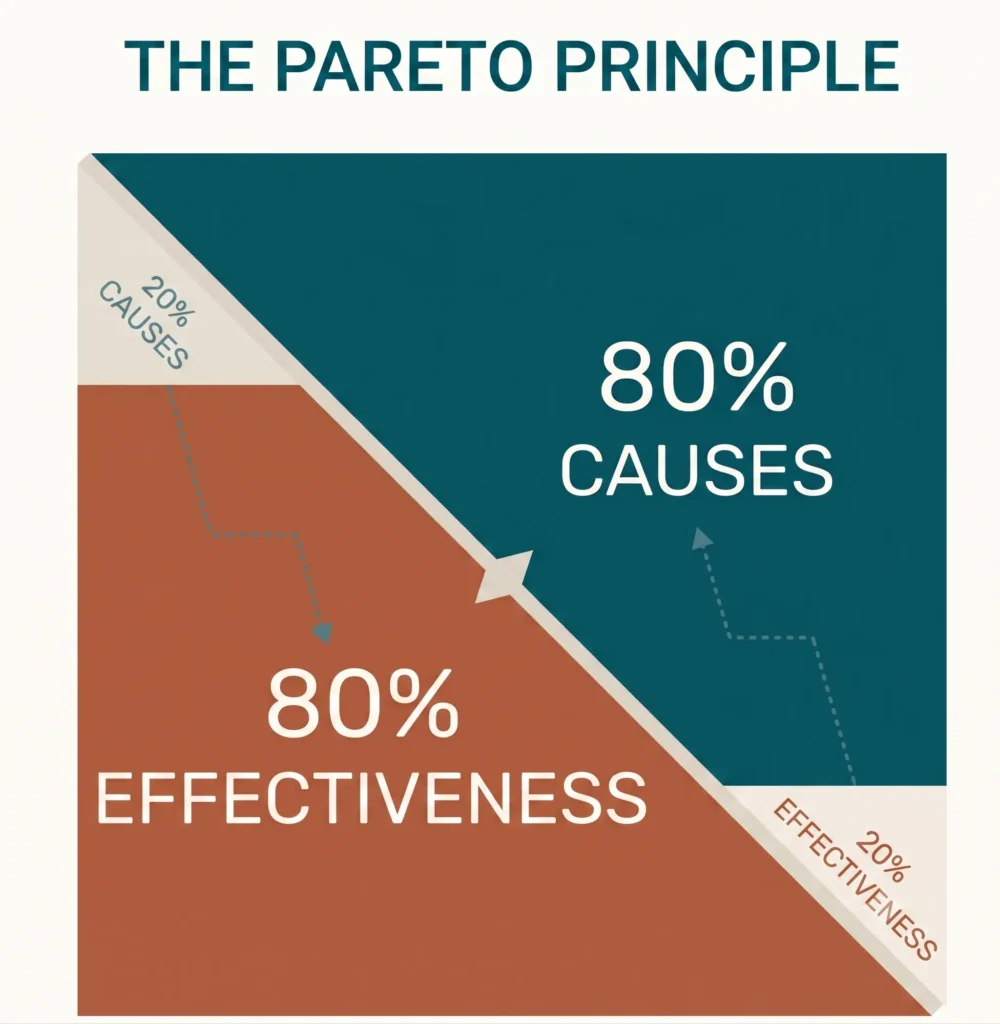
This is not weakness. It is a deeply conditioned pattern, and it needs a structural intervention, not a motivational speech. The Gallup data makes the stakes literal: the leader, not the program, accounts for most of the difference between an engaged team and a disengaged one. You are not standing next to the system. You are the system.
Three Signals That You Are the Bottleneck

The BYG Framework: Uncompromising Delegation in Four Steps
This is not a motivational concept. It is a structural operating system, built across 25+ years of leading engineering teams on three continents and validated across 40+ engineers in DE-SK-IN Greenfield operations. Each step addresses a specific failure mode. Together they build a department that runs reliably without your physical presence.
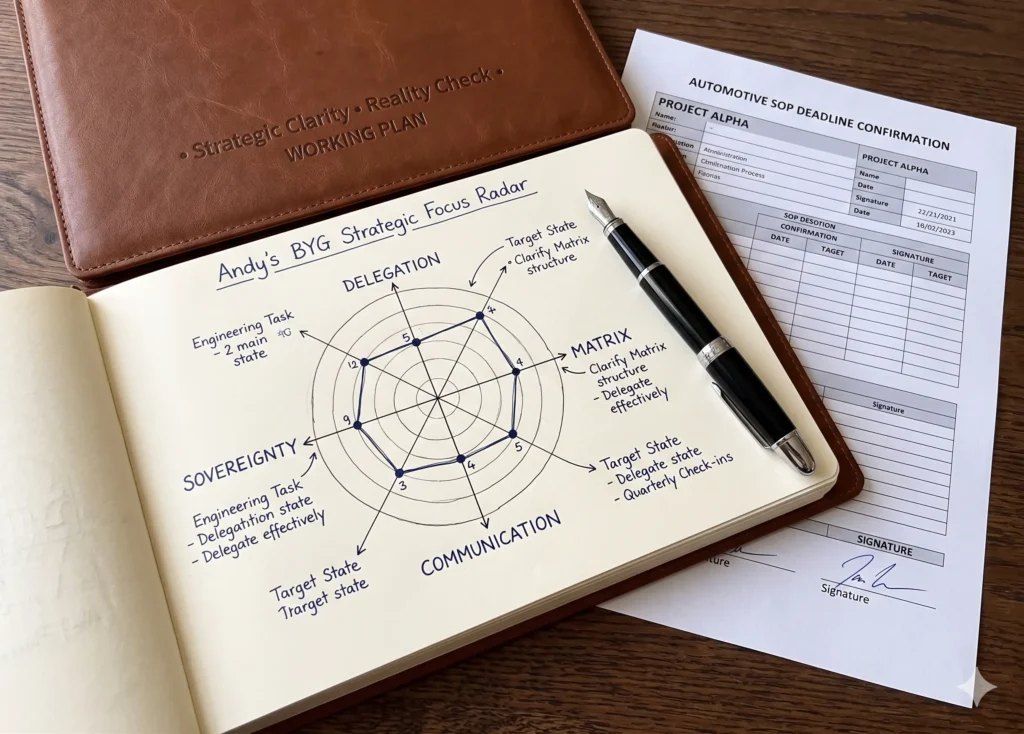
How do you react when an employee presents an issue they could resolve independently?
Does your delegation include the strategic context necessary for understanding SOP or OEM targets?
Are three non-negotiable guardrails applied to every assignment: deadlines, resource limits, and escalation triggers?
Who handles the workload without production loss if your most crucial team member suddenly falls ill?
Could your department function independently without critical errors during a three-month leadership absence?
How autonomously does your staff make decisions before taking action?
I fell into this exact trap myself. During late night hours, I frequently completed tasks that my team in Slovakia should have managed. Honest conversations later revealed that I had delegated the execution, but completely omitted the underlying purpose. That realization shifted my focus from simply learning to let go, toward understanding why my department failed without my constant presence.
The Transformation: What Becomes Possible When You Truly Let Go
Prievidza, 2019. My First Employee. His Name Was Martin.
When the Electronics department was founded, it began with an empty floor and an idea. No office, no tools, no infrastructure. My first Slovak employee was Martin, a software developer by training and a co-founder of a department by conviction.
I could have handed him a task list: write this code, test this module, document that feature. Instead I explained the goal: What do we want to build together? What needs to exist in twelve months for us to actually work effectively?
Martin understood at once that software was the second step. The first was building the infrastructure together. So we organised it jointly: selecting and procuring tools, planning workstations, sourcing debuggers and licences, from screwdrivers to soldering stations. Tasks a software developer was not hired to do, and tasks he solved better than I could have managed alone.
Did Martin do some things differently than I would have?
Yes, and that was valuable. Different is not wrong. He carried the software developer perspective, and for building the software group inside the department that view was worth gold. Far from being a deficiency, it was a competence gain I could not have purchased.
Then came the second Martin, a hardware developer, and the third Martin. My first three employees in Slovakia were all named Martin. Each one built a part of the department with me that I could never have built that fast alone. I did not delegate tasks. I delegated territories, trusting that each of these people understood their territory better than I did. Later came Gabriela and Livia, my two assistants. Scheduling, time-booking, 5S compliance, all the work a director must not consume capacity on. Anyone who believes a director can do everything themselves will fail, not from incompetence, but from never building the network that carries a department.
The network of people, trust and delegated responsibility gave me back the one thing no leader can afford to lose: the capacity to make strategic decisions. Not operational micro-decisions, strategic ones. The decisions that set direction.

The Measurable ROI: What Uncompromising Delegation Delivers
These are the outcomes consistently observed when leaders build and apply this framework in the automotive matrix. Each line ties a mechanism to an effect, with the source stated where the figure is external.
One framing matters more than any single number: Rapid decision-making in a crisis is not a character trait, it is the consequence of keeping operational capacity free. A leader who sinks into operational tasks daily has nothing left when SOP approval, budget release or an OEM escalation lands at once. The network of delegated responsibility is what hands that capacity back.

Delegation in 2026: The Bottleneck Gets More Expensive, Not Less
Two shifts are raising the cost of the Chief Firefighter pattern. The transition to software-defined vehicles turns every program into a continuous-integration problem where a single leader cannot hold all the threads. At the same time, Gallup reports global engagement falling to 21%, tying to a $438B productivity loss. In this environment, a department dependent on one desk is fragile. Uncompromising delegation is the architecture that keeps the system standing when you step away.
- 1:1 Executive Sparring: Confidential, slide-free diagnosis directly with Andy Balbus (30 min).
- Matrix Bottleneck Audit: Precise identification of single-desk dependencies across your DE-SK-IN setup.
- Actionable Roadmap: Immediate structural steps to establish self-steering engineering governance.
Frequently Asked Questions: Executive Delegation Governance & Matrix Execution
These questions come directly from Reality Checks and executive coaching engagements across the DE-SK-IN matrix. They address real operational friction, not theoretical concepts.
Q1: How do I stop micromanaging my engineering team without losing quality standards?
Quality is protected by standards, not by presence. Define what good enough looks like in measurable, written terms before you delegate, then define the escalation trigger, the exact moment the team must call. Inside those boundaries, release control. Quality may dip slightly at first while the team builds confidence. That is not a signal to step back in, it is the signal that learning is happening. Quality usually stabilises within four to six weeks at or above the previous level.
Q2: My team in Pune delivers, but always needs significant rework. Is this a delegation problem or a capability problem?
Usually both, and the capability problem sits downstream of the delegation problem. When engineers receive tasks without context, they optimise for the stated requirement rather than the underlying need, so technically correct deliveries miss the strategic mark. Start with the Why conversation on every delegation and add a short written alignment confirmation after each briefing. Rework rates tend to drop within four to six weeks with no change to your team’s technical competence.
Q3: How do I move from micromanagement to effective delegation in a technical team?
A gradual shift is the wrong approach, because it signals inconsistency and your team never knows which version of you will show up. Make one clean structural change. From today, when a team member brings a problem, your answer is always the same: what are your three proposed solutions, and which do you recommend? Applied consistently, that single shift breaks the dependency loop within six to eight weeks. Document the escalation architecture in the first two weeks so the team knows exactly when to surface risk.
Q4: What is malicious obedience and how does it develop in engineering teams?
Malicious obedience is the pattern where team members follow, or wait for, instructions without applying their own judgment, because they have learned that initiative is not valued. It grows when leaders take problems back, solve issues before the team has a chance, or criticise independent decisions. Over time engineers stop generating solutions because passive execution feels safe. Breaking it requires sustained behavioural change from the leader, not a workshop or a speech.
Q5: How does delegation lead to faster decision-making in a crisis?
A leader who sinks into operational micro-decisions has no time or cognitive capacity left when a real crisis hits, SOP risk, OEM escalation, a budget emergency, for the decisions that set direction. Speed in a crisis is the direct result of keeping operational capacity free. Every task you do not delegate today blocks your decision capacity tomorrow. The network of delegated responsibility drives the operational work and returns to you the time and clarity a crisis demands.
Q6: How long does it take to build a delegation culture in a team?
Behavioural research points to eight to twelve weeks for observable change in escalation patterns and six to twelve months for a genuine ownership culture to stabilise. The timeline depends on how consistently the leader holds the Coach Hat response under pressure and how explicitly the escalation architecture is documented. Teams in hierarchical cultures often need two to three extra weeks to internalise the safety to escalate without it feeling like failure.
Q7: What is the difference between delegation and abdication?
Delegation is bounded autonomy with explicit guardrails, measurable standards and a defined escalation architecture. Abdication is assigning a task and withdrawing, leaving the team without context, standards or a way to surface risk. From the outside they look the same, but they produce opposite results. Delegation creates ownership and capability. Abdication creates anxiety, poor decisions and eventually the Green Melon Effect.
More about the Green Melon Effect ›
Q8: How do I handle a team member who refuses accountability even after clear delegation?
Separate inability from unwillingness. Inability needs structured development: clearer standards, more granular escalation points, deliberate stretch assignments with support. Unwillingness, capability present but passive execution chosen, is a values conversation, not a skills one. Be direct: in this organisation ownership is not optional, so what specifically makes it hard for you to operate independently? If the answer reveals a structural barrier, address it. If it reveals a preference for compliance over responsibility, you are managing a misfit, and the matrix does not forgive that at scale.
Q9: What is the Chief Firefighter Syndrome and how does it damage organisations?
It is the pattern where a leader becomes the primary solver of operational problems. That earns short-term respect and results, but it systematically prevents the organisation from building its own problem-solving capability. The team stops developing independent judgment, the organisation becomes fragile, working when the leader is present and slowing when they are not, and the leader burns out from the impossibility of being everywhere at once. The cure is not working harder. It is building a system that works without you.
Q10: Why do internal leadership programs fail to teach delegation effectively?
Internal programs teach concepts. Delegation fails at implementation, at the exact moment a leader under deadline pressure reverts to doing it themselves because it is faster. The concept is not the problem, the behaviour under pressure is. External support works because it creates an accountability structure that survives the pressure moment. A question like “did you give it back or solve it yourself?” holds in a way a certificate on the wall never will.
Q11: Does the cultural yes really change how I should delegate across DE-SK-IN?
Yes. After agreement from Pune, follow with a verification question: what specifically do you need from me to deliver this by Friday? Concrete requirements signal genuine ownership; a flat “nothing” often hides the real blocker. For Slovak engineers, build the escalation trigger into the contract of every delegation, framed as an expectation rather than a judgment call, so calling early reads as professional rather than as weakness. In cross-timezone work, confirm the Why and the standard in writing, because verbal briefings lose precision in translation.
Q12: Can I combine uncompromising delegation with executive coaching?
Yes, and it is often the most effective structure. Uncompromising delegation addresses the structural operating system: guardrails, escalation architecture, Why conversations. Executive coaching addresses the internal one: the beliefs that make you step in even when you know you should not. Together they form the complete intervention. In the Reality Check we define which combination fits your current pressure.

Uncompromising delegation does not stand alone. These core instruments directly amplify and extend the delegation framework across your international matrix:
- GROW Method: The structured conversation model powering the Coach Hat response to shift cognitive load back to engineering teams.
- SMART Goal Setting: Converting delegated assignments into unambiguous, measurable delivery commitments.
- Eisenhower Matrix & Prioritization: Reclaiming high-value executive hours freed through structural delegation.
- Active Listening: The diagnostic tool that surfaces hidden "Cultural Yes" signals before they turn into SOP delays.
- Conflict Management: Resolving cross-site friction immediately when delegation boundaries break down.
- Full Toolkit & Glossary: Access the complete Automotive Leadership Toolkit and the BYG Leadership Glossary for terms like the Green Melon Effect.
Do Not Trust the Theory: Where This Comes From
The former manager who advised me against the Prievidza role in 2019 had a rational basis for his skepticism. The conditions were demanding and the risks were real. What he did not factor in is that you can build a system stronger than any single person, including its founder. The three Martins, Gabriela, Livia and the dozens who came after were not employees in the conventional sense, they were co-architects of an organisation. When I handed the department to my successor in 2023 and moved to India, it continued without disruption. Today, the department that was expected to fail is still running today, because it was built to outlast any single person, including me.
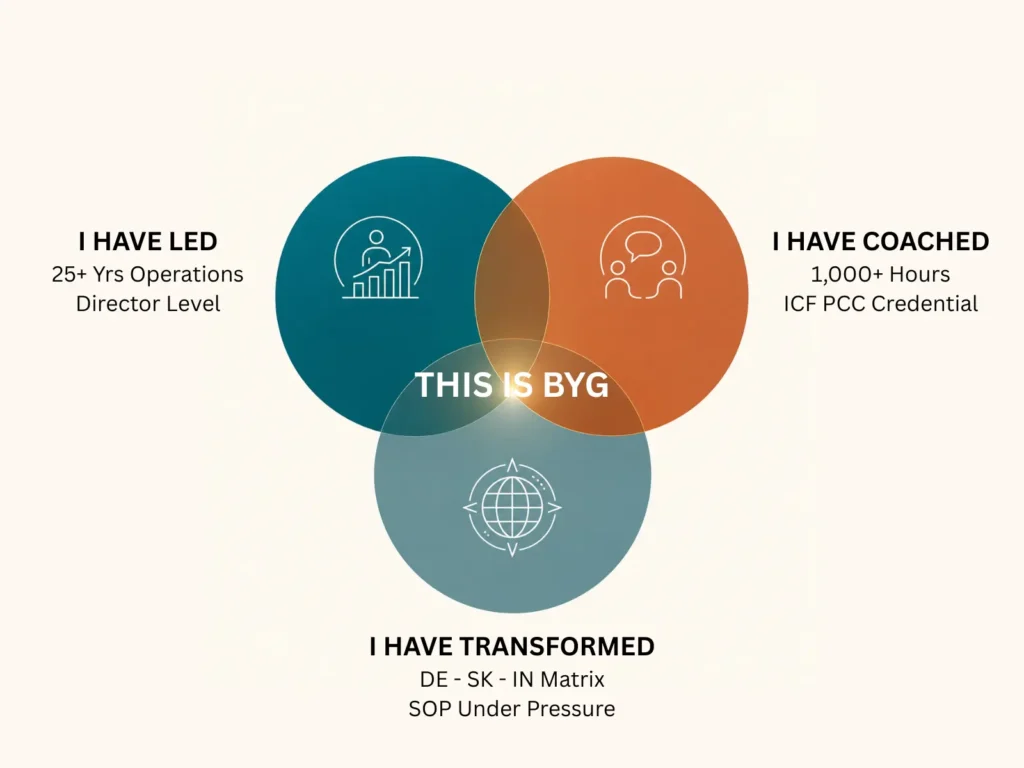
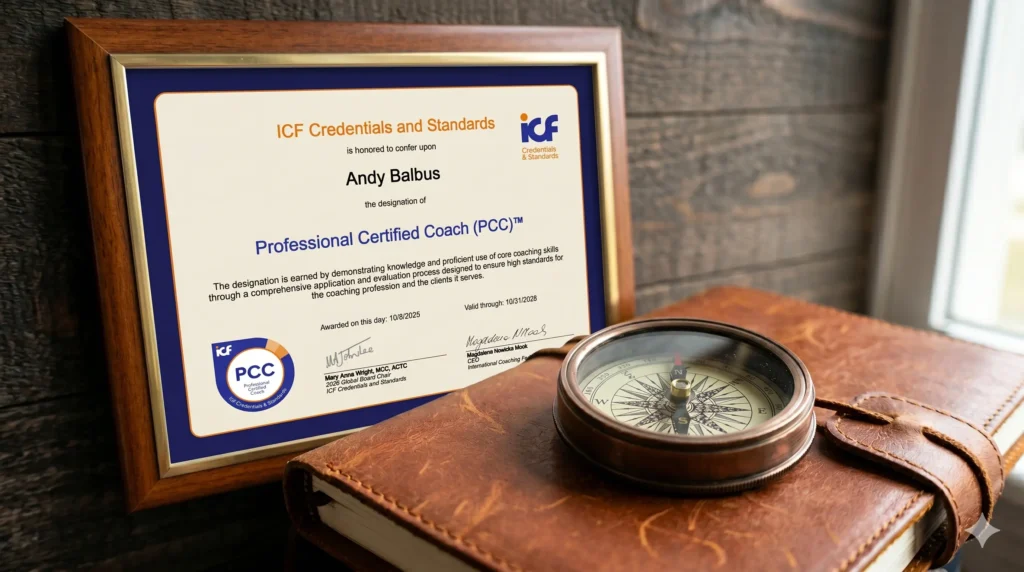
This method rests on 25+ years inside the machine at a Tier-1 automotive supplier, director-level electronics R&D built from zero in Slovakia, a senior electronics leadership role in Pune, and ICF PCC certification. The framework on this page is not borrowed from a textbook, it was paid for in real SOP pressure across the DE-SK-IN matrix.
The Next Step: A Conversation, Not a Commitment
The Reality Check is a 30-minute diagnostic conversation. We identify the one delegation failure mode currently costing your organisation the most, and define a single structural change you can implement this week. No pitch, no program, no commitment. If there is a structural fit between what you need and what BYG Consulting does, we will both know inside 30 minutes.
- 1:1 Founder Dialogue: Direct confidential exchange with Andy Balbus (30 min, zero slides, zero sales pitch).
- Targeted Bottleneck Audit: Precise identification of single-desk dependencies draining your strategic bandwidth.
- Immediate Action Plan: One concrete structural change you can apply directly in your DE-SK-IN matrix.
Direct Contact:
Email: founder_andybalbus@boost-your-growth.com | WhatsApp: +49 151 4495 7099

The Next Stage: Mentoring Matched to Your Leadership Reality
Once the method is clear, the question becomes which mentoring stage fits where you actually stand. These four tracks transfer operational experience directly, calibrated to your current span of control:
- From Expert to Leader: Mastering the initial transition when technical excellence starts working against scalable leadership.
- Team Lead Scaling: Building structural redundancy across sites so single-person outages never derail SOP commitments.
- Mentoring for Automotive Directors: Expanding strategic influence, P&L visibility, and board alignment beyond technical execution.
- Lead Without Authority: Steering cross-functional matrix programs and lateral engineering teams across Germany, Slovakia, and India.

Explore all 28 methods in the BYG Leadership Toolkit ›
Systemic leadership does not end after one call.
Follow Andy Balbus BYG Consulting across our executive channels for unfiltered operational insights, war stories, and straight-talk strategies:


