
Summary
One-on-One Meetings: The 1:1 is the most frequent but least structured leadership meeting. Treating it as a status update wastes time and hides real problems. Transform your one-on-ones into powerful development tools using the GROW method. Learn how to set a reliable cadence, ask open questions, and shift ownership to your team instead of solving their technical problems yourself.
The most frequent leadership conversation in industry is also the least designed one
Look at the recurring slot in your calendar. Thirty minutes, your name, the name of one engineer. It happens, most weeks anyway. And when it happens, it follows a pattern neither of you ever agreed on. Your engineer reports, you listen, you sort things, you make two decisions, time is up.

You leave that room knowing more about the project. About the person who sat across from you, you know nothing you did not already know.
This article is written for leaders in engineering and manufacturing who take that slot seriously and still sense it runs below its value. It is not written for anyone who considers one-on-ones a waste of time. That reader does not need a better conversation structure, they need a different stance on leadership.
What Prievidza Taught Me About One-on-One Meetings
At the start I needed no system, because I had three people
When I built the electronics department in Prievidza from a greenfield in 2019, my team consisted of three engineers. Our one-on-ones were informal and spontaneous. We talked whenever either side had something, often at the next desk, usually without a calendar entry. The entire focus was on enabling those three to build the department together with me.
Growth broke that system quietly
Three engineers turned into forty over the following years. Spontaneity does not scale. It distributes attention by volume: whoever stood at my door often got time, whoever worked quietly and reliably got none. Roughly two years in, I changed it.
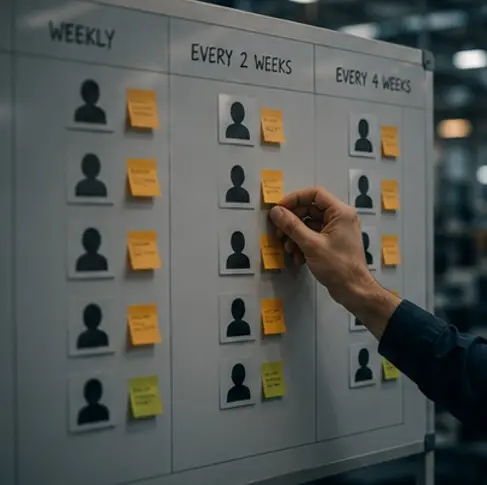
The cadence I introduced, and why it had three tiers
Every new team member received a fixed 30 minutes each week. Anyone who had been with us longer received the same 30 minutes every two weeks, always agreed with them rather than imposed.
Every senior expert received 45 minutes every four weeks. On top of that, everyone had access on demand at any time. The tiers followed experience, not rank and not sympathy.
My assistants kept the system alive, my calendar did not
They tracked the cadence, scheduled the slots, sent the invitations and reshuffled everything when something moved. That freed me to concentrate on people instead of Outlook. The point sounds trivial and is not. A one-on-one that is the first thing to move whenever the day gets tight carries a message you would never say out loud. In my department that conversation was never priority C.
These meetings were explicitly not project reviews
Of course I received project information along the way, that cannot be separated. The purpose sat elsewhere. I wanted to build trust, and above all the trust of my engineers in themselves. They needed to feel that not everything has to be reported upward, that responsibility for their own work sits with them. In parallel I assigned SMART goals to two people jointly, so that their collaboration had a reason of its own.
The observation that surprised me most
Older colleagues, and I mean age rather than years with the company, struggled the most with giving me project information without every detail. They tended to unload everything and then wait to hear what to do. That instruction never came from me. Questions came from me, and I trusted their expertise. This is my observation across four years, not a study. I no longer put it down to age but to conditioning by leadership systems in which instruction was the normal case.

Where I did step in: the conditions around the work
One concrete example. Our fleet manager insisted on a fixed lead time for booking company cars. Our projects produced mornings on which we decided that somebody had to be at the customer that same day. My engineers got nowhere with that request, they were pointed back at the lead time. In Slovakia a director carries different weight than a software developer, that is simply the reality. So I had those conversations and created the conditions. That is what a leader is needed for in a one-on-one, not for the technical call.
And one experiment that failed
I wanted to develop my first software engineer in a targeted way, he had a stream of ideas of his own.
My offer: four days on projects, one day on his ideas. It did not work, because the projects did not sleep on that fifth day. On paper such plans look excellent, against reality they fall apart. Today I would run it differently: strictly through workload, and only when the workload genuinely allows those phases of development and experiment. I would also anchor that day with agreed development goals, so it carries weight. Not everything I tried worked.

What I never did, and I am still proud of that
I never pulled the technical decision to myself. However much detail came out of the projects, I stayed strict about asking for options and directions instead of ruling. Overall accountability sat with me by virtue of the role, that was never in question. The expertise and the preparation of decisions stayed with the team, and that team was outstanding. Anyone who takes the technical call inside a one-on-one has not held a development conversation, they have collected a responsibility that belongs to someone else. It is the shortest definition of micromanagement I know.
No sales conversation. If I am not the right fit, you will hear that within the first five minutes.
What the Research Says About One-on-One Meetings
The most common conversation in industry is the least studied one
Flinchum, Kreamer, Rogelberg and Gooty noted in Organizational Psychology Review in 2022 that one-on-ones make up close to half of all workplace meetings and had until then barely been studied as a subject in their own right. Translated into your week, that reads as follows. The format you invest the most conversation time in is the only one nobody ever handed you a method for. There are courses for conflict facilitation, there are checklists for the Gemba Walk, and for the one-on-one there is a calendar entry. (Source: Flinchum, Kreamer, Rogelberg & Gooty (2022), Organizational Psychology Review.)

Cadence decides the outcome, good intentions do not
Steven Rogelberg described three workable cadences in Harvard Business Review in 2022. First, weekly for around 30 minutes per person. Employees across all job levels rated this the most desirable option, and it correlated with the highest levels of engagement. Second, every other week for 45 to 60 minutes. Third, a hybrid in which part of the team comes weekly and part every two weeks.
My system in Prievidza sat on that line, with two honest deviations. My two-week tier ran at 30 minutes rather than 45 to 60, and the senior tier of 45 minutes every four weeks falls below all three researched plans. What compensated for it was the standing offer of access on demand, which senior experts used regularly. When you set your own cadence, you now know the reference point and can see where you deviate on purpose. (Source: Rogelberg, S. G. (2022), Make the Most of Your One-on-One Meetings, Harvard Business Review, November/December 2022; expanded in Glad We Met, Oxford University Press 2024.)
What regular conversations change in measurable terms
Gallup has tracked the link between consistent communication and engagement for years. People whose manager holds regular meetings with them are almost three times as likely to be engaged as people whose manager does not. The baseline without a regular slot sits at 15 percent. Put that against your attrition: engaged teams show up to 59 percent lower turnover, and replacing a senior engineer costs 150 to 200 percent of annual salary. A weekly half hour adds up to roughly 25 hours a year. That calculation rarely comes out close. (Sources: Gallup, Employees Want a Lot More From Their Managers, based on State of the American Manager; Gallup Business Journal for the 15 percent baseline; replacement cost per PLOS ONE and Accenture.)
Why a status update carries structurally the wrong content
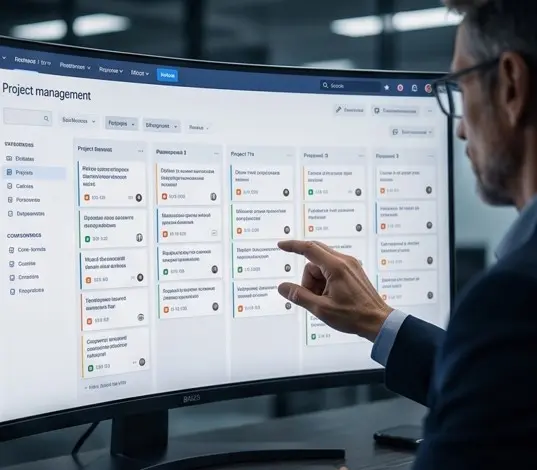
Sidney Yoshida’s Iceberg of Ignorance holds that the top layer of a company knows a fraction of its actual problems, about four percent. The rest sits with the people doing the work. A one-on-one that runs as a status update carries exactly the part that is already in the report. What stays invisible is everything else: the half-solved problem, the quiet overload, the idea nobody had time for. Reaching that layer takes a different kind of question, and open-ended questions are where it starts. (Source: Sidney Yoshida, Iceberg of Ignorance (canonical BYG statistics set).)

Voices From Practice
Prashant Chaudhari worked with me at Brose in test automation and later as a client. His recommendation speaks to the environment a leader builds around individual conversations, which is exactly what a cadence produces over time.
Your Conversation Guide for the Next One-on-One
Theory helps very little at two o’clock on a Thursday. Pick who you are meeting next and what the conversation is actually about. You will get four questions along the GROW architecture, written to be taken with you, plus the one thing to deliberately avoid in that meeting.
Who are you meeting next?
What is this conversation actually about?
The GROW Architecture as a Structure for One-on-One Meetings
GROW comes from coaching and stands for Goal, Reality, Options and Will. In a one-on-one I do not treat it as a questionnaire but as a sequence that stops the conversation from landing on a solution by minute three. In the BYG version every phase carries a decision you make as a leader, namely what you deliberately do not do in that phase.
Goal: the goal belongs to the person, not to the project plan
The first question aims at what your engineer wants to achieve, not at the next milestone. Both are connected, and the order decides the character of the meeting. Start with the milestone and you run a project review with a personal note. Start with the person and you get both.
Reality: the unvarnished picture, without your verdict
This phase covers facts and perception, not your judgement. It is where the layer beneath the status report becomes visible, provided your team dares to show it. Without psychological safety you get the polished version you already have. Active listening is the actual work here, not follow-up questioning.
Options: you ask for paths, you name none
Here you decide whether you lead a team of engineers or a group of executors. Your experience is deep and the temptation matches it. Even so, this phase belongs to your team member's expertise. When nothing comes at all, ask which option they already discarded, and why. Only then bring your own thinking in, explicitly framed as a proposal rather than an instruction.
Will: commitment instead of intention
The close covers who does what by when, and what they need from you to do it.
That second half is usually forgotten and matters more. This is where your role enters, the way mine did with the fleet booking: creating conditions your engineer cannot reach from their position. How to phrase goals that survive contact with the quarter sits in a separate article on goal setting.
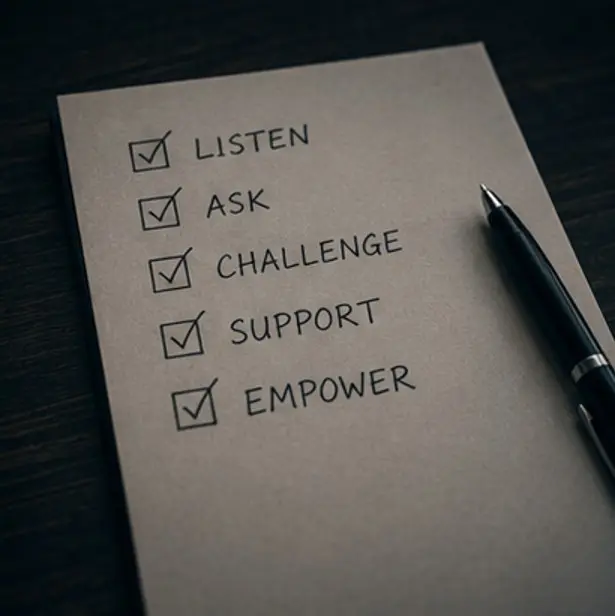
The rule that holds it together: four questions, no answers
If you keep one thing from this article, keep this. The one-on-one is the single meeting in your week where you are explicitly not required to decide. Overall accountability stays with you by role, no conversation format changes that. The technical decision stays with the team. Hold that line and you get engineers who think ahead instead of waiting for the next instruction. Drop it and you end up in the chief firefighter syndrome, wondering why your calendar leaves no room for strategy.
You leave with a phrasing you can use, not with a proposal.
Where a Good Cadence Reaches Its Limits
A reliable rhythm solves no structural problem. When your team works across sites, the rules of remote leadership apply on top. When technical and disciplinary leadership sit with different people, which is the normal case in the matrix between Germany, Slovakia and India, clarify who leads whom first. And when experienced people mainly unload tasks in your one-on-ones, what is missing is often not conversation quality but consistent delegation.
Marianna Kopaskova joined my department in Slovakia as an application engineer straight out of university. Her review describes the two moves that a good one-on-one alternates between: offering another perspective, and standing up for the person when it counts.
How the conversation rhythm fits into a system of goals, roles and rules is covered by the team charter workshop and the mentoring method. Terms used in this article are defined in the leadership glossary, and the full toolkit sits in the methods overview.
FAQ: Frequently Asked Questions About One-on-One Meetings
Q1: How often should I hold one-on-one meetings?
Rogelberg's research supports three cadences: weekly for around 30 minutes, every two weeks for 45 to 60 minutes, or a hybrid. Weekly performs best. My own practice in Slovakia was tiered: new hires weekly, experienced people every two weeks, senior experts every four weeks with a longer slot and access on demand.
Q2: How long should a one-on-one be?
Thirty minutes is enough for a regular rhythm, provided the meeting actually happens. Longer is not automatically better. Consistency carries the value: a reliable half hour beats the two-hour conversation that occurs twice a year.
Q3: What is the difference between a one-on-one and an annual review?
The annual review looks back, evaluates and is usually tied to HR processes. The one-on-one looks forward, develops and belongs to the two of you. Run only the annual review and you correct once a year what has been building for twelve months.
Q4: My engineer only reports project status. How do I turn that around?
Change the first question. Open with how project X is going and you get a report. Open with what has occupied them most this week and you get a person. Say once, explicitly, that this slot is not for status. With long-standing habits that takes several repetitions.
Q5: What do I do when nothing comes and we are finished after ten minutes?
Sit with the silence, that is the most common failure point. If it stays empty, use a question from the future: what do you want to be working on a year from now that you are not working on today. End early rather than filling the time with project topics, otherwise the format collapses for good.
Q6: How do I sustain this with a team of forty?
You do not, if everyone gets the same cadence. I tiered it and handed the scheduling logistics entirely to my assistants. If your span of control is too wide for that, you need a leadership layer in between or real prioritisation of your own work.
Q7: Can I raise criticism in a one-on-one?
Yes, and you should. Criticism does not belong at the end of a development hour though. It belongs at the start, named clearly and tied to the issue rather than the person. After that you run the conversation about the solution through the same four phases. What to avoid is collecting: saving points for weeks devalues the meeting.
Q8: How do one-on-ones work with people in India or Slovakia?
Through the same four phases, with extra care in the reality phase. How acceptable it is to criticise your own project status out loud varies a great deal across cultures. Ask for observations rather than assessments, and allow more time for the answer. There is more on this in intercultural mentoring.
Q9: What if my own manager holds no one-on-ones with me?
Then introduce it from below. Ask for a fixed half hour and bring an agenda that is not a status list. Leaders who have never experienced a good development conversation rarely run one. That is precisely what executive coaching exists for.
Q10: Should I take minutes in a one-on-one?
Record only what became binding: the agreement, the date, the owner. A verbatim record turns a confidential space into a file, and the person across from you notices immediately. Your team member keeps their own notes, which is part of owning the work.
Q11: How do I know whether my one-on-ones are working?
Two signals. Your team makes more decisions without asking you. And topics reach the table before they escalate. If neither shows up, you are probably still running status meetings under a new name.
Q12: Does a good cadence replace leadership development?
No. Cadence is the vessel, not the content. If the shift from expert to leader is still unfinished, a calendar entry will not carry it. That is the work of mentoring from expert to leader, and with a growing span, of mentoring for team leads.

About the Author: The Intersection of Three Worlds
Most providers are either a coach or a consultant. They know the matrix from projects rather than from accountability. I have worked in all three worlds.
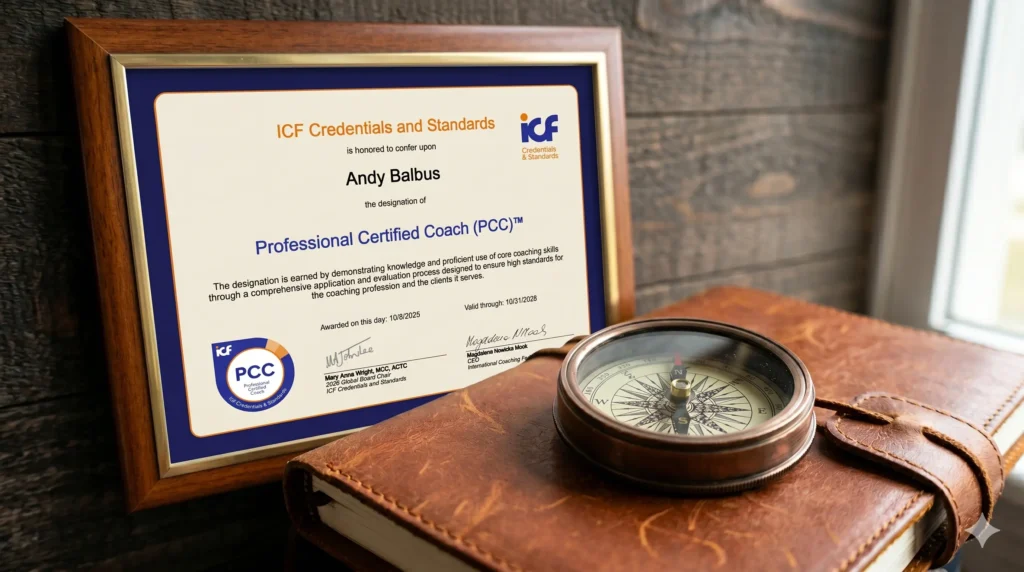
Executive leadership: 25 years of operational automotive DNA, 150 million euro of revenue accountability, an engineering site with 40 engineers built from a greenfield. Executive coaching: ICF PCC certified, more than 1,000 coaching hours.
Intercultural transformation: four years as the accountable leader in Slovakia, two years in Pune, alongside experience in Germany, China, Mexico and the United Kingdom.
Every method I write about has been tested in the engine room of those three worlds, including the conversation cadence in this article. No theory. More about the path is on the page about Andy Balbus and in the case studies.
Results or Excuses?
A one-on-one that only reconciles status costs you nothing, right up until it costs you everything. The engineer who has already resigned internally will not say so in a status report. They say nothing at all, they leave. And the replacement costs you 150 to 200 percent of their annual salary, plus the project time nobody budgets for.
In 30 minutes we look at your current cadence, name the tier that is missing, and you walk out with a decision: which meeting you will run differently from next week, and how. I bring the view from leadership, coaching and cultural change at the same time.

One calendar link, no preparation required.
You can also reach me through the contact page. An overview of the formats, from Accelerate Now and executive coaching to the legacy programme for owners, Your Power Within and coaching for CEOs and senior leaders, sits on the respective pages. Directors working on strategic influence will find their track in mentoring at director level, and leaders without formal authority in leading without authority.
Systematic Leadership does not end with a phone Call.
Follow Andy for more Perspectives and Insights.


Leave a Reply