
Summary
Functional vs Disciplinary Leadership: In a matrix organization, reporting to two bosses often means getting no direction at all. Role ambiguity harms performance far more than conflicting orders. You do not need formal authority to lead effectively. Learn how to align with disciplinary managers, build a shared team vision, and lead through meaning rather than instructions to overcome the diffusion of responsibility.
Two names appear on the org chart. Your engineer ends up following the one who tells him what his work is for.

Splitting functional and disciplinary leadership is one of those constructions that exists on paper in every matrix organization and that almost nobody defines cleanly. On paper it sounds logical: one owns the what, the other owns the who. In practice it produces an engineer in Pune who receives instructions from two sides, a priority from neither, and who therefore does whichever piece of work is demanded loudest.
This article is written for you if you have to produce results through people whose salary someone else signs off. It applies equally if you steer a site functionally while its local head pursues separate targets, or if you run a project where nobody is formally assigned to you. What you will not find here is advice on acquiring more authority, because you will not get it, and this piece explains why you do not need it.
The short answer first: whoever supplies direction is leading. The long answer starts in three countries where not a single person reported to me. What grew out of that now feeds the Team Charter Workshop and the mentoring track on leading without authority.
Three Countries, Not One Employee Who Reported to Me
My First Encounter With Leadership Without Authority
As Coordinator Test Engineering I was responsible for building and functionally leading test engineering satellites in China, India and Mexico. None of those people reported to me. Their managers sat on site, held their own target agreements, their own budgets and a completely different sense of urgency than I had back in Germany.

Why Test Engineering Is Not a Side Show
The scope covered EOL systems, meaning end-of-line test rigs, along with the V1 and V2 validation rigs we developed, programmed and sourced. Those rigs were the instance that allowed our products to carry a defensible quality statement at all. On the shop floor, the EOL decided good part or bad part. Anyone leading that technology functionally is leading at a point where mistakes do not get debated. They get shipped.
What I Used Instead of Instructions
I built a vision with each of the teams. Explicitly not my vision presented to them, but one the team formulated for itself. That took time and felt counterintuitive for a German coordinator working to a schedule. It was also the only currency available to me, since instructions were not on the menu.
The Vision That Hung on Pinboards in Pune
After all these years I cannot reconstruct the exact wording with certainty, so here it is in substance: we want to be the established test engineering team for our internal customers, we deliver the highest quality and we make sure we meet the individual requirements and needs of our partners. It was written in English and it later sat on pinboards at desks in India. Not because I ordered it, but because it was their sentence.

How One Sentence Turned Into a Steering Instrument
Everything the team did afterwards could be mirrored against that sentence. Does this request fit our claim to be the established team for internal customers? Does this shortcut still meet the individual requirements of our partners? At that point a discussion about priorities stopped being a power question between me and a local manager and became a subject-matter question inside the team.
Why This Was Not Higher, Faster, Further
What struck me was how little generic language these visions contained. No team wrote down market leadership or world class. The sentences were specific, adapted to the site and to what people there understood as their contribution. Out of that came a motivation no instruction can generate, for the simple reason that it did not arrive from outside.
The Precursor of What I Now Run as a Workshop
Looking back, that was the early version of my team charter work. At the time I had no name for it and no method, only a problem and no authority. Out of that shortage came the principle that still holds: anyone who cannot instruct has to supply meaning, and meaning outlasts any instruction. The developed version sits in the article on team charter rules and in team commitment.

No sales conversation. If I am not the right fit, you will hear that within the first five minutes.
The Second Route: When Leadership Is Requested Rather Than Granted
Krishna Came to Me, His Manager Did Not
During my time in Pune, Radha Krishna Nemani approached me and asked whether I could coach him. His manager did not send him. The idea was his own. That is the second route through which functional leadership comes into being: it is not granted, it is requested.

Why I Spoke to His Manager First
I ran the coaching in alignment with his line manager. Most people skip that step, and it determines everything that follows. Without the alignment, development turns into a side channel that breeds suspicion. With it, development becomes a shared investment the disciplinary manager backs instead of quietly undermining.
What Happened in the Sessions
Krishna is a distinctly intelligent man and he was not short of knowledge. What he could expand were his individual strengths, and what mentoring added was a more strategic, more methodical way of applying them. Functional leadership at this point does not mean telling somebody what to do. It means helping them deploy what is already there to greater effect.
What the Research Shows About Dual Reporting
The Matrix Is the Default, Not the Exception
In a Gallup panel survey of 3,956 full-time employees, 84 percent were at least slightly matrixed and 17 percent reported to different managers across their work. A later Gallup study covering more than 14,000 respondents put 72 percent on matrixed teams. Dual leadership is not a special arrangement for large programmes. It is the standard shape of most working days.

The Sore Point Is Not the Second Boss, It Is the Expectation
The same survey shows that matrixed employees are markedly less clear about what is expected of them. Among non-matrixed employees, 60 percent strongly agree that they know what is expected at work. Having two managers does not give you twice the leadership. It often gives you none, because each side assumes the other one is setting direction.

The Most Important Number in This Article
Tubré and Collins published a meta-analysis on role ambiguity and role conflict in the Journal of Management. The finding: role ambiguity relates negatively to job performance at a correlation of minus 0.21, while role conflict, the classic situation of two managers wanting contradictory things, shows only a negligible relationship of minus 0.07. Put plainly, two bosses with different wishes cost your team very little. Two bosses who both fail to give direction cost it a great deal.
Ambiguity Is Not a Comfort Topic
A meta-analysis by Schmidt, Roesler, Kusserow and Rau establishes a link between role ambiguity, role conflict and depression. That moves the subject out of organizational aesthetics. Leaving a dual reporting line unresolved does not only generate friction in the project. It produces a lasting burden on people who never find out what their work is measured against.
And Almost None of It Gets Reported Upwards
Sidney Yoshida’s Iceberg of Ignorance describes how top management knows roughly 4 percent of frontline problems. Role ambiguity belongs to the 96 percent that never arrives, because nobody raises a ticket for it. It surfaces instead as a slipped milestone, as an SOP delay or as the quiet departure of good people, described in extended workbench syndrome.
Role Check: How Clear Is the Dual Leadership in Your Area?
Six questions about one specific person in another country or another reporting line. The check evaluates immediately whether your dual leadership holds, whether it rests on your personal relationship, or whether diffusion of responsibility has already set in, and it routes you to the fitting next step.
Role Check
How clear is the dual leadership in your area?
Six questions, two minutes, one concrete result including your next step.
Answer with one specific person in mind, someone in another country or another reporting line. Not your team in general, but that one person.
Question 1 of 6
Five Steps That Make Functional Leadership Hold
1. Say the Dual Leadership Out Loud Instead of Working Around It
Set up a meeting for three, with the person and their disciplinary manager. Settle three questions: who decides when priorities collide, who assesses performance, who gets informed first in an escalation. That conversation takes forty minutes and saves you a year of guesswork.
2. Build a Shared Vision Rather Than Announce One
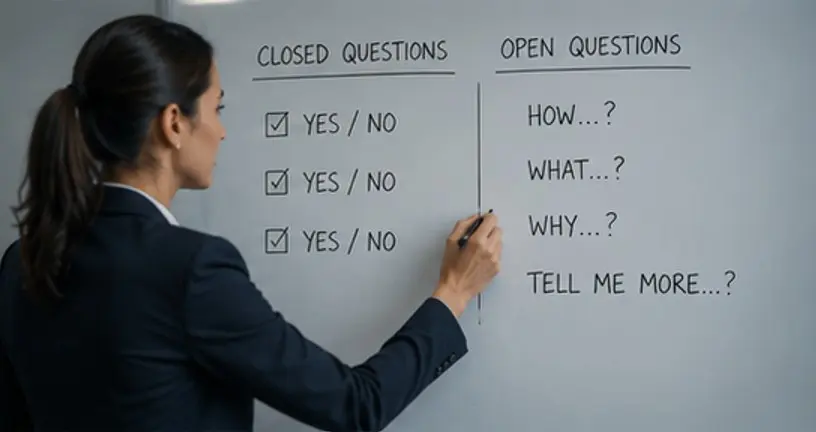
This is the core of my experience across China, India and Mexico. Work out a sentence with the team about what it stands for and let the team do the wording. Your job is the question, not the answer. How to ask those questions without smuggling in the answer sits in the article on open-ended questions and on the active listening method page.
3. Mirror Every Request Against That Sentence
Once the sentence exists, stop arguing and start mirroring. Does this request fit what we stand for? Anyone on the team can ask that, including against you, and that is precisely what makes it work. Without the mirroring, a vision stays a poster, as described in the article on the team storming phase.

4. Get Into the Performance Review Instead of Complaining About It
Functional leadership with no influence on the performance review has no consequences. Agree two criteria with the disciplinary manager that come from your functional accountability and feed into the assessment. That costs you one conversation a year and changes the order in which your requirements get worked on.
5. Offer Development, Never Around the Line
The Krishna case shows the strongest lever: people who ask for development themselves move faster than any managed programme. Keep the alignment with the line while you do it, otherwise you create a side channel and suspicion. The systematic version sits in the BYG mentoring method, the cultural layer in intercultural mentoring.
You leave with a formulation, not with a proposal.
Voices From Practice
Leading Without Authority
Vinayak Gaddam was Deputy Manager at Brose India. I was senior to him and never his manager. His feedback belongs here because it describes what is achievable without authority at all: clarity, confidence and a sense of direction in one’s own role.
Impact Beyond Reporting Lines
Pradeep Pandey worked with me from a different team. That makes him the exact constellation this article is about: effect across team boundaries, with no reporting line forcing it.
Navigating Cross-Cultural Dynamics in Dual Leadership
Arun Alex heads design and development in seating systems and judges the work from the customer side. He appears here because he names the intercultural dimension, without which dual leadership between Germany and India does not function.
FAQ: Frequently Asked Questions on Functional and Disciplinary Leadership
Q1: What exactly separates functional from disciplinary leadership?
Disciplinary leadership owns the employment relationship: hiring, appraisal, salary, leave and separation. Functional leadership owns content, quality and method. The conflict does not come from that split. It comes from nobody regulating how priorities get settled between the two.
Q2: I have no authority. How do I still enforce priorities?
Through meaning rather than through authority. A team that has written down what it stands for settles priorities against that sentence rather than against volume. The mentoring track on leading without authority works on exactly this capability.
Q3: What do I do when the local manager openly blocks my functional requirement?
First check whether he is pursuing a target you do not know about. In most cases that is the cause, and in most cases it was never discussed. If the blockage survives that conversation, run a three-way meeting with an explicit decision rule instead of escalating over the person’s head.
Q4: Is a shared vision not just another poster?
It becomes one if nobody applies it. The difference sits in step 3 of the approach: every request gets mirrored against the sentence, publicly, including against you. A vision that has never changed a decision is decoration.
Q5: How long does building such a vision with a team take?
Half a day to a full day when the team is in one place, and two to three shorter sessions for distributed teams. Duration matters less than one rule: do not take over the wording. The moment your words are in the sentence, it belongs to you rather than to the team.
Q6: What if the person in Pune agrees to everything and nothing happens?
Then examine the form of your questions first and the culture second. A yes can signal understanding rather than commitment, a pattern I describe in the articles on the Indian yes and the translation tax.
Q7: Should I intervene in my functional counterpart’s performance review?
Not intervene, contribute. Two agreed criteria from your functional accountability are enough. Without that share your requirement stays permanently secondary, because only what gets measured gets assessed.
Q8: How do I tell diffusion of responsibility from normal alignment work?
By asking who decides. Normal alignment takes longer and still ends with a named person. Diffusion of responsibility ends with minutes and nobody who feels accountable. The pattern is a close relative of malicious obedience.
Q9: Does this work if I have no leadership experience yet?
Yes, and it is often the entry point. My own first leadership assignment was precisely this constellation, described in the article on the first leadership role. The typical traps are overload and control, covered in overcome micromanagement.
Q10: What is the most common mistake European headquarters make with offshore sites?
Treating functional leadership as control and the site as an extended workbench. That produces the silent resistance which later shows up as a schedule problem. The executive sparring India page and the article on breaking down silos go into it.
Q11: When do I need external support?
When you have raised the dual leadership twice and nothing has changed. At that point the problem usually sits one level up, and there you need neutral facilitation. The formats that fit are executive coaching and the Team Charter Workshop.

About the Author
Andy Balbus spent 25 years in the automotive industry, most recently as Director Electronics in Prievidza with forty engineers and as Senior Manager in Pune, carrying a project budget of 15 million euros and revenue accountability of 150 million euros.
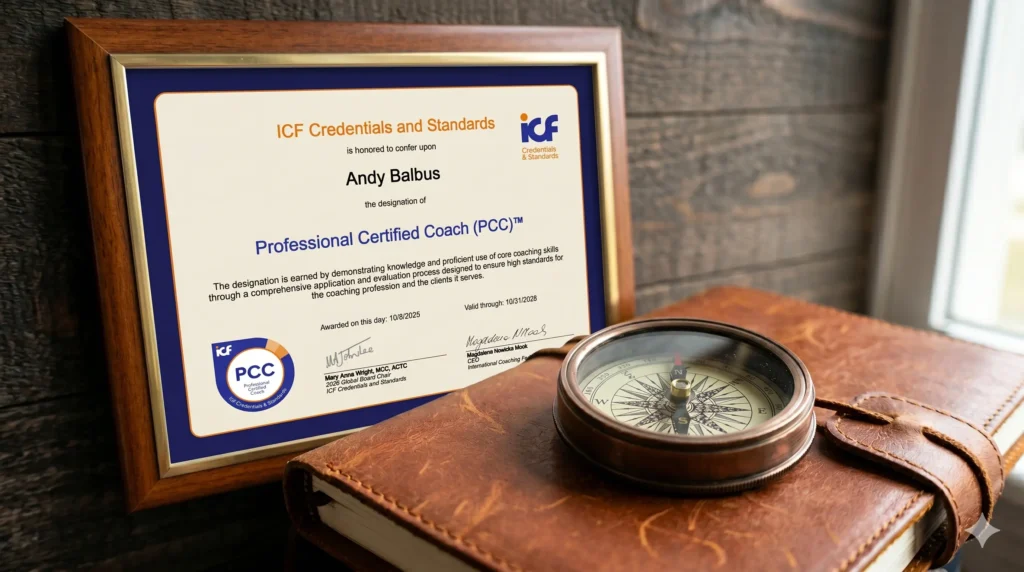
As an ICF PCC certified coach with more than 1,000 coaching hours he works with leaders across the DE-SK-IN matrix.

Three worlds that rarely meet in one person: operational accountability on the plant floor, professional coaching training and four years in Slovakia plus two years in Pune as an accountable executive. Leadership without authority he learned in China, India and Mexico, long before it had a name, and that is the perspective you get in the conversation linked below.
Results or Excuses
Your matrix will not dissolve and you will not be handed more authority. What you can obtain is clarity about who decides in case of doubt, plus a sentence your team uses to test its own priorities. Postponing that clarification by another quarter does not cost you discussions. It costs you a slipped milestone and two engineers who start applying elsewhere. In thirty minutes you get the three questions for your next three-way meeting and the decision on whether you run it alone.

One calendar link, no preparation required.
More on how I work sits on the page about Andy Balbus, in the leadership case studies, in the methods toolkit and in the glossary. For the other mentoring tracks, look at expert to leader, team lead scaling and strategic influence for directors.
Related reading: the green melon effect, leading a task force, setting boundaries as a leader and greenfield scaling in Slovakia. For goal work across sites, the SMART method, the GROW method, uncompromising delegation and the industrial conflict architecture are the next steps.
Systematic Leadership does not end with a phone Call.
Follow Andy for more Perspectives and Insights.


Leave a Reply