Summary
Team Storming Phase: A team that never argues is hiding its real issues. The storming phase is not a failure but a required step for high performance. Learn to structure factual conflicts and translate them into binding team rules without letting them turn personal.
Your team is arguing? Good. It gets dangerous the moment they stop.

This article is written for leaders whose team is just entering the friction, and for everyone whose team is suspiciously harmonious. For the team lead who reads the first open clashes as personal failure. And it fits for the department head who senses after the reorganization that her proven team is starting over. This also applies to everyone who knows the team development stages from a seminar but cannot tell in daily business whether the current grinding means progress or decay.
Week Six: The First Loud Meeting
The first weeks with the new team were pleasant. Everyone polite, everyone constructive, every alignment ended in agreement. Then week six arrives, and the architecture review erupts for the first time: two of your best engineers defend incompatible positions, the voices get louder, the room looks at you. Your first instinct says: the team is falling apart. Team research says the opposite: your team has just stopped being polite and started to work.
An Interest Conflict With My Boss That Never Turned Emotional
Tasks From Above, Without Alignment
My name is Andy Balbus. Storming is not limited to colleagues on the same level; it appears wherever interests collide, including upward. One situation from my leadership practice shows it: my team assistant received additional tasks on top from my boss at the time. He had asked her about her workload in a conversation and then assigned her new tasks directly, without aligning with me. Her capacity was genuinely limited, my tasks and the team’s tasks were already on her desk, and now three interests collided in one person.

A Catalog Instead of a Complaint
The easy path would have been a complaint, upward or into the team, and with it the entry into a relationship conflict. Our method was a different one: I asked her to catalog all the tasks she was already performing for me and my team. After that we worked out time-based experience values per task together and added everything up. This diffuse feeling of overload turned into a number with a unit, and a delicate personnel issue turned into a factual capacity question.
The Dialogue That Brought the Ambush Back Into Balance
With that foundation I sought the dialogue with my boss. No accusation, because he had acted in good faith; he had asked about workload and seen a need, and the only thing missing was the alignment. On the basis of the catalog and the totals we brought the ambush back into balance together, and my assistant could perform her tasks properly again. The conflict was real, the solution was unspectacular, and that is exactly the point.

Interest Conflict Resolved, Emotional Conflict Avoided: The Lesson
What I want to show with this: even when a situation looks difficult, a structured, factually anchored approach makes such situations solvable. Here an interest conflict was resolved without creating an emotional conflict. That ability, keeping a conflict on the substance level and finishing it there, is exactly what every team has to learn in its storming phase. The storm is not the problem. Left unled, it becomes one.
Your team is in the storm right now, or it is suspiciously quiet? Then let us read the signals together. The Reality Check is a 30-minute diagnostic conversation, no slides, no sales pitch.
What Team Research Knows About the Storm

The foundation was laid by Bruce Tuckman in 1965 with his paper Developmental Sequence in Small Groups: teams move through forming, storming, norming, and performing. In this model the storm is no accident; it is a scheduled development stage in which roles, priorities, and ways of working get negotiated. A team that skips this stage does not have it behind itself but ahead of itself, usually at the most expensive moment.
How the storm ends is decided by two conditions, and both have been measured precisely. The largest meta-analysis on the topic (de Wit, Greer, and Jehn, Journal of Applied Psychology 2012, 116 studies with 8,880 groups) shows: relationship and process conflicts damage team performance consistently, while task conflicts do not, and they turn positive where the task level and the relationship level stay decoupled, particularly in leadership teams and when performance is measured through decision quality. The second condition comes from the study by Bradley and colleagues (Journal of Applied Psychology 2012, 117 project teams): task conflict raises team performance only in a climate of high psychological safety. Translated: it is not whether your team argues that decides, but about what and in which climate.
Three Honest Questions Before You Read On
If you hesitate on any of these, the next section is for you.
Leading Through the Storming Phase the BYG Way: Three Steps
1. Recognize the Storm and Read It Correctly
Diagnosis first, and it starts with a reversal: open friction about substance is a progress signal; artificial harmony is the warning signal. A team that still closes every alignment unanimously after weeks is negotiating its real differences somewhere else, in the hallway, in the chat, or not at all. Beyond that, separate storming from dysfunction: in storming, people argue about architecture, priorities, and responsibilities. In dysfunction, they argue about characters and blame. You moderate the first; you stop the second.
2. Lift the Conflict Onto the Substance Level and Keep It There
The meta-analysis by de Wit and colleagues delivers the working instruction: task conflict helps as soon as it is decoupled from the relationship level. Structure is what achieves that, as in the example of my assistant: catalog the facts, quantify the experience values, build the totals, then hold the dialogue. What can be quantified, nobody has to take personally. For the stubborn cases, from escalation routines to conflict moderation, the complete craft sits on the Conflict Management method page.
3. From Storm to Norm: Condense Conflicts Into Ground Rules
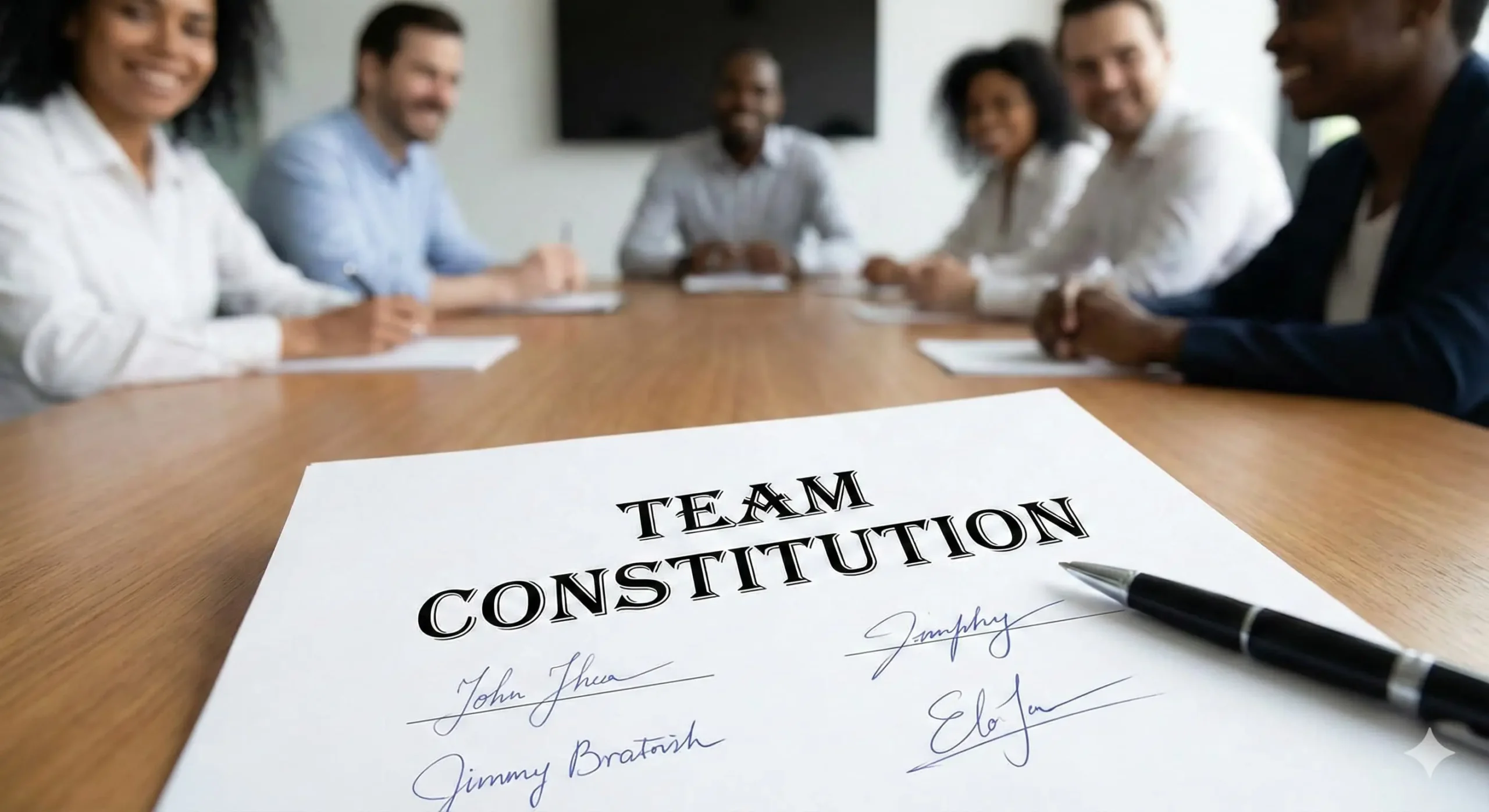
Every well-resolved conflict contains a rule the team carries from now on: how we decide on architecture dissent, who prioritizes in capacity collisions, what we escalate and what we do not. Condense those solutions into explicit ground rules, and storming becomes the norming Tuckman describes. Following Bradley and colleagues, this path needs a climate where dissent is safe; how to build it is covered in the article on psychological safety, and how a team writes its own rules in the article on team charter rules. The facilitated way there is the Team Charter Workshop: one day that structures the storm instead of suppressing it.
You want your team to come out of the storm stronger, with rules it wrote itself, instead of avoiding it?
Explore the Team Charter Workshop
Voices from the Field
Marianna Kopásková was my first direct report during the team build-up in Slovakia; N.R. Krishna took part in my coaching work:
FAQ: Straight Answers to Skeptical Questions
Q1: Is open conflict in the team not a sign of leadership failure?
No, the absence of task conflict is the more worrying sign. Tuckman describes the storm as a scheduled development stage, and the meta-analysis by de Wit and colleagues shows that task conflicts do not damage performance and help under the right conditions. Leadership failure would be suppressing the conflict or letting it tip unmoderated onto the relationship level. The argument is the material; your job is the form.
Q2: Our team has been harmonious for months. Are we simply good?
Maybe, so test it with two questions: do your meetings negotiate real alternatives, and has anyone openly contradicted you in recent weeks? Two yeses mean your team has the storm behind it and carries its norms. Two nos point to artificial harmony: the differences exist, they are just negotiated elsewhere, in the hallway, in the chat, or in silent resistance. That bill gets settled later, usually under schedule pressure.
Q3: How do I tell productive conflict from destructive conflict?
By the object and by the language. Productive conflict negotiates substance: architecture, priorities, responsibilities, and the sentences start with I see a risk in. Destructive conflict negotiates persons: motives, character, blame, and the sentences start with you always. Research separates exactly along this line: task conflict can raise performance, while relationship and process conflict damage it consistently. Your moderation job is steering every person debate back to the substance.
Q4: How long may a storming phase last?
There is no fixed deadline, but there is a direction test: a healthy storm produces decisions and first rules week after week; an unhealthy one produces repetitions. When the same two people have the same argument for the third time, structure is missing, not time. That is the moment for an outside view, a moderation, or a charter day that bundles the open questions and settles them in one go.
Q5: Does every team really have to go through this phase?
Yes, and worse: not only once. Every growth wave, every leadership change, and every reorganization partially resets a team, because new people mean new interests and unclarified roles. Experienced teams pass through the storm faster because they bring learned conflict routines, but nobody skips it. Whoever does not see it experiences it covertly.
Q6: What do I do when two top performers clash personally?
Separate the levels immediately. First identify the substantive issue underneath the person fight, because there almost always is one: an unclarified responsibility, a priority collision, a bypassed decision. Second, individual conversations before the joint one, so both can sort their view without an audience. Third, the joint round strictly about the substance, with agreed rules. If it stays personal despite all that, it is no longer a storming phase but a case for consistent conflict management.
Q7: Does the Tuckman model apply to distributed and hybrid teams?
Yes, with an aggravation: at a distance the storm gets quieter, but not smaller. Friction that would play out at the office whiteboard moves into private chats or disappears entirely, and artificial harmony looks even more convincing remotely. Distributed teams need deliberately created spaces for task conflict: real debates in video rounds, named dissent points on the agenda, and ground rules that explicitly invite contradiction.
Q8: What does psychological safety have to do with the storming phase?
It is the condition under which the storm becomes productive. The study by Bradley and colleagues shows it precisely: task conflict raises team performance only under high psychological safety; without it, the same conflict stays ineffective or tips into the destructive. Whoever wants to work on the team’s conflict behavior works first on the climate in which people contradict. Trust is the investment; the productive storm is the return.
Q9: Does this also work for conflicts with my own boss?
Yes, the example in this article was exactly that. The mechanics stay identical; only the order matters more: build the fact base first, meaning catalog and quantify, then seek the dialogue, without accusation and without an audience. A number with a unit can be negotiated across hierarchy lines; a feeling cannot. And assume good intent, because it is usually there; what was missing was only the alignment.
Q10: How does the Team Charter Workshop help through the storm in practice?
It condenses months of storming work into one facilitated day: the real differences come onto the table in a structured way, get negotiated on the substance level, and are translated into a maximum of five rules the team writes itself and carries for that reason. The storm is not skipped; it is led. How the day is built is covered on the Team Charter Workshop page; the terms around team development sit in the BYG Glossary.

The Next Step for Your Team

If this article describes your team, there are two fitting paths: the Team Charter Workshop, which structures the storm in one facilitated day and condenses it into rules, or the Conflict Management method page for the daily craft of conflict work.

The foundation comes from the articles on psychological safety and team charter rules.
About the Author: The Intersection of Three Worlds
Most providers in this market are either a coach or a consultant, and they know the matrix from the consulting desk. Andy Balbus works at a rare intersection of three worlds. Executive Leadership: 25+ years of operational automotive DNA, €150M revenue accountability, an R&D hub with 40+ engineers built greenfield. Executive Coaching: ICF PCC certified, 1,000+ coaching hours, developing people systematically instead of by gut feeling. Intercultural Transformation: lived and led as the accountable executive for 4 years in Slovakia and 2 years in Pune, with experience across DE, SK, IN, CN, MX, UK. Every method on these pages is tested in the engine room of exactly these three worlds, not in theory.
Results or Excuses: The Reality Check
The first step is a 30-minute diagnostic conversation: you bring your team’s current friction, and together we read whether you have a storm ahead of you, are in the middle of one, or should have led it long ago, seen through leadership, coaching, and culture change at once. No slides, no sales pitch, only your reality.
Systematic Leadership does not end with a phone Call.
Follow Andy for more Perspectives and Insights.


Leave a Reply