
Summary
Translation Tax: Unclear handovers between headquarters and international hubs create a costly Translation Tax resulting in unordered rework. Stop assuming context travels. Label your statements clearly and establish a culture where asking back is explicitly encouraged.
I pointed my finger at a metal part and said: we need holes here. The holes were drilled exactly where my finger had been.

This article is written for leaders who work across the axis between headquarters and sites and wonder why cleanly communicated things still arrive differently. For the HQ manager whose suggestions turn into rebuild projects at the sites. For the hub leader whose team holds back local ideas ever since the center hinted at a direction. And for everyone who refuses to accept the friction losses of international teams as a law of nature.
Half a Sentence From HQ, Two Weeks of Rework at the Site
You write a friendly thought in an email to the hub: have you considered whether option B would be more robust? Two weeks later you learn in the status meeting that the team stopped the running design, built up option B completely, and shifted a milestone for it. Nobody asked whether you actually wanted that. Your thought traveled across the axis; your context did not. The difference between the two has a name: the translation tax.
Shanghai: The Finger That Became an Instruction
A Test Bench Falling Apart
My name is Andy Balbus. On an assignment in Shanghai we had trouble with a test bench: a supplier had built a mechanism for loading DC motors there, and that mechanism was practically falling apart in operation. So I stood in the test lab, examined the construction, and looked for a fast, solid fix.

We Need Holes Here
During the examination I pointed my finger at the metal surface of one mechanical part and said: we have to stiffen the mechanism with bolts and drill holes for them here. To me that was a directional statement, a diagnosis with a rough location. My finger was a pointing device, not a measuring instrument.
The Holes, Exactly Under My Finger
What I never expected is precisely what happened: where my finger had touched the metal, exactly there the holes were drilled. Not at the structurally sensible points, not following an own design calculation, but under my fingerprint. Today I can laugh about it; back then I could not. And here is the decisive part: nobody in that lab did bad work. The colleagues executed my statement with maximum care, literally. Only one thing had been lost, namely my context, and that context was written on no drawing. The stronger respect and hierarchy shape a collaboration, the more literally the statement of the most senior person is taken, and that pattern knows no national border.

Verify Instead of Assume: The Lesson
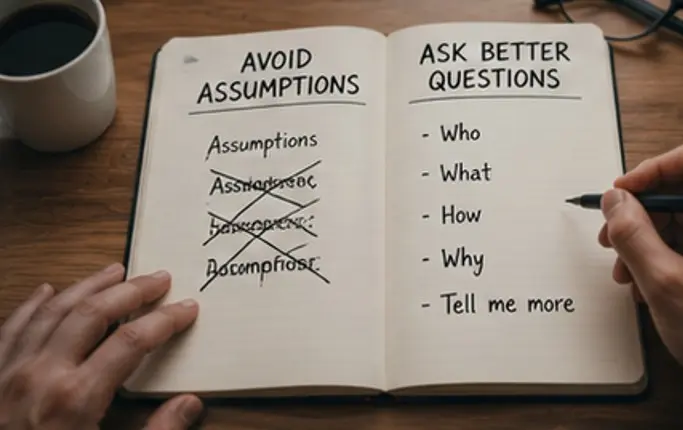
I had to learn to express myself differently, and I had to learn to verify through targeted questions whether my information had arrived with the other person the way I need it. Assumptions do not help here, only real exchange and active listening. Since Shanghai, every important statement across an interface comes with a counter-check: what exactly will you do now? Only the answer to that question shows what has actually arrived.
Your axis between headquarters and sites is paying this tax right now? Then let us look at the handover points together. The Reality Check is a 30-minute diagnostic conversation, no slides, no sales pitch.
What the Tax Costs: Two Numbers for Your Next Budget Conversation

A misread gesture may sound like an anecdote. At project level, exactly such moments add up to a measurable risk. The PMI Pulse of the Profession shows: 56 percent of project budgets are at risk due to ineffective communication. More than every second euro of your project budget depends not on technology or capacity, but on whether meaning passes the handover points undamaged.
The second number comes from McKinsey: 65 percent of execution initiatives fail. Not at the strategy, but in the execution, meaning exactly where intent has to be translated across hierarchy levels, sites, and cultures. Every unverified handover is a throw of the dice at those odds. The translation tax is not a soft culture topic. It is a hard budget item that simply appears in no cost center.

Three Honest Questions Before You Read On
If you hesitate on any of these, the next section is for you.
Cutting the Translation Tax the BYG Way: Three Steps
1. Recognize the Tax: Three Symptoms
Symptom one is rework nobody ordered: a team rebuilds because it believes it has to. Symptom two is questions falling silent: after impulses from headquarters, not a single counter-question comes back, a pattern you know from the article on the Indian Yes and one that reaches far beyond a single culture. Symptom three is local ideas vanishing from the meetings as soon as the center has hinted at a direction. Each symptom is observable, and each marks a handover point where meaning gets lost.
2. Language With a Label: Instruction, Suggestion, or Thought
Since Shanghai I explicitly label statements that cross the axis: this is an instruction. This is a suggestion you may discard. This is only a thought, spoken out loud. These three labels cost half a sentence each and take the translation work away from the hierarchy. The counter-check belongs to it, in both directions: ask the other person to summarize the task in their own words, and ask concretely: what will you do now? Only the back-translation shows whether your context traveled with you.
3. The License to Ask Back: Questioning as a Ground Rule

Labels only work when questions are safe. So anchor the license to ask back as an explicit ground rule of the axis: every impulse from headquarters may and should be questioned, without this counting as resistance. Why that safety is the foundation underneath everything is covered in the article on psychological safety; how a team makes such ground rules binding is shown by the Team Charter Workshop. An axis with a license to ask back pays the translation tax only in small change.
You want to defuse your handover points systematically, from the label to the license to ask back, across cultures?
Explore Intercultural Mentoring
Voices from the Field
From my work across cultural borders:
FAQ: Straight Answers to Skeptical Questions
Q1: Is the translation tax not simply a language problem that English courses solve?
No. In Shanghai everyone involved understood the same words, and still the holes were drilled under my finger. What got lost was not vocabulary but context: diagnosis or instruction, roughly or exactly, negotiable or final. Language training improves the words; the tax arises between the words. That is why labels and counter-checks work where courses stop helping.
Q2: Does this only concern collaboration with Asia?
No, the pattern scales with hierarchy and respect, not with geography. The bigger the perceived gap between sender and receiver, the more literally a statement is taken, and that holds between Coburg and Prievidza just as it holds inside a German department when the division head thinks out loud. Cultural imprints amplify the effect; they do not create it alone.
Q3: How do I make the translation tax visible for my management?
Count three things for four weeks: hours of rework nobody ordered, clarification loops per work package, and shifted milestones with a communication root cause. Put the result next to the PMI figure from this article, by which 56 percent of project budgets are at risk due to ineffective communication. A feeling turns into a number with a unit, and every management team likes talking about numbers with units.
Q4: Is clean meeting documentation not enough?
A protocol preserves the words, not their weight. Whether a sentence in the minutes was an instruction, a suggestion, or a thought is usually not written there, and exactly that classification is where the tax is charged. Minutes are valuable infrastructure, but they replace neither the label on the sentence nor the counter-check with the receiver.
Q5: Do the three labels not feel bureaucratic?
They cost half a sentence each: only a thought. A suggestion, you decide. This is an instruction. Set against two weeks of unordered rework, that is the leanest bureaucracy in your organization. Teams adopt the labels quickly on their own, because they relieve both sides: the sender repairs less, the receiver guesses less.
Q6: What if my counterpart experiences counter-questions as a loss of face?
Then move the counter-check into safe formats: the one-on-one instead of the big round, the written summary in own words instead of the public question, the phrasing as the sender’s assurance instead of the receiver’s exam, for example: I want to make sure I explained it well, what will you tackle first? The verification stays complete without exposing anyone.
Q7: What separates the translation tax from the alignment tax?
The translation tax is the loss of meaning at a single handover point: a suggestion arrives as an order, a diagnosis as a drilling instruction. The alignment tax is the time an organization then pays in coordination loops and clarification meetings to repair such losses. Put simply, the first is the accident and the second is the permanent construction site behind it. Both terms sit with their neighbors in the BYG Glossary.
Q8: Does more documentation help, such as more detailed specifications?
As a fact base yes, as a replacement for verification no. A good specification narrows the room for interpretation, but it still carries no tone and no intent, and nobody reads hundreds of pages completely under schedule pressure. Combine both: a lean, maintained fact base plus the counter-check in conversation. One makes the task unambiguous; the other makes the understanding visible.
Q9: How do I prepare new HQ colleagues for the axis?
With the Shanghai story or your own version of it, because people learn patterns faster through stories than through rules. After that, three pieces of craft: the labels for their own statements, the counter-check as the standard after every important handover, and the license to ask back as a spoken invitation. Whoever additionally understands the cultural patterns of the specific axis starts without paying tuition.
Q10: How does BYG help against the translation tax in practice?
In Intercultural Mentoring we build your handover architecture together: recognize the symptoms, establish labels and counter-checks, anchor the license to ask back, tailored to your specific axis. For the site perspective there is Executive Sparring Slovakia and Executive Sparring India, each with lived experience from both sides of the axis.

The Next Step for Your Axis

If this article describes your collaboration, there are two fitting paths: Intercultural Mentoring for the systematic build-up of your handover architecture, or executive sparring with a site focus on Slovakia and India.

The questioning craft behind the counter-check runs deeper on the Active Listening method page, and the terms around the tax sit in the BYG Glossary.
About the Author: The Intersection of Three Worlds
Most providers in this market are either a coach or a consultant, and they know the matrix from the consulting desk. Andy Balbus works at a rare intersection of three worlds. Executive Leadership: 25+ years of operational automotive DNA, €150M revenue accountability, an R&D hub with 40+ engineers built greenfield. Executive Coaching: ICF PCC certified, 1,000+ coaching hours, developing people systematically instead of by gut feeling. Intercultural Transformation: lived and led as the accountable executive for 4 years in Slovakia and 2 years in Pune, with experience across DE, SK, IN, CN, MX, UK. Every method on these pages is tested in the engine room of exactly these three worlds, not in theory.
Results or Excuses: The Reality Check
The first step is a 30-minute diagnostic conversation: you bring your most expensive handover point, and together we find out where your axis is paying the translation tax, seen through leadership, coaching, and culture change at once. No slides, no sales pitch, only your reality.
Systematic Leadership does not end with a phone Call.
Follow Andy for more Perspectives and Insights.


Leave a Reply