
Summary
Cost of Workplace Conflict: Conflict avoidance feels cheap but is the most expensive decision a leader can make. Unresolved friction burns 2.8 hours per employee weekly and drives up resignations, costing up to 200 percent of an annual salary to replace. Stop sitting out uncomfortable conversations. Learn how to overcome your inner block, name conflicts early, and resolve them systematically before they hit your EBIT.
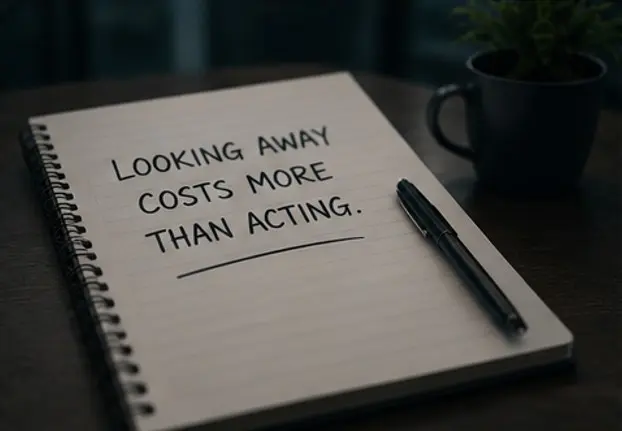
Looking away feels like it costs nothing. In truth it is the most expensive decision a leader can make.

This post is written for leaders who sense a smoldering conflict in their team and would rather sit it out. For the plant manager who lets two feuding experts run because the conversation would be uncomfortable. For the department lead who suspects the falling performance of her team has a name. And for anyone who wants to know what unresolved conflict really costs, in hours, in people, and in EBIT.
Why conflict is a business figure
Conflict feels like a soft topic, like mood and interpersonal matters, yet it is a hard number. Every hour an employee spends on an unresolved conflict is paid working time without a result. Every resignation that follows an escalated conflict costs a multiple of an annual salary to replace. Whoever treats conflict only as a culture question overlooks that it hits EBIT directly, and exactly for that reason it belongs on the leadership table, not in the waiting loop.
Why I would rather have looked away at the start
The inner block to entering a conflict
My name is Andy Balbus. At the start of my career I strongly felt an inner block to entering a conflict at all. A conflict is unpleasant, it is unlearned, and it is unfamiliar, and that is why I found it genuinely hard to take leadership precisely here. In many moments I would rather have looked away, because looking away feels easier in the first instant than the difficult conversation.

Why this is deeply human
I still see this hesitation in many clients whenever the topic comes up. It is deeply human not to want to tackle a hard task when one could look away. Nobody willingly enters a conversation that promises resistance, emotion, and uncertainty. The mistake lies not in the hesitation itself, but in what happens when hesitation turns into permanent looking away.

What looking away really costs
Exactly here the cost effect sets in. The longer a leader looks away, the higher a conflict escalates, a disagreement becomes a front, a front becomes an inner resignation, and at the end often stands the real resignation. When an affected person quits, it costs 150 to 200 percent of their annual salary to replace, not to mention the lost performance and the knowledge that leaves with them. Looking away therefore saves no cost, it only defers it and multiplies it in the process.
Why conflict management is a leadership duty
I learned this myself, and I take my responsibility here deliberately today. It is the leader’s duty to actively work on solutions in conflicts, whether in the communication between the parties or in a conflict where one is a party oneself. Whatever the constellation, conflict management is learnable, and it is no soft extra but a must for every leader. Whoever leads simply cannot afford to look away.
Looking away is not a saving but a loan at high interest. The conflict keeps growing, and the bill comes later, larger, and with a name on it.
Andy Balbus, 25+ years automotive, DE-SK-IN
You know a conflict you would rather sit out right now? Then let us look together at what sitting it out costs and what a way out looks like. The Reality Check is a 30-minute diagnostic conversation, no slides, no sales pitch.
Book your Reality Check: 30 minutes, only your situation
What the numbers say about the cost of conflict

2.8 hours per week nobody books as a cost
Conflict costs measurable time, and time is money. The CPP Global Human Capital Report from 2008 found that employees spend on average 2.8 hours per week on conflict. In the US alone that equals around 359 billion US dollars in paid working time per year that flows into friction instead of value creation. It is also striking that 70 percent of respondents rate conflict management as a critical leadership skill, and still this very skill is rarely learned systematically. The hours vanish silently from productivity, without ever showing up on a cost center.
How much leadership time sinks into conflict
Leadership itself also pays a high price. The researchers Runde and Flanagan show that leaders spend between 20 and 40 percent of their time dealing with conflict. That is the time meant for strategy, development, and decision. Whoever believes they save leadership time by looking away errs twice, because the unresolved conflict later devours all the more attention the bigger it has grown. The bill therefore does not shrink when deferred, it grows more expensive.
The most expensive outcome is resignation
What stands at the end of the escalation has been quantified by the most thorough study to date. The study “Estimating the costs of workplace conflict” by Acas from 2021, produced by Professors Saundry and Urwin, estimates the annual cost of conflict for UK employers at around £28.5 billion, roughly £1,000 per employee.
By far the largest single item is not tribunals but resignations: £11.9 billion alone falls on the estimated 485,000 people who resign each year over conflict, many of them without anyone ever noticing the problem.
The CIPD Good Work Index 2024 confirms the chain with a clear figure: those who experience conflict at work are twice as likely to leave the following year, 33 percent against 16 percent for those without conflict. Set against the canonical replacement cost of 150 to 200 percent of an annual salary, every unspoken conflict becomes a potential six-figure bill.
Three honest questions before you read on
Which conflict in your team are you sitting out right now because the conversation would be uncomfortable?
How much of your own leadership time goes each week into unresolved tension, without anyone measuring it?
And what would it cost if exactly the person at the center of this conflict resigned?
If you hesitate on one of these questions, the next section is for you.
From looking away to resolution: the BYG path in three steps
1. Name the conflict early instead of letting it grow
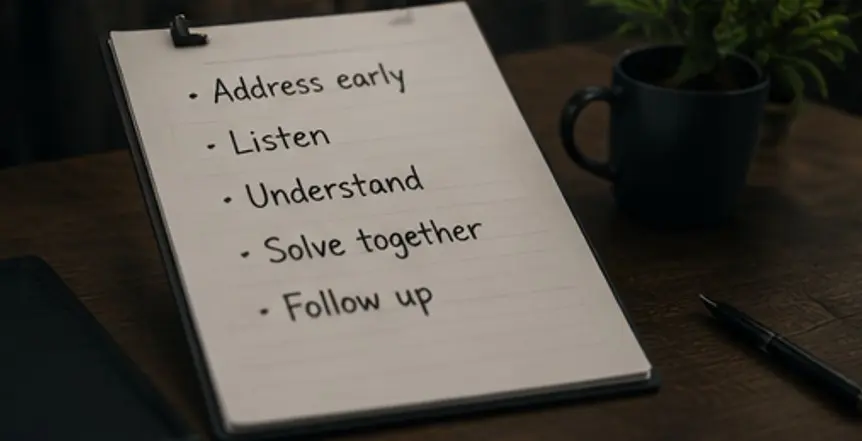
Step one is the hardest and cheapest at once: address the conflict early, while it is still small. The earlier you name it, the lower the cost, because a conversation held early costs minutes, a conflict escalated late costs people. The craft for this is provided by open-ended questions and active listening, with which you understand what is really at stake before you judge. And it takes a climate where tensions may be voiced at all, as the post on psychological safety describes.
2. Overcome your own block and show up clearly
Step two concerns you yourself as a leader. The inner block I felt at the start of my career is not overcome by waiting but by practice and a clear line of your own. A conflict needs no harshness but a clear stance, as the post on setting boundaries as a leader describes. That productive friction is no sign of failure but a normal part of every team’s development is shown by the post on the team storming phase, and whoever wants to build this confidence in a protected setting will find it in the Accelerate Now program.
3. Moderate and resolve conflicts in a structured way

Step three turns a good intention into a result. A moderated conflict follows a structure: separate the viewpoints, find the shared goal, reach workable agreements, and follow up on their observance. Which tension needs attention first is sorted by the Eisenhower prioritization, and how you hand over the agreed steps clearly is shown by the post on uncompromising delegation. Exactly this structure is provided by the industrial conflict architecture method page, and where the conflict arises at the interface between areas, the post on SOP delay helps. How such resolutions pay off in real starting situations is shown in the case studies.
You want to stop paying for conflicts without resolving them?
Go to the Conflict Management method page: conflict as business economics
Or book your Reality Check directly: 30 minutes, only your situation
Voices from the Field
Why these two voices on a page about the cost of conflict? Kishor Dongare describes how Andy turns challenges and overlooked areas into powerful insights, exactly the ability that makes an opportunity out of an expensive conflict instead of letting it escalate. Priyanka Maturi, in turn, names how the work with Andy makes team collaboration stronger and more aligned, the best protection against the friction losses that conflicts cause.
Andy is an outstanding coach who creates a calm, safe, and structured space for deep self-reflection. What sets Andy apart is how he helps reframe challenges and overlooked areas into powerful insights that drive growth and alignment with your goals.
Kishor Dongare, Senior Manager, CREAT Uno Minda
His approach to leadership development is both structured and insightful, helping refine how one can engage with teams to drive stronger and more aligned outcomes. I have seen a tangible improvement in my leadership style as a result.
Priyanka Maturi, Innovation and Growth Strategy
FAQ: Straight Answers to Skeptical Questions

Q1: What exactly is the cost of conflict?
The cost of conflict is the sum of all business losses that arise from unresolved or badly handled conflicts. It includes lost working time, falling productivity, leadership time, sick days, and above all the cost of resignations. Most of these costs appear on no invoice, because they spread across many small losses. More terms around leadership and conflict are explained in the glossary.
Q2: Are 2.8 hours per week not exaggerated?
The figure comes from the CPP Global Human Capital Report and describes the average across many employees. It includes not only open arguments but also brooding over tensions, avoiding certain colleagues, talking about the conflict with third parties, and lost concentration. Taken together, these invisible shares quickly add up to several hours a week, without anyone perceiving them as conflict time.
Q3: Is it not wiser to let small conflicts resolve themselves?
Some friction does resolve itself, and not every tension needs an intervention. The problem is that a leader from a distance often cannot tell which conflict is harmless and which escalates. Looking away as a default stance is therefore risky, because exactly the conflicts you let run turn out to be the most expensive. An early, calm inquiry costs little and creates clarity.
Q4: Why do so many leaders find it hard to tackle conflicts?
Because it is deeply human to avoid unpleasant tasks. A conflict promises resistance, emotion, and uncertainty, and nobody willingly enters it. I experienced exactly this at the start of my career. The good news is that this block can be overcome, because conflict management is a learnable skill and not a question of character.
Q5: What does a resignation arising from a conflict cost me?
By common studies the replacement cost is 150 to 200 percent of the affected person’s annual salary. Add the loss of experience and knowledge, the strain on the remaining colleagues, and the time to full productivity of the replacement. The Acas study also shows that resignations are by far the largest block of conflict cost. Where the friction really arises you see best on site, as the Gemba Walk method page describes. A single avoided resignation often justifies the whole effort for good conflict management.
Q6: Is conflict management not the job of HR or external mediators?
Both can support, yet the responsibility lies with the leader. HR shapes frames and processes, and external moderation helps in stuck cases, but the early, everyday handling of tensions cannot be delegated away. Whoever leads is the first instance to recognize and name a conflict. Exactly for that reason conflict management is a core competence of leadership, not an add-on from others. Jointly developed team charter rules prevent many conflicts before they arise.
Q7: How do I handle a conflict in which I am a party myself?
First, by honestly admitting it, because as a party you are not neutral. Separate your role as a conflict party from your role as a leader, and bring in a neutral moderation if needed. What matters is to seek the conversation anyway and not to abuse your position to simply end the conflict. The techniques from active listening help to stay fair even as a party.
Q8: How do I recognize that a conflict is already costing money?
By falling performance, by people avoiding each other, by rising sick days, and by a mood that tips. When a team suddenly slows down without the task having changed, an unresolved conflict often lies behind it. Frequent turnover in a particular area is also a warning sign. The post on the green melon effect describes a related pattern of hidden costs nobody books.
Q9: Do conflict costs intensify across cultures and sites?
Yes, because across cultures conflicts are handled differently and become visible differently. In some cultures open dispute is avoided, so tensions smolder under the surface and grow all the more expensive. Whoever leads sites across cultures needs particular sensitivity, as intercultural mentoring conveys.
Q10: Is the investment in conflict competence worth it at all?
The arithmetic is clear. A single avoided conflict-driven resignation saves 150 to 200 percent of an annual salary, and the time gained through less friction adds up week after week. Against these sums the investment in conflict competence is small. Conflict management is therefore no expense for a soft topic but one of the most economical investments in leadership there is.
Q11: How does BYG concretely help with the cost of conflict?
The methodical core is the industrial conflict architecture method page, which treats conflict as a business figure. For the individual development of your own conflict competence there is engineering leadership coaching, and for the acute relief of overloaded, feuding teams there is the Accelerate Now program. Anyone who wants to develop team leads toward calm conflict leadership will find the frame in team lead mentoring, and the full range of guidance in the coaching hub.
The next step out of the conflict trap

If this post describes your team, start where the cost arises: with the industrial conflict architecture method page, which resolves conflicts in a structured way, or with the individual work on your own conflict competence in engineering leadership coaching. The mindset behind courageous leadership is described in the BYG core principles.
About the author: three worlds in one difficult conversation
You do not know the cost of conflict from a textbook but from your own effort to have the difficult conversation anyway. Andy Balbus brings together three worlds that rarely meet in one person: 25+ years of operational automotive responsibility with 150M € revenue accountability and an R&D hub of 40+ engineers built greenfield, the methodology of an ICF PCC certified coach with more than 1,000 hours, and the intercultural perspective of four years as the accountable executive in Slovakia plus two years in Pune, with experience across DE, SK, IN, CN, MX, and UK. He has felt the inner block before a conflict himself and learned that overcoming it is part of leadership.
Results or Excuses: The Reality Check
The conflict you are sitting out right now does not get cheaper while you wait, it gets more expensive. The Reality Check is a 30-minute diagnostic conversation: you bring a smoldering conflict, and together we estimate what sitting it out costs and what the first step toward resolution looks like, with the combined view from leadership, coaching, and culture change. No slides, no sales pitch, only your reality and a clear calculation.
Book your Reality Check: 30 minutes, only your situation
Systematic Leadership does not end with a phone Call.
Follow Andy for more Perspectives and Insights.
Leave a Reply