
Summary
Building a Mentoring Program: Mentoring programs fail when they pass on technical facts rather than human judgment. As AI takes over technical tasks, person to person knowledge transfer becomes essential. Learn how to separate documented knowledge from context, align mentors effectively, and establish six core building blocks to create a sustainable mentoring program that develops real leadership capability.
Knowledge you can write down does not need passing on. The rest only travels person to person.
The request sounds harmless. We should set up a mentoring programme, the experienced people pass their knowledge to the younger ones. You nod, somebody builds a list, there is a kick-off with coffee in spring, and by autumn nobody asks about it any more.

The reason is rarely a lack of will.
The reason is that nobody decided beforehand which knowledge actually needs a human being in order to travel.
This article is for leaders and HR professionals who are asked to build a programme and know how many of them quietly die after two quarters. Anyone looking for software that solves this is in the wrong place. It comes down to six decisions, and none of them needs a tool.
How I Built an Academy in Pune, and What I Learned Doing It
Sharing knowledge always came easily to me
And it comes more easily today than it used to. I have certainly worked with colleagues who were restrictive about it and wanted to make themselves exclusive. The motive is understandable: being the only person who can do something feels safe.
My own experience pointed the other way
Passing knowledge on regularly produced better software and better engineering, because suddenly more than one head was working on it and could use the same data. Holding knowledge back does not make you irreplaceable, it makes you the bottleneck. The difference only becomes visible when you go on holiday.
In Pune this became a structured task
Between March 2023 and February 2025 I built the training academy at Brose in India.
That was not merely a programme, it was an institution with a head of its own. I ran the selection interviews for the academy leadership and pushed for the hire. Anyone who builds an academy and then runs it themselves has not built an academy, they have built a dependency.

Earlier, in Slovakia, I met the real resistance
When we took over responsibility from headquarters in Prievidza, the scepticism there was plain: they are taking our work away. What resolved it was not an appeal but a clear goal. Headquarters gained capacity, Slovakia took full responsibility for two product types. Only once both sides knew what they were gaining did the knowledge start to move.
The lesson from that applies to every programme
Passing on knowledge feels like making yourself replaceable. While that objection stays unspoken, experienced people agree politely and then show up irregularly. Build a programme without voicing that sentence yourself, before the mentor does, and you have left the most important question open.
What I hear in conversations today is a different question

Participants from Your Power Within tell me they already know the role they do today will not be needed in this form three years from now. Prompt engineering is a concrete example, becoming steadily less necessary as the systems themselves do more.
The question is no longer how to build a career
It is this: what do I do once AI has taken over my job? That is a different kind of conversation.
It is not about the next title, it is about not feeling superfluous and still being able to contribute. For me it is a constant challenge to take those connections in and listen first, before looking for approaches together with someone.
And my expectation, stated explicitly as an expectation

I expect emotional intelligence to matter considerably more going forward. Technology and software will be handled very well by AI within a few years, and in many areas already are. But once things become interpersonal, once people carry existential worry and are looking for new paths, the human capability counts for more than it did three to five years ago. That is my personal experience and my expectation. I do not know it, I expect it. And I expect further that this development will accelerate.

No sales conversation. If I am not the right person for you, you will hear that in the first five minutes.
What the Data Shows About the Shift in Skills
Four in ten core skills change by 2030
For the Future of Jobs Report 2025 the World Economic Forum surveyed over 1,000 leading employers representing more than 14 million workers across 55 economies. Those employers expect 39 percent of their workers’ core skills to be transformed or outdated by 2030.

The direction of that number is worth noting. In the 2023 report it stood at 44 percent, in 2020 at 57 percent. The shift is therefore slowing at a high level, which the report attributes partly to half of all workers having now completed training, reskilling or upskilling measures. At the same time 63 percent of employers name skills gaps as the biggest barrier to transforming their business. The bottleneck is not the technology, it is the person in front of it.
(Source: World Economic Forum, Future of Jobs Report 2025, published 8 January 2025.)

What shrinks is the purely technical role
David Deming examined how demand for social skills has developed in the labour market in the Quarterly Journal of Economics in 2017. Between 1980 and 2012, social-skill-intensive occupations grew by 11.8 percentage points as a share of all jobs in the US economy.
The second half of that finding is the decisive one for engineering functions. Math-intensive but less socially demanding occupations, explicitly including many STEM roles, shrank by 3.3 percentage points over the same period. Employment and wage growth were strongest where both were required at once: high technical and high social demands together. Deming’s explanation is unsentimental: social skills lower coordination costs, which lets people specialise and still work together efficiently.
This is not a forecast about AI, it is an analysis of three decades of labour market data. It describes a movement that started long before generative AI. My expectation is that the movement accelerates, and that expectation is mine, not the study’s.
(Source: Deming, D. J. (2017), The Growing Importance of Social Skills in the Labor Market, The Quarterly Journal of Economics, 132(4), 1593-1640.)
Why that makes a mentoring programme a leadership task
When four in ten core skills change and at the same time the capabilities gaining value are precisely the ones that cannot be written down, knowledge transfer acquires a new job. No longer passing on technical content, which any search query now delivers faster, but passing on judgement: when to say no, when to escalate, whom to call, which question to ask in which room.
This is not a soft topic in business terms either. Engaged teams show up to 59 percent lower turnover according to Gallup, and replacing a senior engineer costs 150 to 200 percent of annual salary. A programme that shows people a path when their existing path narrows acts on exactly that point.
(Sources: Gallup on up to 59 percent lower turnover; replacement cost per PLOS ONE and Accenture.)
Voices From Practice
Dutonde Amol worked as deputy manager finance on the same team as me. His feedback sits here because it describes what a mentor actually passes on: not technical content, but the ability to make complexity accessible and to read people.
Six Building Blocks Before You Start
Before you draw up a participant list, make six decisions. None of them needs a tool or a platform, and all six are better made now than after the first pairing falls apart. Work through the six points for your own initiative. There are no points and no grade, only the block that is missing and the next step.
Which of these building blocks are settled for you?
The Separation Everything Hangs On
Of the six blocks, one is the lever for all the others: the separation between knowledge a document can carry and knowledge that needs a human being. Get it right and you have a programme with a clear purpose. Skip it and you are scheduling meetings around content a search query delivers faster.
What belongs in documentation
Everything that can be written down completely and means the same when read as when explained. Process steps, tool operation, standards, test specifications, interface descriptions. Cover that content in a mentoring session and you are spending the most expensive resource in your company on a job a decent wiki does better.
What only travels person to person
Judgement. The question of when a deviation is still within bounds and when it is not. Context, meaning why a decision was made a certain way three years ago and what has changed since. And the network, meaning whom you call in which situation and with which question. None of that sits in a document, and nobody can write it down without it turning trivial.
The test that takes two minutes
Take your topic list and delete everything that could sit in a document. What remains is your programme. If nothing remains, you do not need mentoring, you need better documentation. That is not a defeat, it is an initiative saved.
Why this separation falls differently than it did ten years ago
The line is moving, and it moves in one direction. More and more of what once required a personal explanation is now retrievable. What remains is exactly what Deming measures and what the World Economic Forum lists among the growing skills. Your programme should therefore become narrower and deeper, not broader.
And what that means for choosing mentors

The strongest technical performer is not the best mentor. The best mentor is the one who can explain their own decisions. In the selection conversation, ask about a decision that later turned out to be wrong, and how they noticed. Somebody who can answer that passes on judgement. Somebody who only reports outcomes passes on content, and for that you need nobody.

You leave with a phrasing you can use, not with a proposal.
Where a Programme Alone Is Not Enough
Mentoring solves no structural problems. If your site only executes what gets decided elsewhere, work on the extended workbench first. If terminology is renegotiated between sites on every call, you are paying the translation tax. And if nobody in your meetings pushes back, what is missing is not a mentor but psychological safety. The four role tracks have their own pages: expert to leader, team lead scaling, leading without authority and strategic influence at director level.
Amruta Shinde Vhatkar worked with me and describes in her feedback exactly the dual role a good programme depends on: providing backing while pointing to concrete paths.
How the method behind it is built sits on the mentoring method page and in intercultural mentoring. Terms from this article are defined in the leadership glossary, and the full toolkit sits in the methods overview.
FAQ: Frequently Asked Questions About Building a Mentoring Program
Q1: How do I start from nothing?
With the purpose and the separation, not with the participant list. Write down in one sentence what the programme should achieve, then delete from your topic list everything that could sit in a document. What remains is your programme.
Q2: How many pairs should I start with?
Four to six. At that size you can follow every pair personally and understand the drop-outs rather than merely counting them. Programmes that launch with 40 pairs mostly produce administration in year one.
Q3: Should mentor and mentee come from the same department?
Better not, and from the same reporting line certainly not. The moment the mentor also assesses, you get a second management conversation instead of a protected space. Crossing department lines also builds the network that later turns out to be the real value.
Q4: How often should the pairs meet?
Monthly with a fixed slot is a good starting point, plus the option to talk at short notice when needed. Reliability matters more than frequency. After the third postponed session the mentee stops asking.
Q5: What does the mentor get out of it?
You have to answer that before the mentor asks. Concretely there are three things: visibility beyond their own department, relief because somebody else can take work on, and their own development, because explaining your decisions is the sharpest form of reflection there is.
Q6: How do I handle experienced people who will not share?
Take the motive seriously rather than judging it. Being the only person who can do something feels safe. So frame the transfer as a strategic goal with a visible gain on both sides, the way we did in Slovakia: headquarters gained capacity, the site gained full responsibility.
Q7: Does a mentoring programme need software?
No, certainly not at the start. With four to six pairs a spreadsheet is enough. Software becomes sensible from around thirty pairs, and it replaces none of the six decisions. A programme never fails for want of a platform, it fails for want of a purpose.
Q8: How do I measure whether it works?
Set a goal and an end point per pair and you have a yardstick at the level where mentoring acts. At programme level, drop-out rate and whether pairs voluntarily continue past the agreed end are useful. Do not expect too much too soon from turnover figures, they lag.
Q9: How long should a mentoring relationship last?
Until the agreed goal is reached, typically six to twelve months. The agreed end point matters more than the duration. Without one the relationship continues out of politeness and blocks capacity for the next pair.
Q10: Does mentoring work across sites and cultures?
Yes, with two adjustments. It takes more effort to build the relationship, because the chance encounter is missing. And under high power distance take care, because open disagreement comes harder. More on this in intercultural mentoring and in the article on the Indian yes.
Q11: What is the difference between mentoring and coaching?
A mentor brings their own experience and shares judgement from the path they walked. A coach works with questions and deliberately brings no content. Both are valuable and they are different things. What executive coaching delivers sits on its own page.
Q12: Is a programme still worth it when AI takes over so much?
In my assessment more than before, though with different content. What can be written down is increasingly retrievable. What remains is judgement, context and network, and that only travels person to person. That is my expectation, not a forecast.

About the Author: The Intersection of Three Worlds
Most providers are either a coach or a consultant. They know mentoring programmes from the design stage, not from building an institution that keeps running without them. I have worked in all three worlds.
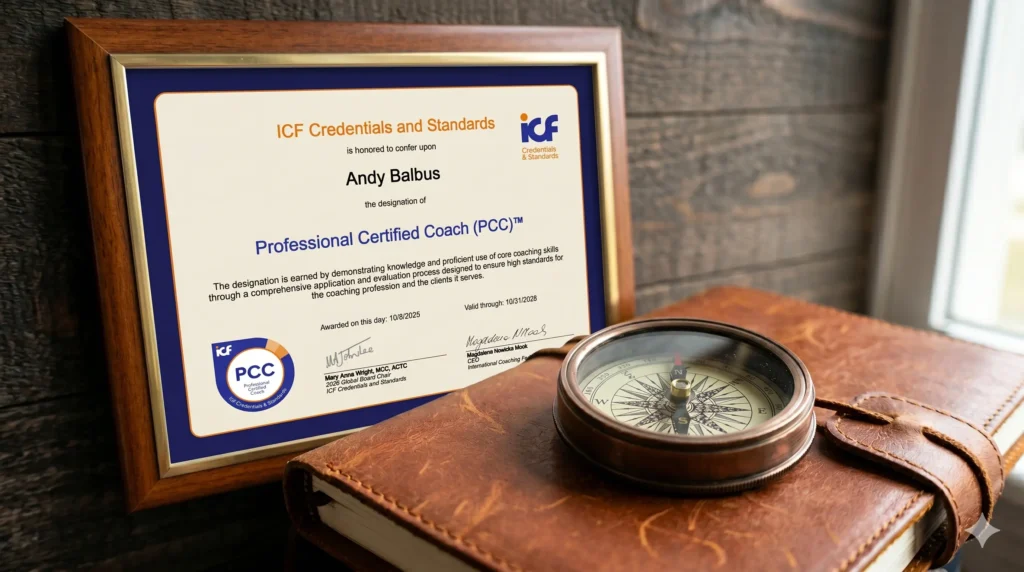
Executive leadership: 25 years of operational automotive DNA, 150 million euro of revenue accountability, an engineering site with 40 engineers built from a greenfield. Executive coaching: ICF PCC certified, more than 1,000 coaching hours.

Intercultural transformation: four years as the accountable leader in Slovakia, two years in Pune, alongside experience in Germany, China, Mexico and the United Kingdom.
I built the training academy in Pune and then handed it to somebody else. That is the test every programme has to pass. More about the path is on the page about Andy Balbus and in the case studies.
Results or Excuses?
Your most experienced people carry knowledge that appears in no document. When they say no, whom they call, why a decision fell a certain way three years ago. That leaves your company on the day those people do, and replacing them costs 150 to 200 percent of an annual salary. At the same time, people on your team are asking themselves what becomes of their role in three years. Both problems have the same answer.
In 30 minutes we go through your six building blocks, name the one that is missing, and you leave with a phrasing that states the purpose of your programme in a single sentence. I bring the view from leadership, coaching and cultural change at the same time.
One calendar link, no preparation required.

You can also reach me through the contact page. How the formats connect is visible in Accelerate Now, in coaching for automotive leaders, in coaching for CEOs and senior leaders, in female executive coaching and in the legacy programme for owners.
To work structurally, use the team charter workshop, the GROW structure, the SMART method, prioritisation, uncompromising delegation, active listening, the conflict architecture, the Gemba Walk and remote leadership. To dig into root causes, start with breaking down silos, goal setting, micromanagement, the first leadership role, no time for strategy and the chief firefighter syndrome.
Systematic Leadership does not end with a phone Call.
Follow Andy for more Perspectives and Insights.


Leave a Reply