
Summary
Team Commitment: A room full of nodding heads does not guarantee execution on Monday. The gap between polite agreement and real accountability destroys project value. Discover how to turn vague intentions into binding team commitments by building a clear infrastructure of documentation, ownership, and measurable follow up.
Everyone nods in the room. Monday nothing happens. And nobody lied.

This post is written for leaders who know the difference between a chorus of nods and real accountability. For the plant manager whose meetings end in clear promises whose results still evaporate. For the project lead who senses that agreement in the room and action at the desk are two different things. And for anyone who suspects that missing team commitment is not a character flaw but a question of structure.
Why nodding does not mean execution
Agreement in a meeting is cheap, execution on Monday is expensive. A nod costs nothing, it signals politeness, avoids conflict, and ends the discussion. Action, by contrast, demands time, priority, often budget, and always the willingness to let something else slide. Between the one and the other lies a gap that no amount of clear talk in the room can bridge on its own. That gap is where good intentions go to die, and it closes only through an infrastructure that turns agreement into accountability.
What I saw in the management rounds in Prievidza
The big visit and the motto faster, higher, further
My name is Andy Balbus. During my years as Director Electronics in Prievidza I lived through the top-management visits, and they cost us a great deal of work. We planned the tour through the plant, we built an exhibition of the products we were developing, and we explained every step. At the end of the day came a summary meeting, and there we were usually praised and criticized in the same breath, both always belonged together. The motto was faster, higher, further, and no matter how good the numbers were, it was by nature never enough.

Points fired into the room
That, though, is only the frame, not the actual point. What I observed was not a one-off at a single meeting, it was the standard bar a few exceptions. Many points were named and fired into the room, and around the table heads nodded. Everyone agreed, nobody objected, the mood was harmonious. And precisely here was the problem, because what looked like a result in the room was in truth only a shared nod without any anchoring.
The chain that never started
Many of these points would have been worth implementing. But that would have required writing them down, then working them out in small rounds with the necessary deciders, planning and budgeting them, because money would have been needed too. After that would have come deciding, implementing, verifying the result, and adjusting where necessary. None of those processes ever started. It stayed a top-management announcement without sustainability, a nod that left the room and never arrived on Monday.

Why agreement without structure is worthless
From those rounds I took away a lesson I have seen in every team since. Agreement is not commitment until it is carried into a structure. A point that is not written down, not assigned to an owner, and not given a date simply no longer exists once the meeting ends. Accountability grows not from the volume of the announcement but from the quiet, unspectacular infrastructure behind it.
You recognize your own meetings in this? Then let us look together at where agreement turns into execution in your team, and where it does not. The Reality Check is a 30-minute diagnostic conversation, no slides, no sales pitch.
What the numbers say about the execution gap

The Paradox of Agreement: High Confidence, Empty Meetings
The gap between nodding and acting is no Prievidza anecdote, it is measurable and widespread. A 2025 study published in Zurich by the Global Association of Applied Behavioural Scientists, led by Dr. Melina Moleskis with scientists from the University of East Anglia, the London School of Economics, and Warwick Business School, surveyed 105 professionals across industries. The result is a paradox: 91 percent rate their own decision-making skills as above average, yet 45 percent admit they lack structured routines for important decisions, and 85 percent were never formally trained in it.
The Cost of the Gap: Why Transformations Fail at the Finish Line
The sharpest figure from the same study lands straight on the management round: 64 percent say meetings are not effective forums for decisions. That is exactly what I saw in Prievidza. The room was full, the nodding was real, and still the meeting failed as a place of decision, because no structure followed the nod. Agreement in the room and accountability on Monday really are two different things.
What this gap costs in the end shows up in the big undertakings. In its 2021 study “Losing from Day One”, McKinsey examined more than a thousand transformations and found that around 70 percent fall short, and that the largest share of value is lost not in planning but in implementation. The decision in the room was rarely the problem. The problem was that between agreement and lived execution the bridge was missing, the same bridge that was never built in the Prievidza summary meetings.
Three Honest Questions Before You Read On
If you hesitate on one of these questions, the next section is for you.
From agreement to execution: the BYG path in three steps
1. Write it down instead of firing it out
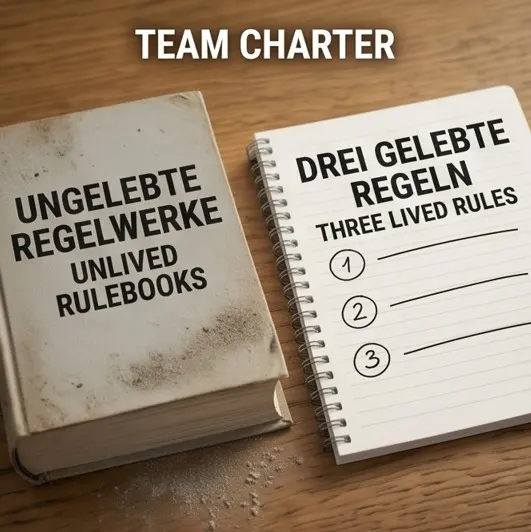
Step one ends the firing of points into the room. Every point that truly matters gets written down, assigned to an owner, and given a date, before the room empties. That is exactly what the Team Charter Workshop is built for, turning vague intentions into a binding operating agreement. How a team works out such rules together in the first place, rather than having them imposed from above, is shown in the post on team charter rules, and the fact that binding rules are no cozy affair but grow out of productive friction is described in the post on the team storming phase.
2. Work it out and budget it in a small round
Step two is the one the management rounds skipped. A written point belongs in a small round with exactly the deciders who can work it out, plan it, and budget it. Clear, measurable goals from the GROW method and the SMART method turn an intention into a verifiable plan with milestones. Anyone who does not want to work the points off alone but instead hands over real responsibility will find the craft in uncompromising delegation, and anyone who wants people to voice objections in the meeting rather than merely nod builds the openness described in the post on psychological safety.
3. Implement, verify, adjust

Step three closes the loop that an announcement alone never closes. After implementation the result is verified and, where needed, adjusted, otherwise even the best plan fizzles out. Whether a promise in the room is real you test with the techniques from the posts on open-ended questions and active listening, which make the difference between polite nodding and genuine agreement audible. In intercultural teams this check matters most, because a yes does not mean the same thing everywhere, as the post on the Indian yes shows.
You want to finally turn agreement into reliable execution?
Go to the Team Charter Workshop: the binding operating agreement ›
Voices from the Field
Why these two voices on a page about team commitment? Marianna Kopásková was my first direct report in Slovakia, so she knows from up close how announcements become workable agreements, and how a leader stands up for their people instead of merely passing points along. Tanaya Deole, in turn, rates BYG explicitly at the organisational level and stresses the cultural sensitivity, exactly the perspective that matters when a yes is meant differently across cultures.
FAQ: Straight Answers to Skeptical Questions
Q1: Is a nod in the meeting not already a promise?
It is an agreement, but not accountability. A nod signals, at best, alignment with the direction, at worst only the wish to end the discussion. It becomes accountability only once the point is written down, tied to a name, and given a date. Without those three elements the promise is no longer findable on Monday.
Q2: What exactly is meant by team commitment?
Team commitment is the reliable execution of what was jointly decided, not the good feeling in the moment of agreement. It shows up not in the meeting but in the week that follows, in what actually gets done. Real commitment therefore needs an infrastructure of documentation, ownership, and follow-up. More terms around leadership and teams are explained in the glossary.
Q3: Why do people nod when they have no intention of executing?
Rarely out of bad faith, mostly out of structure. A nod avoids conflict, saves time, and costs nothing in the moment, while an objection demands effort and courage. When a team has not learned that objections are wanted and free of consequence, it takes the path of least resistance. That is why psychological safety is the precondition for agreement to mean anything at all.
Q4: How do I spot a polite nod that is not genuine agreement?
By the reaction to open questions. Someone who truly agrees can explain what they will do next and by when. Someone who only nods retreats into generalities or falls silent. Ask for the concrete next step, the date, and the possible obstacles, and you hear at once whether the agreement holds. The craft for this is in the post on active listening.
Q5: Does a yes mean the same thing in every culture?
No, and that is one of the most common friction points in the matrix. In some cultures a yes is a sign of respect and listening, not of agreement with the substance. Anyone who does not know this takes a polite yes for a commitment and wonders at the missing execution. How this misunderstanding arises and how to resolve it is shown in the post on the Indian yes.
Q6: Does so much structure not make every meeting bureaucratic?
The structure is leaner than the chaos it replaces. Three elements per point suffice: an owner, a date, a next step. That costs a few minutes in the meeting and saves hours the following week in questions, misunderstandings, and duplicated work. It turns bureaucratic only when you document points nobody wanted to implement, which is why part of the structure is the courage not to record unimportant points at all.
Q7: Who should create accountability in the team, the leader or the team?
Both, but in different roles. The leader creates the frame in which writing down, assigning, and following up are taken for granted. The team fills that frame by taking ownership and voicing objections openly. Accountability becomes most robust when the rules are not imposed but worked out together, as the Team Charter Workshop provides.
Q8: What do I do with promises that come from above without my having any say over the budget?
You make visible the condition under which the promise is executable at all. If a point needs budget that is not there, then without that budget it is not a commitment but a wish. Put that in writing and play it back upward, instead of silently absorbing the impossible task. How to hold a clear line upward as well is shown in the post on setting boundaries as a leader.
Q9: How do I stop good points from simply evaporating after the meeting?
Through a fixed place where every point lives with an owner, a date, and a status, and through the habit of rolling open points into the next agenda instead of letting them disappear. What is once written down no longer vanishes, because it is back on the table at the next meeting. This follow-up is precisely the difference between an announcement and a lived agreement.
Q10: Does this apply to remote and matrix teams too?
There above all. Across distance and time zones a nod cannot even be seen, and the execution gap grows rather than shrinks. A written structure, visible to all, replaces the body language that is missing in the room. How to lead distributed teams accountably across sites is shown on the remote leadership method page.
Q11: How does BYG concretely help turn agreement into execution?
The core is the Team Charter Workshop, which anchors the commitment infrastructure in your team. For the individual development of leaders who are meant to model accountability there is executive coaching, and for acute relief of overloaded teams there is Accelerate Now. What this looks like in real starting situations is shown in the case studies.

The next step out of the agreement trap

If this post describes your meetings, start where the gap opens: with a binding operating agreement in the Team Charter Workshop or with the individual work on your own leadership in engineering leadership coaching. The mindset behind accountable leadership is laid out in the BYG core principles, and anyone who wants to develop team leads toward exactly this accountability will find the frame in team lead mentoring.
About the author: three worlds in one agreement
Accountability cannot be taught in theory, it has to have been carried. Andy Balbus brings together three worlds that rarely meet in one person: 25+ years of operational automotive responsibility with 150M € revenue accountability and an R&D hub of 40+ engineers built greenfield, the methodology of an ICF PCC certified coach with more than 1,000 hours, and the intercultural perspective of four years as the accountable executive in Slovakia plus two years in Pune, with experience across DE, SK, IN, CN, MX, and UK. He has lived through the management rounds where people nodded and nothing followed, and he has learned which structure makes the difference.
Results or Excuses: The Reality Check
The next meeting is coming, and with it the question of whether agreement turns into execution or once again into just a nod. The Reality Check is a 30-minute diagnostic conversation: you bring a meeting whose results recently evaporated, and together we find the point where accountability gets lost, with the combined view from leadership, coaching, and culture change. No slides, no sales pitch, only your reality.
Systematic Leadership does not end with a phone Call.
Follow Andy for more Perspectives and Insights.


Leave a Reply