
Summary
Escalation Management: When experts constantly jump in to fix problems other departments should solve, your escalation chain is broken. Covering for others is not helpfulness but a costly margin killer that burns out your best engineers. Learn how to build a robust escalation protocol, demand proper preparatory work, and hold the line against your own impulse to simply fix the problem yourself.
The real mistake is rarely the timing. It is that one level quietly absorbs another level’s work and mistakes that for helpfulness.

Escalation management is treated in many industrial organizations as a confession. Escalating means you could not handle it yourself, runs the unspoken rule, so people wait, compare, measure again and give it one more try. What that culture produces is not loyalty. It produces a chain of surprises that always arrive at the moment when correcting course costs the most.
This article is written for you if your team routinely solves problems it is not formally responsible for. It applies equally when your escalation levels are cleanly documented and skipped in practice, or when your best people stand at a machine on a Saturday that another department is supposed to look after.
The core argument up front, and it departs from the usual debate: this is mostly not about too early or too late. It is about whether everyone in the chain takes their responsibility and delivers. Building such a chain is the subject of Accelerate Now and the industrial conflict architecture method page.
Prievidza: When My Development Team Co-Operated the Production Line
Development, One Door Away From Manufacturing
In Slovakia I was Director Electronics, accountable for development and not for manufacturing. We held the product know-how and we sat right there on site, essentially one door away from production. That proximity is an advantage and it is also the root cause of everything that followed.
What 3rd Level Support Means on Paper
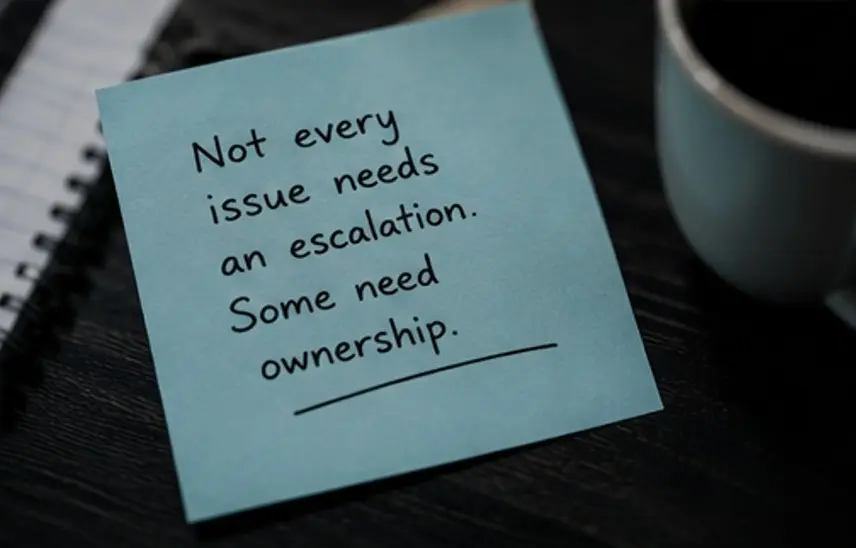
My test engineering team was 3rd level support by definition.
In an EOL standstill it was meant to take over once the means of the first two levels had been exhausted and the corresponding checks documented. That is what the concept said, and the concept was right, because a team with product know-how exists for the difficult five percent and not for the daily ninety-five.
What Actually Happened
Reality looked different. The first and second level lacked capacity, partly in headcount but mostly in knowledge and in organization. So my people were called far too early, and when they arrived the preparatory work had not been done. They started by catching up on tasks that belonged to somebody else.
The Price Never Appeared in a Project Report
The load grew, overtime became routine and weekend shifts followed. What stands out is that nobody flagged this as a problem, because the line was running again. On paper the site looked like a well-functioning operation while a department was quietly consuming its own future in the background.
What I Did

I sat down with the decision makers and opened the discussion about regulating this properly. Out of that discussion came an escalation plan, cleanly documented, with defined levels. That plan took us months, and it was the easiest part of the entire undertaking.
Paper Is the Start, Not the Result
Then the actual work began: training everyone involved, writing checklists, placing equipment where it was needed. An escalation plan nobody can apply because the measuring device sits two halls away is not a plan. It is a document that prevents exactly zero minutes of downtime when it matters.
The Hardest Step Came Last
The most exhausting part was holding the line and genuinely insisting that the first two levels did their work. The impulse I had to suppress went like this: my people can fix it, then it runs again. That sentence sounds like accountability and it would have voided everything we had built, because each exception teaches the organization that the rule is negotiable.
The Goal Was Never to Help Less
The goal was for production to solve line problems faster and independently, with my team taking over only the critical, highly demanding interventions at the EOL. The alternative would have been engineers available around the clock. All of them had families and a 40-hour contract, and I was not going to allow that.

No sales conversation. If I am not the right fit, you will hear that within the first five minutes.
What the Data Shows About Silence, Downtime and Overload
Silence Is the Default, Not the Exception
Milliken, Morrison and Hewlin interviewed 40 full-time employees in depth for the Journal of Management Studies. 85 percent of them described situations in which they felt unable to raise an issue they considered important with their supervisor. The most frequent reason was fear of being viewed negatively. The study is qualitative and small, and its message is uncomfortably precise: the default setting in the system is silence, not reporting.

And the Colleagues Stay Silent Too
The same research found that 74 percent of those who felt uncomfortable said colleagues who knew about the same issue also stayed quiet. Silence is not a trait of a few cautious individuals. It is collective behaviour the organization has previously rewarded.
What Downtime Actually Costs
The Siemens study True Cost of Downtime puts unplanned downtime in automotive at roughly 2.3 million US dollars per hour, up 113 percent on the previous survey. Against that number, the question of whether a technician properly worked through the second escalation level is not a formality. It is a question with an hourly price tag attached.
The Pattern Almost Never Gets Reported Upwards

Sidney Yoshida’s Iceberg of Ignorance describes how top management knows around 4 percent of frontline problems. A team permanently absorbing other people’s tasks never appears in that statistic, because the line is running again. It surfaces later as an SOP delay or as the resignation of somebody nobody can replace.
The Invoice That Arrives Last
According to the joint estimates by WHO and ILO, working 55 hours or more per week carries a 35 percent higher risk of stroke and a 17 percent higher risk of dying from ischemic heart disease compared with 35 to 40 hours. For 2016 the authors attribute 745,194 deaths to this exposure. Anyone celebrating weekend shifts as commitment should know that number before approving the next special assignment.
Plus the Quiet Attrition
Attrition rates of 20 to 25 percent are unremarkable in technical organizations, and replacing a qualified specialist costs 150 to 200 percent of an annual salary. A specialist who has covered other people’s gaps for two years rarely resigns citing that reason. He resigns with a polite formulation, and the organization learns nothing from it.
Escalation Check: Where Does Your Chain Break?
Six questions about your last significant standstill or project incident. The check evaluates immediately whether your chain holds, whether it rests on individual people, or whether you are in fact dealing with a responsibility problem.
Escalation Check
Does escalation actually work in your organization?
Six questions about your last significant standstill or project incident. Two minutes, one uncomfortable result.
Question 1 of 6
No sales conversation. One calendar link, no preparation required.
Five Steps to an Escalation Chain That Holds
1. State the Current Situation Without Assigning Blame
Write down how often your team worked below its remit over the past three months, with dates and hours. That list replaces every discussion about perception. Avoid any wording that targets individuals, because you need the other levels as partners rather than as defendants.
2. Negotiate With the Decision Makers, Not With Those Affected
The chain gets settled where capacity and budget are owned. Seek the conversation with the decision makers of the adjacent areas and put your list on the table. Plan in months rather than weeks. How to hold a position in that conversation without damaging the relationship is covered in the article on setting boundaries.
3. Enable Before You Demand
A plan without training, checklist and equipment produces frustration on both sides. For every level, settle three things: who can do it, with what, and how do they know they are finished? That sequence is not negotiable, because demanding responsibility somebody cannot technically carry is not leadership. It is a template for the next conflict.
4. Hold the Line, Even When It Hurts
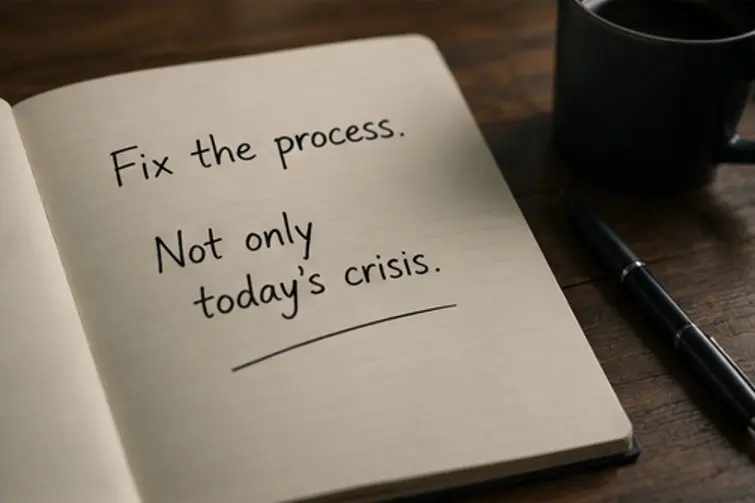
The hardest step is where you defend the rule against your own helping impulse. Your team can solve the problem, which is precisely why you must not let it solve this one. A single exception costs you six months of effect, a pattern also described in the articles on overcoming micromanagement and uncompromising delegation.
5. Reward Early Reporting Visibly
A chain only holds when reporting early ends better than rescuing late. Thank the person who flagged a problem before it got expensive, publicly, and raise no question of fault in that moment. Anyone who reports early and gets exposed for it once will never report early again. The link to rules and commitment sits in the article on team commitment.
You leave with a formulation, not with a proposal.
Voices From Practice
Radical Clarity Over Diplomacy in High-Stakes Environments
Valentine Nelaev has spent more than 18 years in oil and gas, an industry where a late report bites even faster than in automotive. His feedback belongs here because it describes what counts in these conversations: clarity rather than diplomacy.
Navigating Inconvenient Truths and Tough Decisions
Smriti Kiran Singh-Sawant works as a functional safety specialist, a role that lives on inconvenient reports. Her feedback belongs here because it names the connection between honest feedback and difficult decisions.
Scaling Ownership Through Successful Handovers
Priti Shahane built the training academy in Pune after I handed the role over. She appears here because her path shows what this article is about: responsibility is not taken off somebody, it is handed over and then required.
FAQ: Frequently Asked Questions on Escalation Management
Q1: When is the right moment to escalate?
As soon as it becomes foreseeable that a committed result will not be reached with the available means. The trigger is therefore a forecast rather than damage already done. More important than the exact moment, though, is whether your own level completed its work first.
Q2: Why does escalation count as weakness in so many plants?
Because it was historically tied to blame. In a culture that hunts for the culprit after every report, people learn very quickly that waiting is personally cheaper than speaking. The company carries the cost of that logic while the individual gets the benefit.
Q3: How long does it take to establish an escalation chain properly?
The documented plan takes weeks to months, the workable implementation takes considerably longer. In my case, training, checklists and equipment were more demanding than the plan itself, and the real test came afterwards, when the preparatory work had to be insisted on consistently.
Q4: What if the upstream level genuinely cannot do the preparatory work?
Then enabling comes first and the rule comes second. Establish whether knowledge, tooling or time is missing, because those three gaps call for different answers. Only once that foundation exists is insisting on the rule fair.
Q5: Is it not more efficient to send the expert straight away?
In the short term yes, in the medium term no. Every direct jump to the third level prevents the first from learning and increases dependency on a handful of people. Twelve months later you have an organization where three individuals are irreplaceable, and that is a risk rather than an efficiency gain.
Q6: How do I handle my own impulse to just help?
Make it a topic of conversation instead of suppressing it. The impulse is legitimate, it is simply aimed at the wrong target. Tell your team explicitly why you are not stepping in this time, otherwise holding the line reads as indifference.
Q7: What belongs in a robust escalation plan?
Four entries per level: trigger, ownership, required preparatory work with evidence, and maximum dwell time. Without the dwell time you get the most common failure mode, a level that is formally responsible and stays busy indefinitely.
Q8: How do I tell a genuine emergency from a convenience escalation?
By the evidence of preparatory work. A genuine emergency can be described in two sentences with measured values, while a convenience escalation starts with a mood. Treating both the same way is exactly how organizations lose their response capability for the real case, as described in the article on leading a task force.
Q9: What do I do when the neighbouring department openly ignores the agreement?
Then the problem sits one level up and belongs there. Present your hours list and describe the effect on schedules and attrition rather than on your mood. The structural pattern behind it is covered in the article on breaking down silos.
Q10: Does this apply to distributed sites as well?
Yes, and it gets harder, because the physical proximity that makes the short cut attractive is missing. Documentation carries more weight instead. What else gets lost between sites is described in the translation tax and the green melon effect.
Q11: When is external support worth it?
When you are part of the conflict yourself, which is almost always the case in questions of ownership. Neutral facilitation brings the adjacent areas to one table faster than any further presentation. The formats that fit are Accelerate Now and the Team Charter Workshop.

About the Author
Andy Balbus spent 25 years in the automotive industry, most recently as Director Electronics in Prievidza with forty engineers and as Senior Manager in Pune, carrying a project budget of 15 million euros and revenue accountability of 150 million euros.

As an ICF PCC certified coach with more than 1,000 coaching hours he works with leaders across the DE-SK-IN matrix.

Three worlds that rarely meet in one person: operational accountability next to a running production line, professional coaching training and four years in Slovakia plus two years in Pune as an accountable executive. How an escalation chain gets built and then defended he learned at a machine that decided good part or bad part, and that is the perspective you get in the conversation linked below.
Results or Excuses
Your line is running again, and that is precisely the problem. As long as somebody closes the gap, nobody will want to close it. Postponing this clarification by another quarter does not cost you discussions. It costs you weekends of your best engineers and eventually their resignation at 150 to 200 percent of an annual salary. In thirty minutes you get the hours calculation for your case, the wording for the conversation with the decision makers, and the decision on where you stop stepping in.
One calendar link, no preparation required.
More on how I work sits on the page about Andy Balbus, in the leadership case studies, in the methods toolkit and in the glossary. Related reading: team charter rules, the team storming phase, chief firefighter syndrome, hidden factory and malicious obedience. If the site sits in Slovakia, executive sparring Slovakia is the next step. For work at the line itself, the Gemba walk, the SMART method, Eisenhower prioritization and active listening are the practical next reads.
Systematic Leadership does not end with a phone Call.
Follow Andy for more Perspectives and Insights.


Leave a Reply