
Summary
Developing Executive Presence: Executive presence is not a personality trait you are born with, it is preparation and command of your subject. Research shows that 67 percent of presence is based on “gravitas,” meaning you know your topic well enough to answer six questions deep. Stop agonizing over your appearance or accent. Learn to craft a strong opening, prepare your responses to likely objections, and claim your space in the room with confidence and structure.
Presence is not a personality trait. It comes out of preparation and command of the subject, which is exactly why it can be built.
Executive presence usually gets treated as something a person either brings along or does not. Anyone said to lack it receives advice about posture, voice and clothing. That order is backwards, because it starts at the five percent and leaves the two thirds that actually matter untouched.

This article is written for you if your contributions in large rooms carry less weight than their content deserves.
It applies equally if you are unchallenged in your own field and still get passed over in committee, or if you work in a corporate language that is not your first.
The argument up front: presence is structure and preparation rather than a change of personality. Treating it as a question of character puts it out of reach. Treating it as a craft makes it learnable, and that is exactly what Your Power Within is built on.
Two Appearances at One Venue, Two Entirely Different Outcomes
The Invitation That Set It Off
Roughly twenty years ago my manager at the time and I were given the chance to speak at an automotive industry conference. My topic was the scalability of test systems. It dealt with a technique that tests a single device as readily as six or twelve, without keeping a fully equipped test rig available for every case.

Why the Topic Belonged to Me
The core was a modular kit: components get added on demand, comparable to a plug-in system, rather than holding capacity permanently. I had developed that solution myself and knew every weak point in it. That is a precondition which matters later, and it fell into the period of my first leadership role.
Preparation I Still Remember Twenty Years On
I prepared intensively and built slides with few images and little text.
What strikes me today is not the slides themselves but the fact that I can still picture them two decades later. Nobody remembers talent. Work, on the other hand, sticks.
More Than a Hundred Listeners and an Overrun
I spoke in front of more than a hundred people from the automotive industry, and I ran well over my allotted time. Nobody stopped me and I was allowed to carry on. Afterwards came good feedback and questions showing the substance had landed. An audience only lets the speaker overrun when it wants to keep listening.
For Me at the Time That Was a Very Large Stage
That group mattered enormously to me at that point in my career, and I was absorbed in the situation. What I showed there is what I would call leadership presence today. Back then I had no name for the state, I only felt it.
Twenty Metres Away It Had Disappeared
At the trade fair booth the task was building contacts, and that is exactly where it failed.

Whenever no positive, inviting manner came across from the other person, that presence simply did not appear in me. I waited for the signal, and without the signal I did not move.
What That Difference Proves
Same person, same industry, same audience, a few metres apart and a completely different outcome. If presence were a character trait, it could not vanish within an hour. What had changed was not my nature but two conditions: I had commanded the topic and I had prepared.
My Conclusion, With Two Decades of Distance

Presence appeared in me when I felt secure and competent. Both of those can be manufactured, which is why I am certain from experience that presence can be learned. Not as a personality rebuild but as preparation, knowledge and experience. How that turns into a position you hold under pressure is covered in the article on setting boundaries.
No sales conversation. If I am not the right fit, you will hear that within the first five minutes.
What the Research Says About Executive Presence
Two Thirds Rests on Substance, Five Percent on Appearance
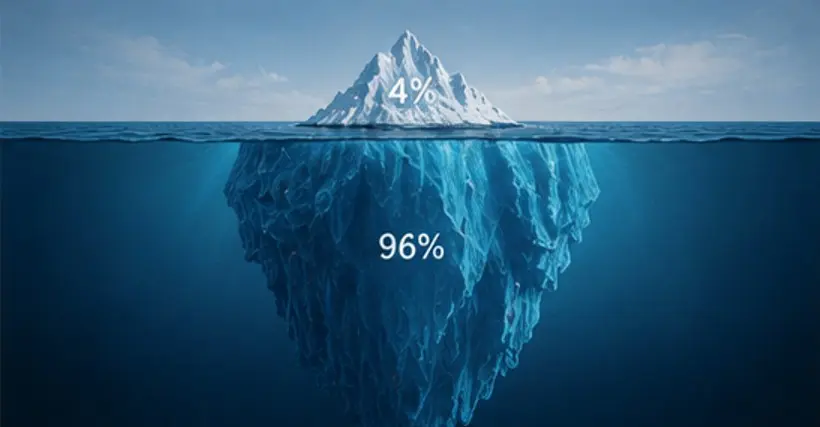
Sylvia Ann Hewlett and the Center for Talent Innovation surveyed roughly 4,000 college-graduate professionals and asked 268 senior executives to weight the components of executive presence. The result: gravitas 67 percent, communication 28 percent, appearance 5 percent. Working on your wardrobe therefore addresses one twentieth of the problem.
And Gravitas Means Nothing Other Than Command of the Subject
That research describes gravitas as signalling that you know your stuff cold and can go six questions deep in your own field. This is not aura, it is preparation. That state is exactly what I had on stage and exactly what I lacked at the booth.
Why This Is Not a Side Issue for Your Career
The same study puts executive presence at 26 percent of what it takes to earn the next promotion. More than a quarter of your advancement therefore rests on something most organizations neither name nor train. What becomes of it in distributed work is described in the article on virtual team ground rules.
The Finding That Concerns Corporate Language
Lev-Ari and Keysar played participants 45 trivia statements, read by native speakers and by speakers with mild and heavy accents. Statements delivered with an accent were rated less truthful. Listeners had been told explicitly that the speakers were reciting statements written by somebody else, so the knowledge was not attributed to them.

The Mechanism Is Not Prejudice, Which Makes It Worse
The authors attribute the effect to processing fluency. Listening to accented speech takes more effort, and that effort is not recognised as effort but interpreted as lower credibility. Anyone working in a corporate language that is not their first is therefore not fighting rejection. They are fighting a processing effect inside the listener. What that effort costs additionally across sites is described in the translation tax and in intercultural mentoring.
The Good News Sits in the Follow-Up Study
Boduch-Grabka and Lev-Ari showed the effect weakens considerably when listeners have been exposed to the same accent beforehand. Familiarity reduces the distortion. For you that means frequency beats perfection. Speaking regularly makes you easier to understand and therefore more credible, and that is precisely what a practice space is for.
Presence Check: What It Actually Comes Down To
Ten questions about the last significant room you spoke in. The check measures five layers: command of the subject, preparation, initiative, frequency and visibility. At the end you see a percentage, your profile across all five layers and the single point where your effect currently gets lost.
Presence Check
Why is your contribution not landing?
Ten questions across five layers, three minutes, a measurable result with a concrete next step.
Answer with the last significant room you spoke in mind. Not your best appearance, but your most recent one.
Question 1 of 10
Five Steps to Presence That Does Not Depend on Mood
1. Prepare Six Questions Deep Rather Than Slides
Take your next topic and write down the six follow-up questions it could trigger, along with your answers. That is the real preparation, because gravitas originates there. Slides with few images and little text come afterwards rather than first.
2. Fix Your Opening Word for Word
The first two sentences decide whether the room listens, and they are the only part you can fully control. Write them out and say them aloud. Those two sentences replace every advice chapter about posture, a point related to the article on open-ended questions.
3. Stop Waiting for the Invitation
My booth failure was not a personality problem but an expectation: I wanted a friendly signal before I would move. Decide in advance which three people you will speak to, regardless of how they seem in that moment. That replaces a mood with a decision.
4. Frequency Before Perfection, Especially in a Second Language
Because familiarity demonstrably reduces the accent effect, speaking regularly beats rare flawless appearances.
Find small recurring occasions before you take on the big room. A protected practice space achieves more here than any language training, and that is what Your Power Within is designed for.

5. Plan Visibility Rather Than Hope for It
Put your topics on the agenda actively instead of waiting for an occasion. Speaking only when asked leaves your visibility to chance. For the move out of a purely technical role, mentoring from expert to leader is the fitting entry point. How to place topics without formal authority sits on the mentoring pages leading without authority and strategic influence for directors.
You leave with a formulation, not with a proposal.
Voices From Practice
Values-Based Leadership Presence
Smriti Kiran Singh-Sawant works as a functional safety specialist and names the exact term this article is about. She appears here because she describes the link between clarity on your own values and the effect you have in a room.
Creating Space for Honest Reflection and Self-Awareness
Jimena Aguilar Aued went through the Power Within programme. Her feedback belongs at this point because presence needs a space for honest thinking before it becomes visible in the large room.
Bridging Insight and Action
Amruta Shinde Vhatkar describes the part that sits between insight and effect. She appears here because building presence means taking concrete steps rather than feeling differently about yourself.
FAQ: Frequently Asked Questions on Executive Presence
Q1: Is executive presence innate?
No, and my own experience is a useful counter-example. On stage it was there, at a booth twenty metres away it was not. What differed was preparation and command of the subject, and both of those can be manufactured.
Q2: What does gravitas mean concretely?
In the Center for Talent Innovation research, gravitas stands for signalling that you know your stuff cold and can answer six questions deep in your own field. At 67 percent it is by far the largest share of executive presence. Appearance sits at 5 percent.
Q3: Do I have to get louder or more dominant?
No, that is usually the wrong lever and quickly reads as a performance. What works better is a prepared opening, a clear core message and the willingness to begin without being invited. Volume replaces no substance, and substance rarely needs volume.
Q4: I work in English although it is not my first language. What does that mean for my effect?
It costs you credibility measurably, though not because of your ability. Lev-Ari and Keysar show that accented statements get rated as less true, because listening takes more effort and that effort is misread as doubt. Knowing this makes it less personal and more structural.
Q5: Can anything be done about it?
Yes, through frequency. In the follow-up research the effect weakens markedly once listeners are already familiar with the same accent. Speaking regularly in the same room therefore beats rare, perfectly prepared appearances.
Q6: How do I prepare for an important committee?
Three things suffice: the sentence the room should take away, the six most likely follow-up questions with answers, and your opening in exact wording. Everything else is optional. For formulating the objective, the SMART method helps.
Q7: What do I do when I get interrupted?
You finish the sentence and then take up the objection explicitly. The most common mistake is apologising and handing over the thread. A factual note that you will close the thought briefly is accepted in almost every case.
Q8: Does this work differently for women?
The mechanisms are the same, the starting position is not. Women in technical leadership roles receive feedback about delivery rather than content more often, which is exactly where attention shifts onto the 5 percent. Female executive coaching works on that shift.
Q9: How long does it take before something changes?
The preparation works immediately, familiarising your environment takes repetition. Plan on a quarter of regular appearances before your role in a room shifts noticeably. Appearing once only measures the day you had. The same applies at board level, where executive coaching for CEOs provides the support.
Q10: Is this not self-promotion in the end?
Only when nothing sits behind the effect. At 67 percent gravitas, executive presence is essentially the ability to let existing substance land. Without substance it collapses at the first critical follow-up question.
Q11: When is a programme worth it?
When your working life offers no protected space to try things out. That is what Your Power Within is built for, and for individual work on your effect there is executive coaching.

About the Author
Andy Balbus spent 25 years in the automotive industry, most recently as Director Electronics in Prievidza with forty engineers and as Senior Manager in Pune, carrying a project budget of 15 million euros and revenue accountability of 150 million euros.
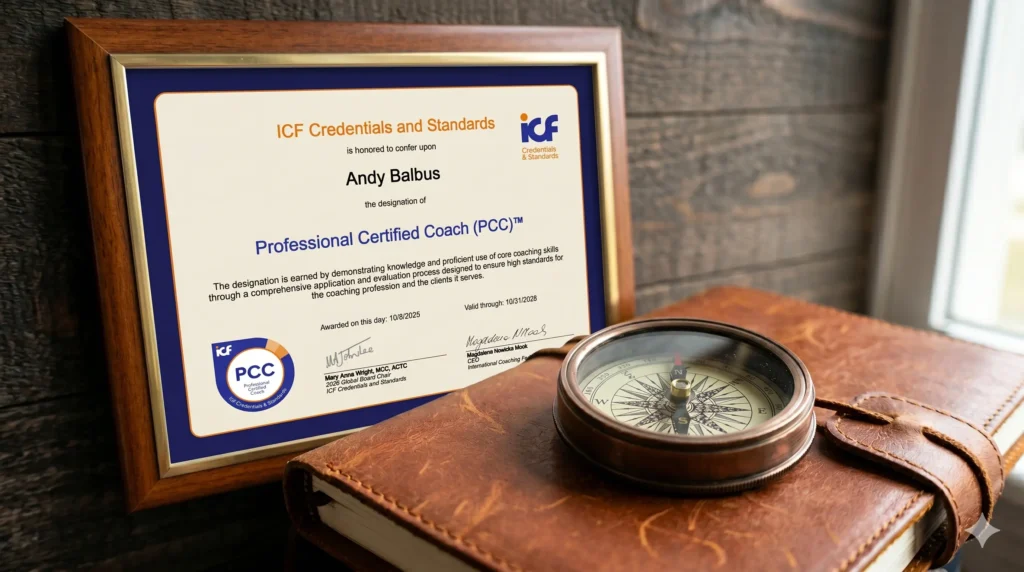
As an ICF PCC certified coach with more than 1,000 coaching hours he works with leaders across the DE-SK-IN matrix.
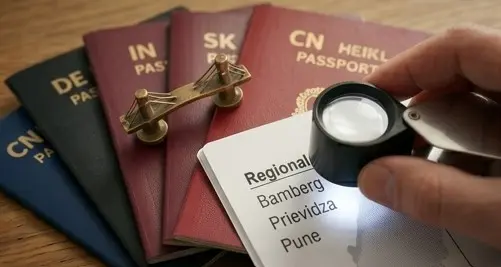
Three worlds that rarely meet in one person: operational accountability in rooms with real resistance, professional coaching training and four years in Slovakia plus two years in Pune as an accountable executive. What presence feels like when it is there, and how quickly it disappears, he learned across a single conference day, and that is the perspective you get in the conversation linked below.
Results or Excuses
As long as you treat presence as a trait it stays out of reach, and that is convenient. The moment you treat it as preparation it becomes work you can start today. More than a quarter of your next promotion depends on it, and every room where your contribution sinks is a room where somebody else takes your topic. In thirty minutes we settle your six most likely follow-up questions, draft your opening sentence and name the one room where you will speak regularly from now on.

One calendar link, no preparation required.
More on how I work sits on the page about Andy Balbus, in the leadership case studies and in the glossary. Related reading: open-ended questions in leadership, the team storming phase, loneliness at the top, no time for strategy and stabilizing a team after restructuring. For work on effect and structure, active listening, Eisenhower prioritization, the Team Charter Workshop and Accelerate Now are the practical next steps.
Systematic Leadership does not end with a phone Call.
Follow Andy for more Perspectives and Insights.


Leave a Reply