
Summary
Toxic High Performers: A brilliant but toxic employee costs your team more than their performance delivers. Contagious negative behavior lowers the baseline temperature of your entire organization and drives up costly turnover. Stop tolerating bad behavior for the sake of output. Learn how to address the invisible costs, set firm boundaries with clear consequences, and protect your team’s performance.
It takes no bully. A colleague who complains every day, or a boss who explodes, is enough to make a team quietly switch off.

This piece is written for leaders who have a technically strong employee and still sense that something in the team is tipping.
It is for anyone who has told themselves the behaviour must be endured because the output is good. And it is for those who would rather do the arithmetic than wait for a verdict on whether someone is truly toxic.
Two Observations From 26 Years in Industry That Cured Me of Labels
Two years in the same office
I am Andy Balbus, once, I shared an office for two years with a colleague who was, at heart, a friendly man. He was also frustrated, negative and complained daily. About the company, about decisions, about colleagues, about the circumstances. Nobody would have called him toxic, and back then neither would I.

What I noticed in myself
It grew interesting once I started watching my own reactions. On some days he managed to infect me too and pull me down with him. I left that office in a different state than I had entered it. Since our work rarely overlapped, these stayed short moments, yet they were real.
Why short moments are not a small matter
If loose contact was enough to turn my mood, what happens to people who work closely with someone like that every single day? This is the part most leaders underestimate. A complaining, grumbling colleague runs no campaign against anyone. He simply lowers the base temperature of an entire team.
The second observation: a boss who exploded
The second experience goes back roughly twenty years. A manager in our environment had a habit of erupting in anger. I was not in his team, yet our department shared many interfaces with his, which let me watch the effect from the outside over a long period.

What a team looks like when it ducks
His people moved around him with their heads down.
Contact between the boss and his staff shrank to the bare minimum, because everyone in that team lived with the constant risk of the next outburst. People working that way stop reporting problems and start hoping problems will solve themselves, a pattern I later recognised again in the Chief Firefighter Syndrome.
What his people told me at the time
I spoke with several members of his team back then. What I heard was thoughts of resignation, anger and disappointment. Performance had settled into doing exactly what the rules required and nothing beyond. These were capable engineers. They had only stopped giving more than the minimum, the quiet decline the piece on team commitment describes.
Why I could not step in
At that point I held no leadership role, so intervening was not open to me. Looking back, that is the bitter part of the observation. From the outside I saw what the manager could not see from the inside, and nobody told him, because everyone had grown used to the idea that this was simply how he was.
Labels decide nothing, arithmetic does
Both observations taught me the same lesson, and it still shapes my executive coaching today. The question is never whether someone is toxic. The question is what their behaviour costs the people around them. Once you calculate that way, a vague discomfort turns into a concrete matter you can raise without passing judgement on a human being.
No sales pitch. If I am not the right fit for your case, you will hear it in the first five minutes.
What Toxic Behaviour Actually Costs
The extreme cases: what Harvard calculated
Michael Housman and Dylan Minor analysed 58,542 workers across eleven firms for Harvard Business School and ran exactly the arithmetic this article is about. One toxic worker generated roughly 12,489 US dollars in turnover costs triggered among colleagues. A top one percent performer, by contrast, added around 5,303 US dollars in extra output. Avoiding a toxic worker therefore pays almost twice what hiring an exceptional one gains you.

Why that figure covers only the tip
An honest caveat belongs here, otherwise the number gets abused. The study defines toxicity narrowly through the most severe cases, meaning workers terminated for harassment, fraud or serious policy violations, about five percent of the workforce. My complaining office colleague would never have appeared in that data set. For everything below that threshold you need different figures, and our documented case studies show where the everyday damage sits.
Contagion is the real mechanism
One finding from the same research explains why I had to watch myself in that office. Employees exposed to toxic behaviour are 46 percent more likely to display such behaviour themselves later on. A single person rarely stays an isolated case. He shifts the tone of an entire group, which is why psychological safety works as the counterforce rather than any policy.
The everyday layer eats working time
For the many cases below the dismissal threshold, the CPP Global Human Capital Report 2008 supplies the solid numbers. Employees spend an average of 2.8 hours per week dealing with conflict, which costs around 359 billion US dollars a year in the United States alone. Seventy percent of respondents rate conflict competence as a critical leadership skill, which is why structured conflict architecture is no soft topic. Runde and Flanagan add that leaders spend 20 to 40 percent of their time on conflict, time missing from proper prioritisation.
When people leave, you pay twice
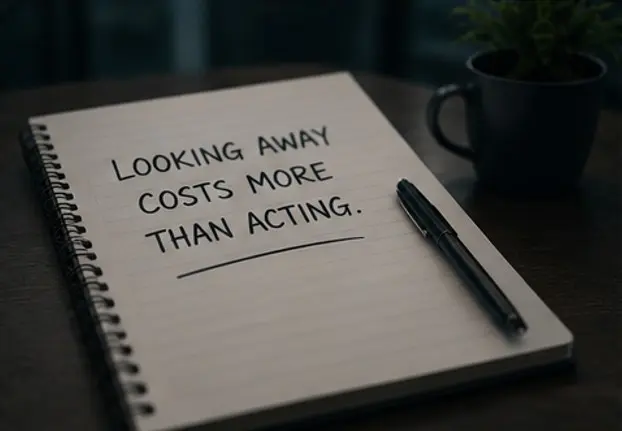
Sooner or later the topic lands on attrition, and there it gets expensive. Refilling a position costs between 150 and 200 percent of annual salary depending on qualification, against turnover rates of 20 to 25 percent in many technical functions. Gallup shows the reverse effect: organisations with strong engagement report up to 59 percent lower turnover. Your best engineer rarely resigns over salary. He resigns over the person at the next desk.
Three Questions Worth Answering Honestly
If any of those made you pause, the next section was written for you.
Addressing Behaviour Without Writing Off the Person: The BYG Path in Three Steps
The three steps below build on one another and draw on tools from the BYG method toolkit. None of them requires you to brand anyone as toxic.
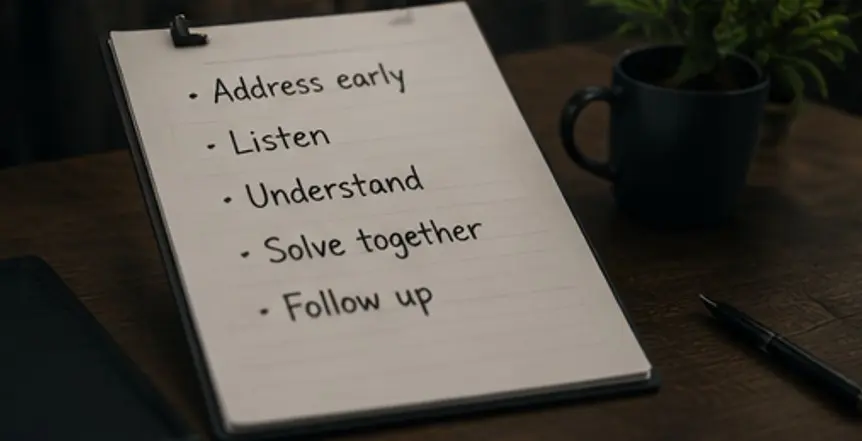
1. Name the behaviour, do not judge the character
The first step decides whether a conversation remains possible at all. Do not say someone is negative. Describe what you observed and what effect it had. A sentence about the last three meetings, where every proposal was taken apart before it was understood, can be verified. A verdict on character cannot. Open-ended questions and active listening help here, because chronic complaining often hides an unmet expectation or an old injury.
2. Make the costs visible
The second step puts the arithmetic on the table. Who avoids coordination? Which topics no longer get reported? How much of your own week goes into moderating side effects? A Team Charter Workshop makes these invisible costs explicit, because the team agrees on rules everyone is measured against, the high performer included. Our piece on team charter rules shows how such rules emerge in practice, while malicious obedience shows how fast unspoken anger turns into silent refusal.
3. Set the boundary and carry the consequence
The third step is where most leaders fail.

An agreement without consequence is a request, and requests do not change ingrained behaviour. Agree on verifiable goals the SMART way, set a clear deadline and state what follows if nothing changes. Our piece on setting boundaries as a leader describes what a workable no looks like. If nothing moves, separation is not a failure. It is protection for everyone else.
You leave with a sentence you can use the next morning, not with a proposal.
Voices From Practice
Holding such a conversation demands clarity in yourself first. Priyanka Maturi worked with me through both a cross-country cultures programme and the six-week BYG workshop, and she describes exactly what this article asks of you: the shift in how you engage a team once your own questions are settled.
FAQ: Frequently Asked Questions About Toxic High Performers
Q1: What is a toxic high performer exactly?
It describes someone technically valuable whose behaviour costs the environment more than their output delivers. What matters is not character but effect: falling participation, unreported problems, growing distance across the team. Key terms are explained in the BYG glossary.
Q2: Does it have to involve bullying?
No, and this is the most common misreading. A persistently negative colleague runs no campaign against anyone and still lowers the mood of a whole team. The Harvard figures capture only the severest cases, while the everyday damage happens well below that line.
Q3: Can a leader be the toxic factor?
Certainly, and there the damage usually runs deeper. When a superior reacts unpredictably, the team cuts contact to a minimum and delivers nothing beyond the required. Anyone willing to examine their own share will find an honest entry point in the piece on overcoming micromanagement.
Q4: Why do I tolerate the behaviour for so long?
Because output is visible and damage is not. Technical results appear in the report, lost motivation appears nowhere. Only when you add turnover and time costs does the balance visibly tip.
Q5: How do I raise this without wounding the person?
Separate observation from evaluation. Describe concrete situations and their effect instead of assigning traits. Behaviour can be changed, a verdict on character can only be disputed.
Q6: What if the person rejects the feedback?
Then you need a verifiable agreement with a deadline and a named consequence. Without that part every conversation stays without effect, and your team learns that the rules do not apply to this person.
Q7: When should I start considering separation?
When nothing measurably changes after a clear agreement with a deadline, and other employees are already leaving or switching off internally. The arithmetic decides: losing one person weighs less than the silent withdrawal of an entire team.
Q8: How do I repair the climate once the person has gone?
A departure rarely restores on its own what eroded over months. Expect a fresh storming phase in which roles and rules get renegotiated, and lead that phase deliberately instead of sitting it out.
Q9: Does cultural context play a role?
It mainly changes visibility. In some cultures dissatisfaction is voiced openly, in others it stays below the surface and only shows up in deadlines that slip. How easily such signals are misread is covered in the piece on the translation tax.
Q10: What if my own boss is the problem?
You cannot steer his behaviour, but you can steer your response and protect your team. Clear agreements, documented commitments and a sounding board outside the reporting line all work, much as the piece on loneliness at the top describes.
Q11: How do I start if I am in the middle of such a case right now?
Write down what you have concretely observed and what it has cost so far, before you seek the conversation. That preparation decides how the meeting goes. A first structured look at it fits into 30 minutes, and the services overview shows the formats that follow.

About the Author: The Intersection of Three Worlds
Most providers know difficult employees from the seminar room, not from accountability for deadline and budget. With Andy Balbus, three worlds meet. First, executive leadership: 25+ years of operational automotive DNA, 150 million euros of revenue accountability, an electronics organisation of 40+ engineers built greenfield.

Second, executive coaching: ICF PCC certified, over 1,000 coaching hours, including mentoring for scaling team leads.

Third, intercultural transformation: four years in Slovakia and two in Pune as the accountable leader, with experience across DE, SK, IN, CN, MX and UK. Anyone who has watched a single person lower the temperature of a team speaks about this from the engine room, not from a textbook.
Results or Excuses
The behaviour you have endured for months will not improve while you wait for insight. It will get more expensive, because every week without clarity costs you motivation, willingness to report problems and eventually the people you least want to lose. In a 30-minute Reality Check we do the arithmetic together and sort out which conversation is due first, with the view from leadership, coaching and cultural change at once. No slides, no sales pitch, only your case and the honest question of what the waiting has already cost you.

One calendar link, no preparation needed. You bring the case, we sort the rest together.
Systematic Leadership does not end with a phone Call.
Follow Andy for more Perspectives and Insights.


Leave a Reply